

307
16 A Network Perspective on Governing Interactions
challenging if one adheres strictly to the de fi nition of governance provided by
Kooiman et al. ( 2005 ) . By de fi nition, any governing interactions will be from the
governing system to the system-to-be-governed, thus members will at times be in
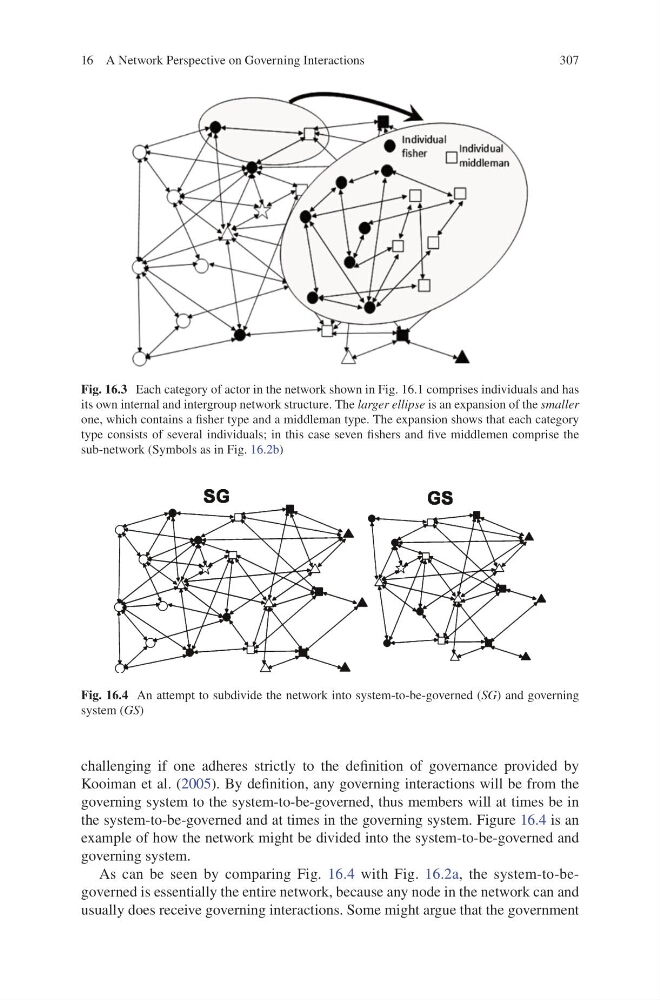
the system-to-be-governed and at times in the governing system. Figure 16.4 is an
example of how the network might be divided into the system-to-be-governed and
governing system.
As can be seen by comparing Fig. 16.4 with Fig. 16.2a , the system-to-begoverned is essentially the entire network, because any node in the network can and
usually does receive governing interactions. Some might argue that the government
Fig. 16.3 Each category of actor in the network shown in Fig. 16.1 comprises individuals and has
its own internal and intergroup network structure. The larger ellipse is an expansion of the smaller
one, which contains a fi sher type and a middleman type. The expansion shows that each category
type consists of several individuals; in this case seven fi shers and fi ve middlemen comprise the
sub-network (Symbols as in Fig. 16.2b )
Fig. 16.4 An attempt to subdivide the network into system-to-be-governed ( SG ) and governing
system ( GS )
16 A Network Perspective on Governing Interactions
challenging if one adheres strictly to the de fi nition of governance provided by
Kooiman et al. ( 2005 ) . By de fi nition, any governing interactions will be from the
governing system to the system-to-be-governed, thus members will at times be in
the system-to-be-governed and at times in the governing system. Figure 16.4 is an
example of how the network might be divided into the system-to-be-governed and
governing system.
As can be seen by comparing Fig. 16.4 with Fig. 16.2a , the system-to-begoverned is essentially the entire network, because any node in the network can and
usually does receive governing interactions. Some might argue that the government
Fig. 16.3 Each category of actor in the network shown in Fig. 16.1 comprises individuals and has
its own internal and intergroup network structure. The larger ellipse is an expansion of the smaller
one, which contains a fi sher type and a middleman type. The expansion shows that each category
type consists of several individuals; in this case seven fi shers and fi ve middlemen comprise the
sub-network (Symbols as in Fig. 16.2b )
Fig. 16.4 An attempt to subdivide the network into system-to-be-governed ( SG ) and governing
system ( GS )