

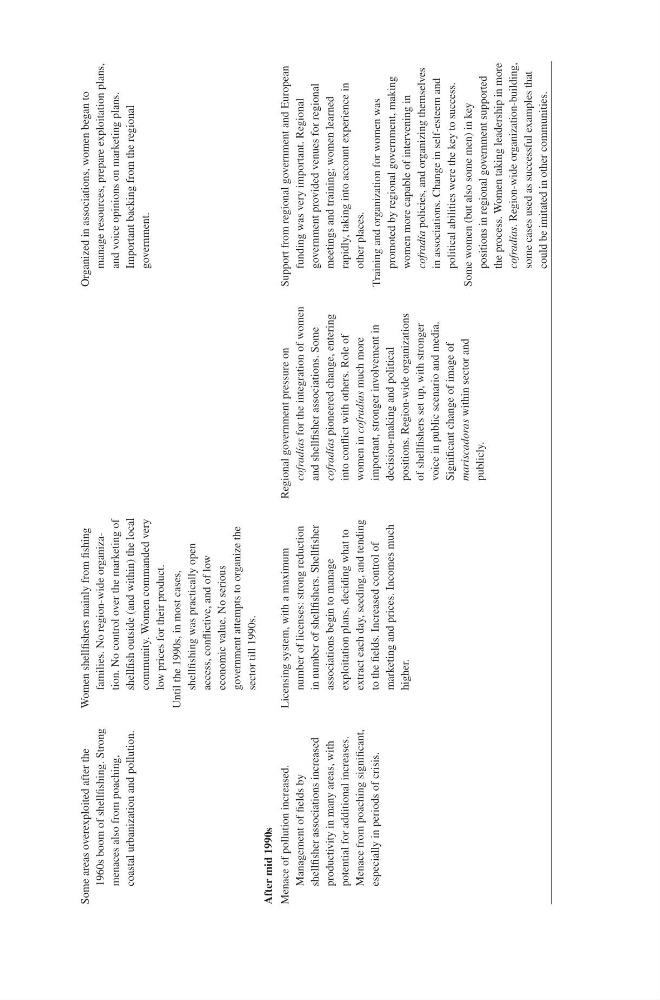
Some areas overexploited after the
1960s boom of shell fi shing. Strong
menaces also from poaching,
coastal urbanization and pollution.
Women shell fi shers mainly from fi shing
families. No region-wide organization. No control over the marketing of
shell fi sh outside (and within) the local
community. Women commanded very
low prices for their product.
Organized in associations, women began to
manage resources, prepare exploitation plans,
and voice opinions on marketing plans.
Important backing from the regional
government.
Until the 1990s, in most cases,
shell fi shing was practically open
access, con fl ictive, and of low
economic value. No serious
government attempts to organize the
sector till 1990s.
After mid 1990s
Menace of pollution increased.
Management of fi elds by
shell fi sher associations increased
productivity in many areas, with
potential for additional increases.
Menace from poaching signi fi cant,
especially in periods of crisis.
Licensing system, with a maximum
number of licenses: strong reduction
in number of shell fi shers. Shell fi sher
associations begin to manage
exploitation plans, deciding what to
extract each day, seeding, and tending
to the fi elds. Increased control of
marketing and prices. Incomes much
higher.
Regional government pressure on
cofradías
for the integration of women
and shell fi sher associations. Some
cofradías
pioneered change, entering
into con fl ict with others. Role of
women in cofradías
much more
important, stronger involvement in
decision-making and political
positions. Region-wide organizations
of shell fi shers set up, with stronger
voice in public scenario and media.
Signi fi cant change of image of
mariscadoras
within sector and
publicly.
Support from regional government and European
funding was very important. Regional
government provided venues for regional
meetings and training; women learned
rapidly, taking into account experience in
other places.
Training and organization for women was
promoted by regional government, making
women more capable of intervening in
cofradía
policies, and organizing themselves
in associations. Change in self-esteem and
political abilities were the key to success.
Some women (but also some men) in key
positions in regional government supported
the process. Women taking leadership in more
cofradías
. Region-wide organization-building,
some cases used as successful examples that
could be imitated in other communities.
1960s boom of shell fi shing. Strong
menaces also from poaching,
coastal urbanization and pollution.
Women shell fi shers mainly from fi shing
families. No region-wide organization. No control over the marketing of
shell fi sh outside (and within) the local
community. Women commanded very
low prices for their product.
Organized in associations, women began to
manage resources, prepare exploitation plans,
and voice opinions on marketing plans.
Important backing from the regional
government.
Until the 1990s, in most cases,
shell fi shing was practically open
access, con fl ictive, and of low
economic value. No serious
government attempts to organize the
sector till 1990s.
After mid 1990s
Menace of pollution increased.
Management of fi elds by
shell fi sher associations increased
productivity in many areas, with
potential for additional increases.
Menace from poaching signi fi cant,
especially in periods of crisis.
Licensing system, with a maximum
number of licenses: strong reduction
in number of shell fi shers. Shell fi sher
associations begin to manage
exploitation plans, deciding what to
extract each day, seeding, and tending
to the fi elds. Increased control of
marketing and prices. Incomes much
higher.
Regional government pressure on
cofradías
for the integration of women
and shell fi sher associations. Some
cofradías
pioneered change, entering
into con fl ict with others. Role of
women in cofradías
much more
important, stronger involvement in
decision-making and political
positions. Region-wide organizations
of shell fi shers set up, with stronger
voice in public scenario and media.
Signi fi cant change of image of
mariscadoras
within sector and
publicly.
Support from regional government and European
funding was very important. Regional
government provided venues for regional
meetings and training; women learned
rapidly, taking into account experience in
other places.
Training and organization for women was
promoted by regional government, making
women more capable of intervening in
cofradía
policies, and organizing themselves
in associations. Change in self-esteem and
political abilities were the key to success.
Some women (but also some men) in key
positions in regional government supported
the process. Women taking leadership in more
cofradías
. Region-wide organization-building,
some cases used as successful examples that
could be imitated in other communities.