

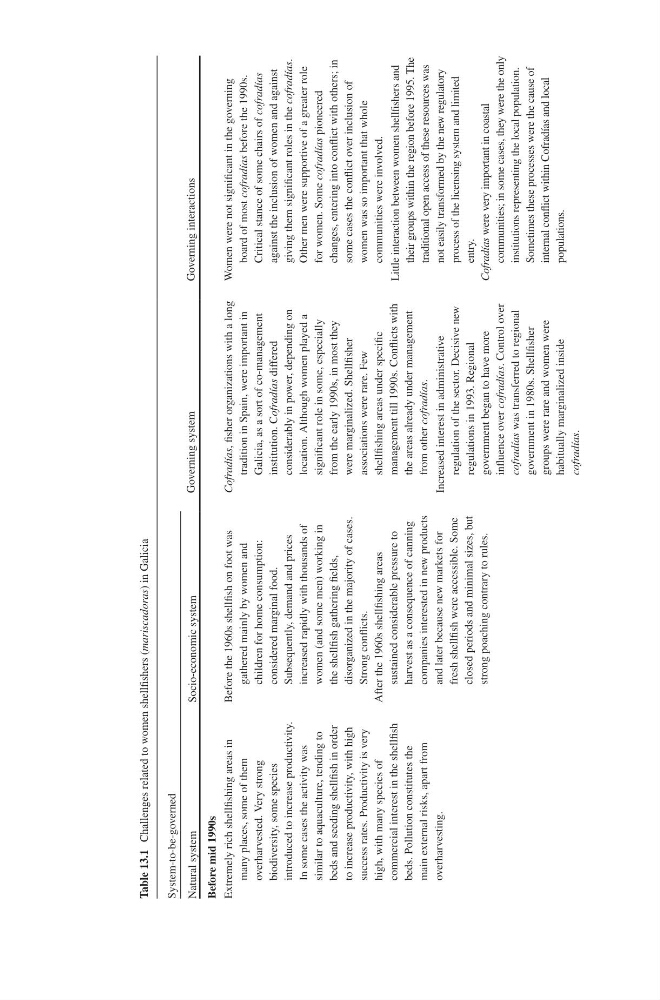
Table 13.1
Challenges related to women shell fi shers ( mariscadoras
) in Galicia
System-to-be-governed
Governing system
Governing interactions
Natural system
Socio-economic system
Before mid 1990s
Extremely rich shell fi shing areas in
many places, some of them
overharvested. Very strong
biodiversity, some species
introduced to increase productivity.
In some cases the activity was
similar to aquaculture, tending to
beds and seeding shell fi sh in order
to increase productivity, with high
success rates. Productivity is very
high, with many species of
commercial interest in the shell fi sh
beds. Pollution constitutes the
main external risks, apart from
overharvesting.
Before the 1960s shell fi sh on foot was
gathered mainly by women and
children for home consumption:
considered marginal food.
Subsequently, demand and prices
increased rapidly with thousands of
women (and some men) working in
the shell fi sh gathering fi elds,
disorganized in the majority of cases.
Strong con fl icts.
After the 1960s shell fi shing areas
sustained considerable pressure to
harvest as a consequence of canning
companies interested in new products
and later because new markets for
fresh shell fi sh were accessible. Some
closed periods and minimal sizes, but
strong poaching contrary to rules.
Cofradías
, fi sher organizations with a long
tradition in Spain, were important in
Galicia, as a sort of co-management
institution. C ofradías
differed
considerably in power, depending on
location. Although women played a
signi fi cant role in some, especially
from the early 1990s, in most they
were marginalized. Shell fi sher
associations were rare. Few
shell fi shing areas under speci fi c
management till 1990s. Con fl icts with
the areas already under management
from other cofradías
.
Increased interest in administrative
regulation of the sector. Decisive new
regulations in 1993. Regional
government began to have more
in fl uence over cofradías
. Control over
cofradías
was transferred to regional
government in 1980s. Shell fi sher
groups were rare and women were
habitually marginalized inside
cofradías
.
Women were not signi fi cant in the governing
board of most cofradías
before the 1990s.
Critical stance of some chairs of cofradías
against the inclusion of women and against
giving them signi fi cant roles in the cofradías
.
Other men were supportive of a greater role
for women. Some cofradías
pioneered
changes, entering into con fl ict with others; in
some cases the con fl ict over inclusion of
women was so important that whole
communities were involved.
Little interaction between women shell fi shers and
their groups within the region before 1995. The
traditional open access of these resources was
not easily transformed by the new regulatory
process of the licensing system and limited
entry.
Cofradías
were very important in coastal
communities; in some cases, they were the only
institutions representing the local population.
Sometimes these processes were the cause of
internal con fl ict within Cofradías and local
populations.
Challenges related to women shell fi shers ( mariscadoras
) in Galicia
System-to-be-governed
Governing system
Governing interactions
Natural system
Socio-economic system
Before mid 1990s
Extremely rich shell fi shing areas in
many places, some of them
overharvested. Very strong
biodiversity, some species
introduced to increase productivity.
In some cases the activity was
similar to aquaculture, tending to
beds and seeding shell fi sh in order
to increase productivity, with high
success rates. Productivity is very
high, with many species of
commercial interest in the shell fi sh
beds. Pollution constitutes the
main external risks, apart from
overharvesting.
Before the 1960s shell fi sh on foot was
gathered mainly by women and
children for home consumption:
considered marginal food.
Subsequently, demand and prices
increased rapidly with thousands of
women (and some men) working in
the shell fi sh gathering fi elds,
disorganized in the majority of cases.
Strong con fl icts.
After the 1960s shell fi shing areas
sustained considerable pressure to
harvest as a consequence of canning
companies interested in new products
and later because new markets for
fresh shell fi sh were accessible. Some
closed periods and minimal sizes, but
strong poaching contrary to rules.
Cofradías
, fi sher organizations with a long
tradition in Spain, were important in
Galicia, as a sort of co-management
institution. C ofradías
differed
considerably in power, depending on
location. Although women played a
signi fi cant role in some, especially
from the early 1990s, in most they
were marginalized. Shell fi sher
associations were rare. Few
shell fi shing areas under speci fi c
management till 1990s. Con fl icts with
the areas already under management
from other cofradías
.
Increased interest in administrative
regulation of the sector. Decisive new
regulations in 1993. Regional
government began to have more
in fl uence over cofradías
. Control over
cofradías
was transferred to regional
government in 1980s. Shell fi sher
groups were rare and women were
habitually marginalized inside
cofradías
.
Women were not signi fi cant in the governing
board of most cofradías
before the 1990s.
Critical stance of some chairs of cofradías
against the inclusion of women and against
giving them signi fi cant roles in the cofradías
.
Other men were supportive of a greater role
for women. Some cofradías
pioneered
changes, entering into con fl ict with others; in
some cases the con fl ict over inclusion of
women was so important that whole
communities were involved.
Little interaction between women shell fi shers and
their groups within the region before 1995. The
traditional open access of these resources was
not easily transformed by the new regulatory
process of the licensing system and limited
entry.
Cofradías
were very important in coastal
communities; in some cases, they were the only
institutions representing the local population.
Sometimes these processes were the cause of
internal con fl ict within Cofradías and local
populations.