

147
8 Applying the Governability Concept in Fisheries…
various segments of systems-to-be-governed make their own choices. This situation
is mirrored by a relative lack of diversity in the hierarchical mode. Here governors
have chosen to employ a pyramid-like and, hence, repetitive structure of interaction
(cf. Bundy et al. 2008 ) . Co-governance takes an intermediate position.
When we turn to complexity , the situation described above is reversed. Complexity
of interactions may be largest in the hierarchical mode. This is namely due to the
scale of operations and the number of partaking units is frequently larger. The selfgoverning mode, which involves a smaller number of units at a lower scale level,
reveals a less complex set of interactions. Here again, the co-governance mode is
likely to hold the middle ground.
Finally, dynamics , or the propensity towards change, run parallel to the expectations of diversity. They are generally largest in the self-governance mode, where
positions and interaction styles are less formalized and therefore more fl exible. The
hierarchical mode leans on bureaucracy and standardized procedures, both of which
tend to resist change. Interactions in the co-governance mode are de fi nitely more
dynamic than in the hierarchical mode, connecting governors from a host of different origins. The varying values, principles and objectives available, and the different
styles of operation, make for an ongoing process of public reasoning (Sen 2009 ) and
negotiated decision-making. We suggest therefore that co-governance will generally take a medium position as far as dynamics are concerned.
Effects of Governing Modes on Interactions: Examples
from South Asia
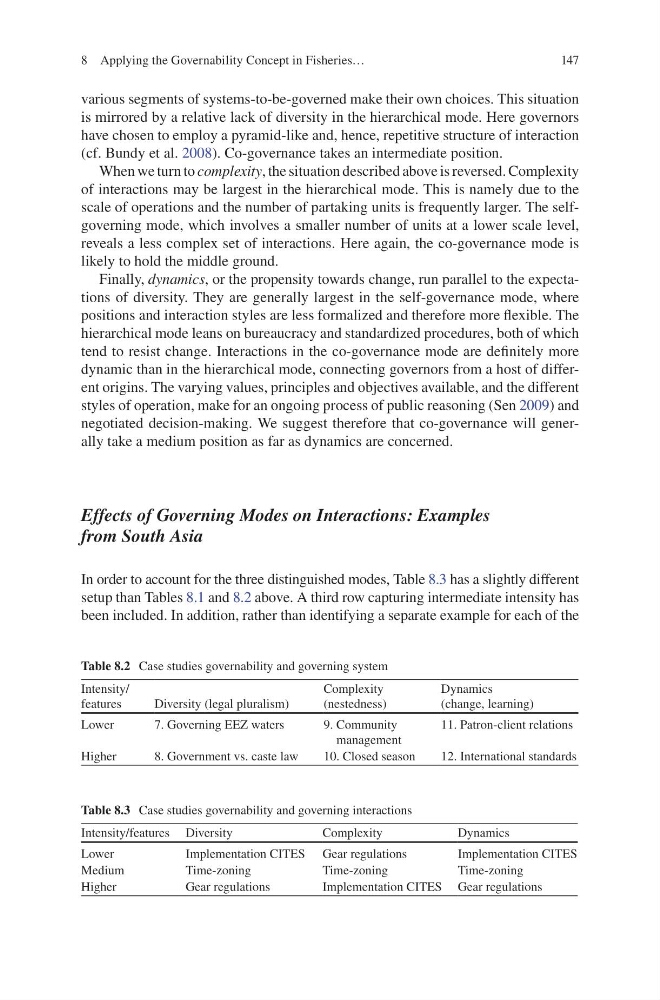
In order to account for the three distinguished modes, Table 8.3 has a slightly different
setup than Tables 8.1 and 8.2 above. A third row capturing intermediate intensity has
been included. In addition, rather than identifying a separate example for each of the
Table 8.3 Case studies governability and governing interactions
Intensity/features Diversity
Complexity
Dynamics
Lower
Implementation CITES Gear regulations
Implementation CITES
Medium
Time-zoning
Time-zoning
Time-zoning
Higher
Gear regulations
Implementation CITES Gear regulations
Table 8.2 Case studies governability and governing system
Intensity/
features
Diversity (legal pluralism)
Complexity
(nestedness)
Dynamics
(change, learning)
Lower
7. Governing EEZ waters
9. Community
management
11. Patron-client relations
Higher
8. Government vs. caste law
10. Closed season
12. International standards
8 Applying the Governability Concept in Fisheries…
various segments of systems-to-be-governed make their own choices. This situation
is mirrored by a relative lack of diversity in the hierarchical mode. Here governors
have chosen to employ a pyramid-like and, hence, repetitive structure of interaction
(cf. Bundy et al. 2008 ) . Co-governance takes an intermediate position.
When we turn to complexity , the situation described above is reversed. Complexity
of interactions may be largest in the hierarchical mode. This is namely due to the
scale of operations and the number of partaking units is frequently larger. The selfgoverning mode, which involves a smaller number of units at a lower scale level,
reveals a less complex set of interactions. Here again, the co-governance mode is
likely to hold the middle ground.
Finally, dynamics , or the propensity towards change, run parallel to the expectations of diversity. They are generally largest in the self-governance mode, where
positions and interaction styles are less formalized and therefore more fl exible. The
hierarchical mode leans on bureaucracy and standardized procedures, both of which
tend to resist change. Interactions in the co-governance mode are de fi nitely more
dynamic than in the hierarchical mode, connecting governors from a host of different origins. The varying values, principles and objectives available, and the different
styles of operation, make for an ongoing process of public reasoning (Sen 2009 ) and
negotiated decision-making. We suggest therefore that co-governance will generally take a medium position as far as dynamics are concerned.
Effects of Governing Modes on Interactions: Examples
from South Asia
In order to account for the three distinguished modes, Table 8.3 has a slightly different
setup than Tables 8.1 and 8.2 above. A third row capturing intermediate intensity has
been included. In addition, rather than identifying a separate example for each of the
Table 8.3 Case studies governability and governing interactions
Intensity/features Diversity
Complexity
Dynamics
Lower
Implementation CITES Gear regulations
Implementation CITES
Medium
Time-zoning
Time-zoning
Time-zoning
Higher
Gear regulations
Implementation CITES Gear regulations
Table 8.2 Case studies governability and governing system
Intensity/
features
Diversity (legal pluralism)
Complexity
(nestedness)
Dynamics
(change, learning)
Lower
7. Governing EEZ waters
9. Community
management
11. Patron-client relations
Higher
8. Government vs. caste law
10. Closed season
12. International standards