

122
J.J. Pascual-Fernández and R. Chuenpagdee
Governability of Multiple Stressors Affecting Ecosystem Health
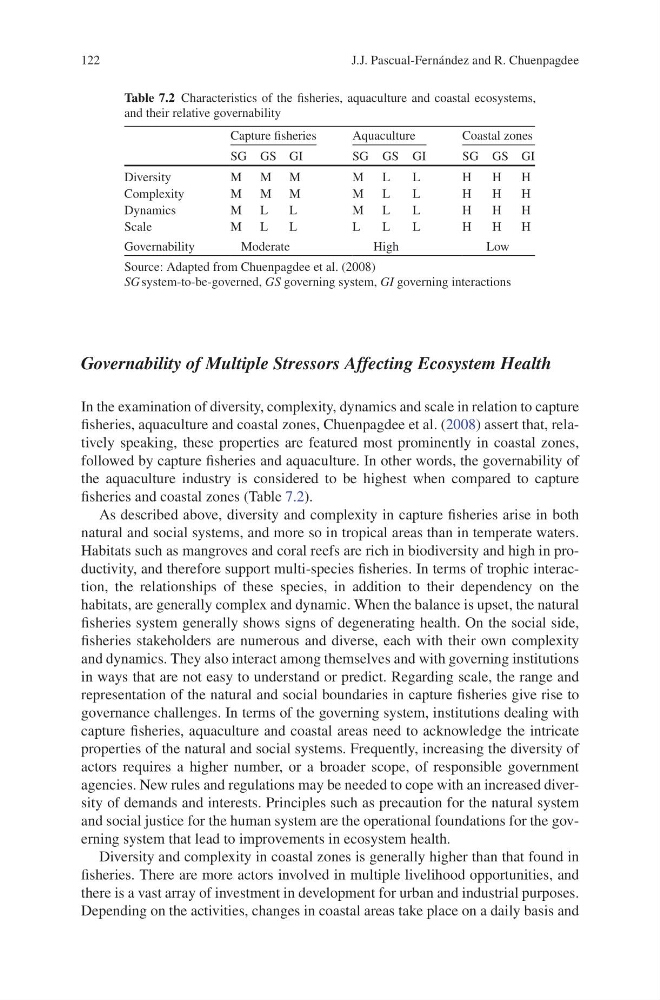
In the examination of diversity, complexity, dynamics and scale in relation to capture
fi sheries, aquaculture and coastal zones, Chuenpagdee et al. ( 2008 ) assert that, relatively speaking, these properties are featured most prominently in coastal zones,
followed by capture fi sheries and aquaculture. In other words, the governability of
the aquaculture industry is considered to be highest when compared to capture
fi sheries and coastal zones (Table 7.2 ).
As described above, diversity and complexity in capture fi sheries arise in both
natural and social systems, and more so in tropical areas than in temperate waters.
Habitats such as mangroves and coral reefs are rich in biodiversity and high in productivity, and therefore support multi-species fi sheries. In terms of trophic interaction, the relationships of these species, in addition to their dependency on the
habitats, are generally complex and dynamic. When the balance is upset, the natural
fi sheries system generally shows signs of degenerating health. On the social side,
fi sheries stakeholders are numerous and diverse, each with their own complexity
and dynamics. They also interact among themselves and with governing institutions
in ways that are not easy to understand or predict. Regarding scale, the range and
representation of the natural and social boundaries in capture fi sheries give rise to
governance challenges. In terms of the governing system, institutions dealing with
capture fi sheries, aquaculture and coastal areas need to acknowledge the intricate
properties of the natural and social systems. Frequently, increasing the diversity of
actors requires a higher number, or a broader scope, of responsible government
agencies. New rules and regulations may be needed to cope with an increased diversity of demands and interests. Principles such as precaution for the natural system
and social justice for the human system are the operational foundations for the governing system that lead to improvements in ecosystem health.
Diversity and complexity in coastal zones is generally higher than that found in
fi sheries. There are more actors involved in multiple livelihood opportunities, and
there is a vast array of investment in development for urban and industrial purposes.
Depending on the activities, changes in coastal areas take place on a daily basis and
Table 7.2 Characteristics of the fi sheries, aquaculture and coastal ecosystems,
and their relative governability
Capture fi sheries
Aquaculture
Coastal zones
SG GS GI
SG GS GI
SG GS GI
Diversity
M M M
M L
L
H
H
H
Complexity
M M M
M L
L
H
H
H
Dynamics
M L
L
M L
L
H
H
H
Scale
M L
L
L
L
L
H
H
H
Governability
Moderate
High
Low
Source: Adapted from Chuenpagdee et al. (2008)
SG system-to-be-governed, GS governing system, GI governing interactions
J.J. Pascual-Fernández and R. Chuenpagdee
Governability of Multiple Stressors Affecting Ecosystem Health
In the examination of diversity, complexity, dynamics and scale in relation to capture
fi sheries, aquaculture and coastal zones, Chuenpagdee et al. ( 2008 ) assert that, relatively speaking, these properties are featured most prominently in coastal zones,
followed by capture fi sheries and aquaculture. In other words, the governability of
the aquaculture industry is considered to be highest when compared to capture
fi sheries and coastal zones (Table 7.2 ).
As described above, diversity and complexity in capture fi sheries arise in both
natural and social systems, and more so in tropical areas than in temperate waters.
Habitats such as mangroves and coral reefs are rich in biodiversity and high in productivity, and therefore support multi-species fi sheries. In terms of trophic interaction, the relationships of these species, in addition to their dependency on the
habitats, are generally complex and dynamic. When the balance is upset, the natural
fi sheries system generally shows signs of degenerating health. On the social side,
fi sheries stakeholders are numerous and diverse, each with their own complexity
and dynamics. They also interact among themselves and with governing institutions
in ways that are not easy to understand or predict. Regarding scale, the range and
representation of the natural and social boundaries in capture fi sheries give rise to
governance challenges. In terms of the governing system, institutions dealing with
capture fi sheries, aquaculture and coastal areas need to acknowledge the intricate
properties of the natural and social systems. Frequently, increasing the diversity of
actors requires a higher number, or a broader scope, of responsible government
agencies. New rules and regulations may be needed to cope with an increased diversity of demands and interests. Principles such as precaution for the natural system
and social justice for the human system are the operational foundations for the governing system that lead to improvements in ecosystem health.
Diversity and complexity in coastal zones is generally higher than that found in
fi sheries. There are more actors involved in multiple livelihood opportunities, and
there is a vast array of investment in development for urban and industrial purposes.
Depending on the activities, changes in coastal areas take place on a daily basis and
Table 7.2 Characteristics of the fi sheries, aquaculture and coastal ecosystems,
and their relative governability
Capture fi sheries
Aquaculture
Coastal zones
SG GS GI
SG GS GI
SG GS GI
Diversity
M M M
M L
L
H
H
H
Complexity
M M M
M L
L
H
H
H
Dynamics
M L
L
M L
L
H
H
H
Scale
M L
L
L
L
L
H
H
H
Governability
Moderate
High
Low
Source: Adapted from Chuenpagdee et al. (2008)
SG system-to-be-governed, GS governing system, GI governing interactions