

Basic Biological Processes
in a higher concentration- it can also be an inhibitor. As the equilibria NHJINH!
and HNOziN02 both are pH dependent, a situation can be reached as illustrated in
Figs 3.10 a-c. Note that a partial inhibition of the processes does not necessarily
mean a reduced nitrification degree, but merely that the process is slower, and this
should be taken into consideration in the practical design of a treatment plant as it
means that the plant must be bigger if the same treatment result is required as
without inhibition.
Inhibiting substances
The nitrification process in activated sludge plants can be inhibited by many
different substances. As nitrifying treatment plants are designed so as o~y to allow
for the nitrification process to take place, even a limited inhibition could cause the
nitrification to stop completely. However, this will not take place instantaneously,
but after a washout period over several weeks. Such a stop in nitrification is
therefore not a result of the nitrifying bacteria being 100 per cent inhibited by the
toxic substance concerned, but it is a result of the washing out of the nitrifying
bacteria I 1 I. As a general rule, we can say that the nitrifying bacteria are not more
sensitive to toxic substances than other bacteria in a treatment plant- see Fig 3.11.
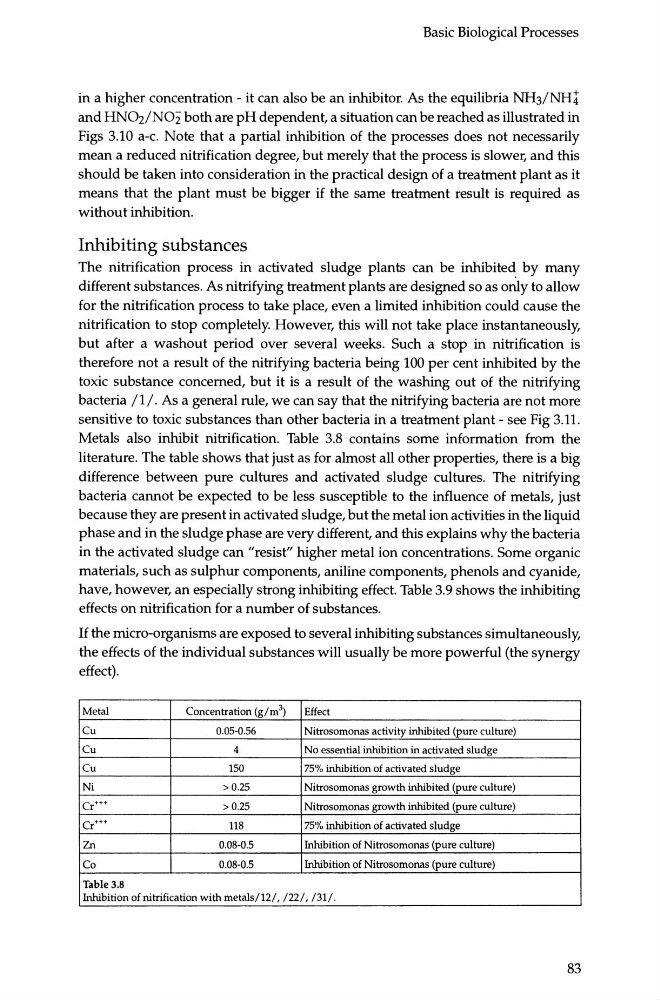
Metals also inhibit nitrification. Table 3.8 contains some information from the
literature. The table shows that just as for almost all other properties, there is a big
difference between pure cultures and activated sludge cultures. The nitrifying
bacteria cannot be expected to be less susceptible to the influence of metals, just
because they are present in activated sludge, but the metal ion activities in the liquid
phase and in the sludge phase are very different, and this explains why the bacteria
in the activated sludge can "resist" higher metal ion concentrations. Some organic
materials, such as sulphur components, aniline components, phenols and cyanide,
have, however, an especially strong inhibiting effect. Table 3.9 shows the inhibiting
effects on nitrification for a number of substances.
If the micro-organisms are exposed to several inhibiting substances simultaneously,
the effects of the individual substances will usually be more powerful (the synergy
effect).
Metal
Concentration (g/m 3 )
Effect
Cu
0.05-0.56
Nitrosomonas activity inhibited (pure culture)
Cu
4
No essential inhibition in activated sludge
Cu
150
75% inhibition of activated sludge
Ni
>0.25
Nitrosomonas growth inhibited (pure culture)
cr+++
>0.25
Nitrosomonas growth inhibited (pure culture)
Cr+++
118
75% inhibition of activated sludge
Zn
0.08-0.5
Inhibition of Nitrosomonas (pure culture)
Co
0.08-0.5
Inhibition of Nitrosomonas (pure culture)
Table3.8
Inhibition of nitrification with metals/12/, /22/, /31/.
83
in a higher concentration- it can also be an inhibitor. As the equilibria NHJINH!
and HNOziN02 both are pH dependent, a situation can be reached as illustrated in
Figs 3.10 a-c. Note that a partial inhibition of the processes does not necessarily
mean a reduced nitrification degree, but merely that the process is slower, and this
should be taken into consideration in the practical design of a treatment plant as it
means that the plant must be bigger if the same treatment result is required as
without inhibition.
Inhibiting substances
The nitrification process in activated sludge plants can be inhibited by many
different substances. As nitrifying treatment plants are designed so as o~y to allow
for the nitrification process to take place, even a limited inhibition could cause the
nitrification to stop completely. However, this will not take place instantaneously,
but after a washout period over several weeks. Such a stop in nitrification is
therefore not a result of the nitrifying bacteria being 100 per cent inhibited by the
toxic substance concerned, but it is a result of the washing out of the nitrifying
bacteria I 1 I. As a general rule, we can say that the nitrifying bacteria are not more
sensitive to toxic substances than other bacteria in a treatment plant- see Fig 3.11.
Metals also inhibit nitrification. Table 3.8 contains some information from the
literature. The table shows that just as for almost all other properties, there is a big
difference between pure cultures and activated sludge cultures. The nitrifying
bacteria cannot be expected to be less susceptible to the influence of metals, just
because they are present in activated sludge, but the metal ion activities in the liquid
phase and in the sludge phase are very different, and this explains why the bacteria
in the activated sludge can "resist" higher metal ion concentrations. Some organic
materials, such as sulphur components, aniline components, phenols and cyanide,
have, however, an especially strong inhibiting effect. Table 3.9 shows the inhibiting
effects on nitrification for a number of substances.
If the micro-organisms are exposed to several inhibiting substances simultaneously,
the effects of the individual substances will usually be more powerful (the synergy
effect).
Metal
Concentration (g/m 3 )
Effect
Cu
0.05-0.56
Nitrosomonas activity inhibited (pure culture)
Cu
4
No essential inhibition in activated sludge
Cu
150
75% inhibition of activated sludge
Ni
>0.25
Nitrosomonas growth inhibited (pure culture)
cr+++
>0.25
Nitrosomonas growth inhibited (pure culture)
Cr+++
118
75% inhibition of activated sludge
Zn
0.08-0.5
Inhibition of Nitrosomonas (pure culture)
Co
0.08-0.5
Inhibition of Nitrosomonas (pure culture)
Table3.8
Inhibition of nitrification with metals/12/, /22/, /31/.
83