

Nitrification
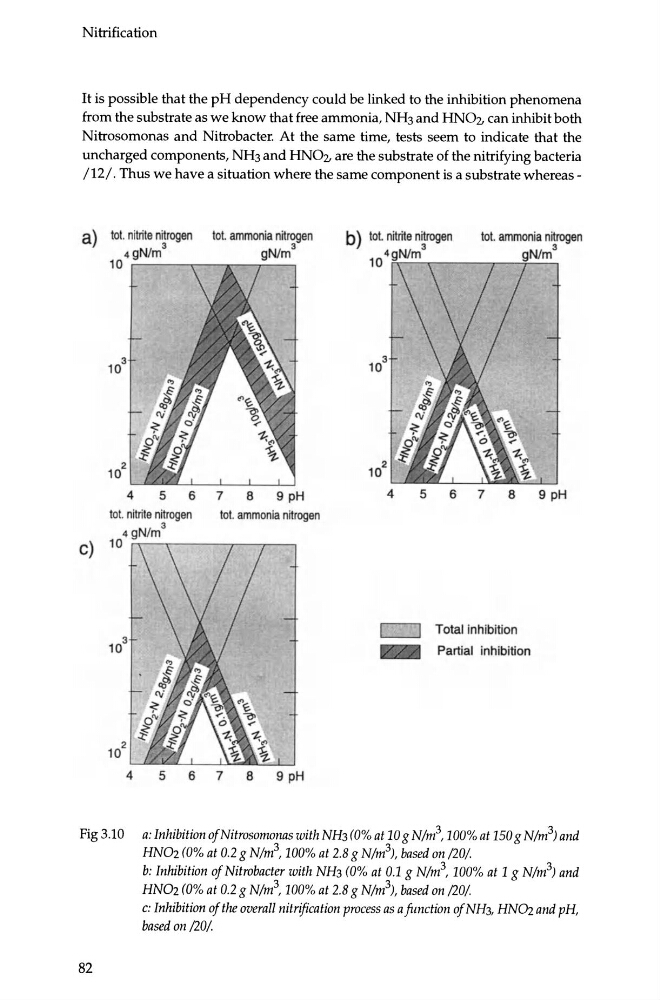
It is possible that the pH dependency could be linked to the inhibition phenomena
from the substrate as we know that free ammonia, NH3 and HNO:z, can inhibit both
Nitrosomonas and Nitrobacter. At the same time, tests seem to indicate that the
uncharged components, NH3 and HNO:z, are the substrate of the nitrifying bacteria
/12/. Thus we have a situation where the same component is a substrate whereasa) tot. nitrite n~rogen
4gN/m
10
tot. ammonia nitrogen
3
gN/m
tot. ammonia nitrogen
3
4
5
6
7
8
9 pH
5
6
7
8 9pH
tot. ammonia nitrogen
tot. nitrite nitrogen
3
4gN/m
c) 10
Fig 3.10
82
4
5
6
7
8
9 pH
c::::J Total inhibition
-
Partial inhibition
a: Inhibition ofNitrosomonas with NH3 (0% at 10 g N!m 3 , 100% at 150 g N !m 3 ) and
HN02 (0% at 0.2 g N!m 3 , 100% at 2.8 g N!m 3 ), based on /20/.
b: Inhibition of Nitrobacter with NH3 (0% at 0.1 g N/m 3 , 100% at 1 g N!m 3 ) and
HN02 (0% at 0.2 g N/m 3 , 100% at 2.8 g N/m 3 ), based on /20/.
c: Inhibition of the overall nitrification process as a function of NH3, HN02 and pH,
based on /20/.
It is possible that the pH dependency could be linked to the inhibition phenomena
from the substrate as we know that free ammonia, NH3 and HNO:z, can inhibit both
Nitrosomonas and Nitrobacter. At the same time, tests seem to indicate that the
uncharged components, NH3 and HNO:z, are the substrate of the nitrifying bacteria
/12/. Thus we have a situation where the same component is a substrate whereasa) tot. nitrite n~rogen
4gN/m
10
tot. ammonia nitrogen
3
gN/m
tot. ammonia nitrogen
3
4
5
6
7
8
9 pH
5
6
7
8 9pH
tot. ammonia nitrogen
tot. nitrite nitrogen
3
4gN/m
c) 10
Fig 3.10
82
4
5
6
7
8
9 pH
c::::J Total inhibition
-
Partial inhibition
a: Inhibition ofNitrosomonas with NH3 (0% at 10 g N!m 3 , 100% at 150 g N !m 3 ) and
HN02 (0% at 0.2 g N!m 3 , 100% at 2.8 g N!m 3 ), based on /20/.
b: Inhibition of Nitrobacter with NH3 (0% at 0.1 g N/m 3 , 100% at 1 g N!m 3 ) and
HN02 (0% at 0.2 g N/m 3 , 100% at 2.8 g N/m 3 ), based on /20/.
c: Inhibition of the overall nitrification process as a function of NH3, HN02 and pH,
based on /20/.