

Nitrification
NH! + 1.86 Oz + 1.98 HC03----+
0.020 C5H 7N02 + 0.98 N03 + 1.88 HzC03 + 1.04 HzO
(3.28)
Example 3.5
Calculate the oxygen consumption for the total nitrification process.
From Expression (3.28) we find that 1.86 moles of 0 2 per mole of NH~ are used, that
is, the oxygen consumption per g NH~-N is:
1.86 mol 02 · 32 g 02/mol
+
---~-..:;__..:;___ = 4.25 g 02/g NH4·N
1 mol NH!-N · 14 g N/mol
That is, the stoichiometric coefficient VNH4.o2 = 4.25.
From Expression (3.28), the oxygen consumption per g N03-N formed can also be calculated:
1.86 mol 02 · 32 g 02/mol
-----=--..!:....-=--- = 4.34 g 02/g N03-N =
0.98 mol N03-N · 14 g N/mol
4.34 g 0 2/g NH~-N oxidized
The difference between 4.34 g 0 2/g NH~-N and what we can calculate by combining
Expressions (3.22) and (3.23):
NH! + 2 02 ---+ N03 + 2 H+ + H20
2 mol 02 · 32 g 02/mol
1 mol N03 -N · 14 g N/mol
4.57 g 02/g N03-N = 4.57 g 02/g NH!-N oxidized
is due to the fact that inorganic carbon, which the bacteria assimilate, also acts as an
oxidizing agent thus reducing the oxygen consumption somewhat.
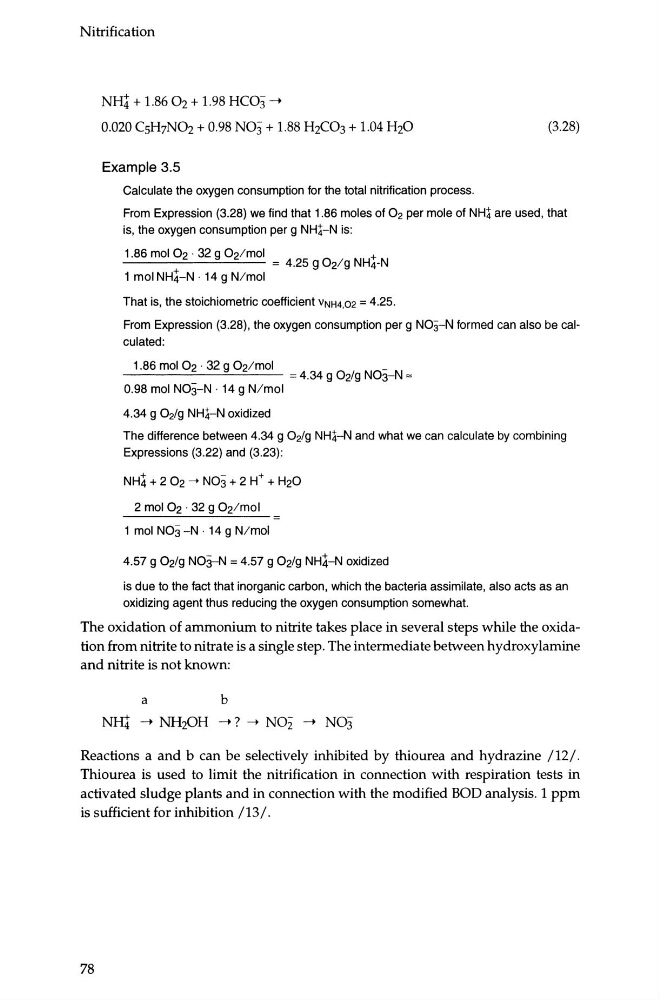
The oxidation of ammonium to nitrite takes place in several steps while the oxidation from nitrite to nitrate is a single step. The intermediate between hydroxylamine
and nitrite is not known:
a
b
Reactions a and b can be selectively inhibited by thiourea and hydrazine /12/.
Thiourea is used to limit the nitrification in connection with respiration tests in
activated sludge plants and in connection with the modified BOD analysis. 1 ppm
is sufficient for inhibition /13/.
78
NH! + 1.86 Oz + 1.98 HC03----+
0.020 C5H 7N02 + 0.98 N03 + 1.88 HzC03 + 1.04 HzO
(3.28)
Example 3.5
Calculate the oxygen consumption for the total nitrification process.
From Expression (3.28) we find that 1.86 moles of 0 2 per mole of NH~ are used, that
is, the oxygen consumption per g NH~-N is:
1.86 mol 02 · 32 g 02/mol
+
---~-..:;__..:;___ = 4.25 g 02/g NH4·N
1 mol NH!-N · 14 g N/mol
That is, the stoichiometric coefficient VNH4.o2 = 4.25.
From Expression (3.28), the oxygen consumption per g N03-N formed can also be calculated:
1.86 mol 02 · 32 g 02/mol
-----=--..!:....-=--- = 4.34 g 02/g N03-N =
0.98 mol N03-N · 14 g N/mol
4.34 g 0 2/g NH~-N oxidized
The difference between 4.34 g 0 2/g NH~-N and what we can calculate by combining
Expressions (3.22) and (3.23):
NH! + 2 02 ---+ N03 + 2 H+ + H20
2 mol 02 · 32 g 02/mol
1 mol N03 -N · 14 g N/mol
4.57 g 02/g N03-N = 4.57 g 02/g NH!-N oxidized
is due to the fact that inorganic carbon, which the bacteria assimilate, also acts as an
oxidizing agent thus reducing the oxygen consumption somewhat.
The oxidation of ammonium to nitrite takes place in several steps while the oxidation from nitrite to nitrate is a single step. The intermediate between hydroxylamine
and nitrite is not known:
a
b
Reactions a and b can be selectively inhibited by thiourea and hydrazine /12/.
Thiourea is used to limit the nitrification in connection with respiration tests in
activated sludge plants and in connection with the modified BOD analysis. 1 ppm
is sufficient for inhibition /13/.
78