

Basic Biological Processes
Most nitrifying bacteria are autotrophic and thus use carbon dioxide as the carbon
source. The carbon dioxide should be reduced before the carbon can form part of the
cell mass, and this reduction takes place through the oxidation of the nitrogen
source of the organism concerned. For oxidation of ammonia, the expression for
growth is:
(3.24)
For oxidation of nitrite, the corresponding growth expression is:
(3.25)
Once the observed yield constants, Yobs,NH4 and Yobs, N02, are known, the equations
of reaction can be calculated. The maximum yield constants can be calculated as stated
in /8/; however, the metabolic efficiency is lower than normal (approx. 0.20).
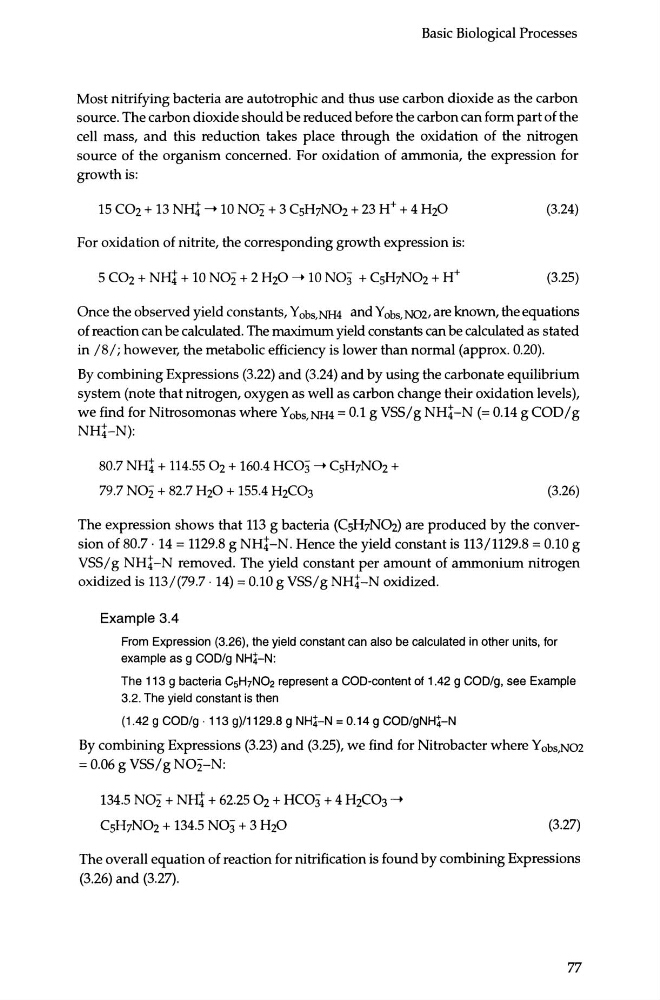
By combining Expressions (3.22) and (3.24) and by using the carbonate equilibrium
system (note that nitrogen, oxygen as well as carbon change their oxidation levels),
we find for Nitrosomonas where Yobs,NH4 = 0.1 g VSS/g NH!-N (= 0.14 g COD/g
NH!-N):
80.7 NH! + 114.55 0 2 + 160.4 HC03--+ C5H7N02 +
79.7 N02 + 82.7 H20 + 155.4 H2C03
(3.26)
The expression shows that 113 g bacteria (CsH7ND2) are produced by the conversion of 80.7 · 14 = 1129.8 g NH!-N. Hence the yield constant is 113/1129.8 = 0.10 g
VSS/g NH!-N removed. The yield constant per amount of ammonium nitrogen
oxidized is 113/{79.7 · 14) = 0.10 g VSS/g NH!-N oxidized.
Example 3.4
From Expression (3.26), the yield constant can also be calculated in other units, for
example as g COD/g NHl-N:
The 113 g bacteria C5H7N02 represent a COD-content of 1.42 g COD/g, see Example
3.2. The yield constant is then
(1.42 g COD/g · 113 g)/1129.8 g NHl-N = 0.14 g COD/gNHl-N
By combining Expressions (3.23) and (3.25), we find for Nitrobacter where Yobs,N02
= 0.06 g VSS/g N02-N:
134.5 N02 + NH! + 62.25 02 + HC03 + 4 H2C03 --+
CsH7N02 + 134.5 N03 + 3 H20
(3.27)
The overall equation of reaction for nitrification is found by combining Expressions
(3.26) and (3.27).
77
Most nitrifying bacteria are autotrophic and thus use carbon dioxide as the carbon
source. The carbon dioxide should be reduced before the carbon can form part of the
cell mass, and this reduction takes place through the oxidation of the nitrogen
source of the organism concerned. For oxidation of ammonia, the expression for
growth is:
(3.24)
For oxidation of nitrite, the corresponding growth expression is:
(3.25)
Once the observed yield constants, Yobs,NH4 and Yobs, N02, are known, the equations
of reaction can be calculated. The maximum yield constants can be calculated as stated
in /8/; however, the metabolic efficiency is lower than normal (approx. 0.20).
By combining Expressions (3.22) and (3.24) and by using the carbonate equilibrium
system (note that nitrogen, oxygen as well as carbon change their oxidation levels),
we find for Nitrosomonas where Yobs,NH4 = 0.1 g VSS/g NH!-N (= 0.14 g COD/g
NH!-N):
80.7 NH! + 114.55 0 2 + 160.4 HC03--+ C5H7N02 +
79.7 N02 + 82.7 H20 + 155.4 H2C03
(3.26)
The expression shows that 113 g bacteria (CsH7ND2) are produced by the conversion of 80.7 · 14 = 1129.8 g NH!-N. Hence the yield constant is 113/1129.8 = 0.10 g
VSS/g NH!-N removed. The yield constant per amount of ammonium nitrogen
oxidized is 113/{79.7 · 14) = 0.10 g VSS/g NH!-N oxidized.
Example 3.4
From Expression (3.26), the yield constant can also be calculated in other units, for
example as g COD/g NHl-N:
The 113 g bacteria C5H7N02 represent a COD-content of 1.42 g COD/g, see Example
3.2. The yield constant is then
(1.42 g COD/g · 113 g)/1129.8 g NHl-N = 0.14 g COD/gNHl-N
By combining Expressions (3.23) and (3.25), we find for Nitrobacter where Yobs,N02
= 0.06 g VSS/g N02-N:
134.5 N02 + NH! + 62.25 02 + HC03 + 4 H2C03 --+
CsH7N02 + 134.5 N03 + 3 H20
(3.27)
The overall equation of reaction for nitrification is found by combining Expressions
(3.26) and (3.27).
77