

Treatment Plants for Phosphorus Removal from Wastewater
Design based on dissolved plus suspended phosphate
The content of total phosphorus, Cp, can be determined as the sum of dissolved
phosphorus, Sp, and suspended phosphorus, Xp.
Cp=Sp+ Xp
(10.18)
Theoretical calculations of dissolved phosphorus, Sp, after chemical precipitation
processes are still uncertain /1/ and /13/. The alternative is to use existing empirical measuring results for dissolved phosphorus from chemical precipitation plants.
The phosphorus concentrations are normally stated as a function of the metal/phosphorus molar ratio which means that the effects of pH, calcium and alkalinity cannot be evaluated.
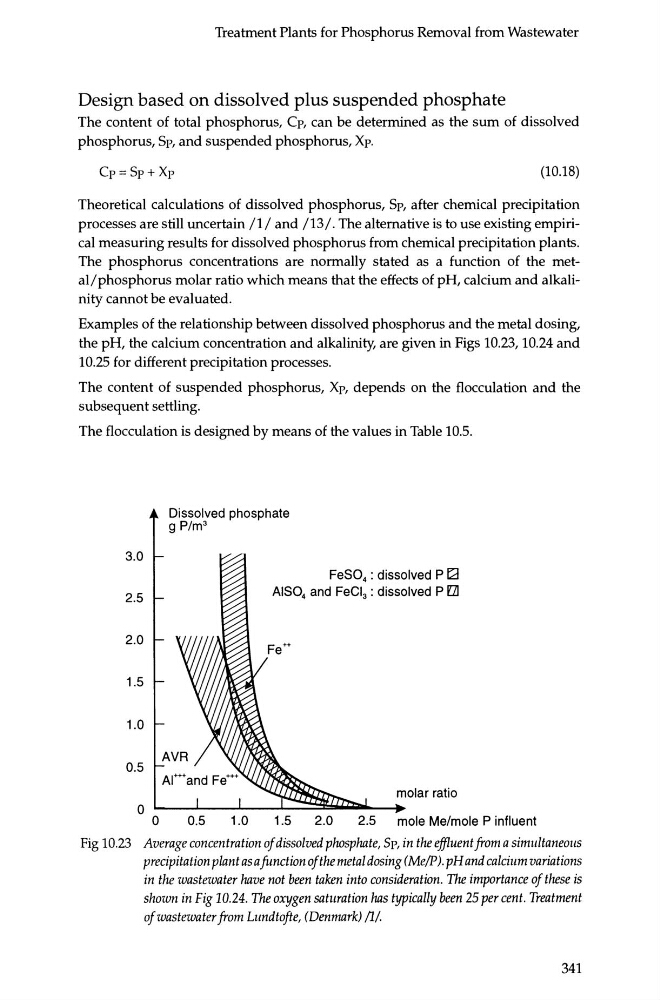
Examples of the relationship between dissolved phosphorus and the metal dosing,
the pH, the calcium concentration and alkalinity, are given in Figs 10.23, 10.24 and
10.25 for different precipitation processes.
The content of suspended phosphorus, Xp, depends on the flocculation and the
subsequent settling.
The flocculation is designed by means of the values in Table 10.5.
3.0
2.5
2.0
1.5
1.0
0.5
0 0
Dissolved phosphate
g P/m 3
0.5
1.0
FeS04 : dissolved P 1::3
AIS04 and FeCI3 : dissolved P ~
1.5
2.0
2.5 mole Me/mole P influent
Fig 10.23 Average concentration of dissolved phosphate, Sp, in the effluent from a simultaneous
precipitation plant as a function of the metal dosing (Me/P ). pH and calcium variations
in the wastewater have not been taken into consideration. The importance of these is
shown in Fig 10.24. The oxygen saturation has typically been 25 per cent. Treatment
of wastewater from Lundtofte, (Denmark) !1/.
341
Design based on dissolved plus suspended phosphate
The content of total phosphorus, Cp, can be determined as the sum of dissolved
phosphorus, Sp, and suspended phosphorus, Xp.
Cp=Sp+ Xp
(10.18)
Theoretical calculations of dissolved phosphorus, Sp, after chemical precipitation
processes are still uncertain /1/ and /13/. The alternative is to use existing empirical measuring results for dissolved phosphorus from chemical precipitation plants.
The phosphorus concentrations are normally stated as a function of the metal/phosphorus molar ratio which means that the effects of pH, calcium and alkalinity cannot be evaluated.
Examples of the relationship between dissolved phosphorus and the metal dosing,
the pH, the calcium concentration and alkalinity, are given in Figs 10.23, 10.24 and
10.25 for different precipitation processes.
The content of suspended phosphorus, Xp, depends on the flocculation and the
subsequent settling.
The flocculation is designed by means of the values in Table 10.5.
3.0
2.5
2.0
1.5
1.0
0.5
0 0
Dissolved phosphate
g P/m 3
0.5
1.0
FeS04 : dissolved P 1::3
AIS04 and FeCI3 : dissolved P ~
1.5
2.0
2.5 mole Me/mole P influent
Fig 10.23 Average concentration of dissolved phosphate, Sp, in the effluent from a simultaneous
precipitation plant as a function of the metal dosing (Me/P ). pH and calcium variations
in the wastewater have not been taken into consideration. The importance of these is
shown in Fig 10.24. The oxygen saturation has typically been 25 per cent. Treatment
of wastewater from Lundtofte, (Denmark) !1/.
341