

Treatment Plants for Phosphorus Removal from Wastewater
Simultaneous precipitation
This type of process is the most widespread in respect of the removal of phosphorus.
Here ferrous sulphate is most commonly used as precipitant which gives a small
extra oxygen consumption for the oxidation of ferrous iron into ferric iron, see
Expression (10.8). The precipitation process is alkalinity consuming, as appears
from Expressions (10.3) and (10.4). For soft water types it may therefore be necessary
to add alkalinity in the form of lime. The precipitant can be added in the sand filter
or directly in the aeration tank. By simultaneous precipitation we have no direct
control of the flocculation, but normally the flocculation of the biological sludge is
sufficient to avoid problems. It may be an advantage to combine simultaneous
precipitation with preprecipitation and/ or post precipitation and finally contact
filtration, see bl;!low.
Post precipitation
This type of process is normally based on the use of aluminium salts. We get a pure
chemical precipitation process without much interference from organic matter or
particles. On the other hand we get a chemical sludge which is both voluminous
and relatively difficult to dewater.
Contact filtration
If we aim to obtain very low effluent concentrations for phosphorus, we can make
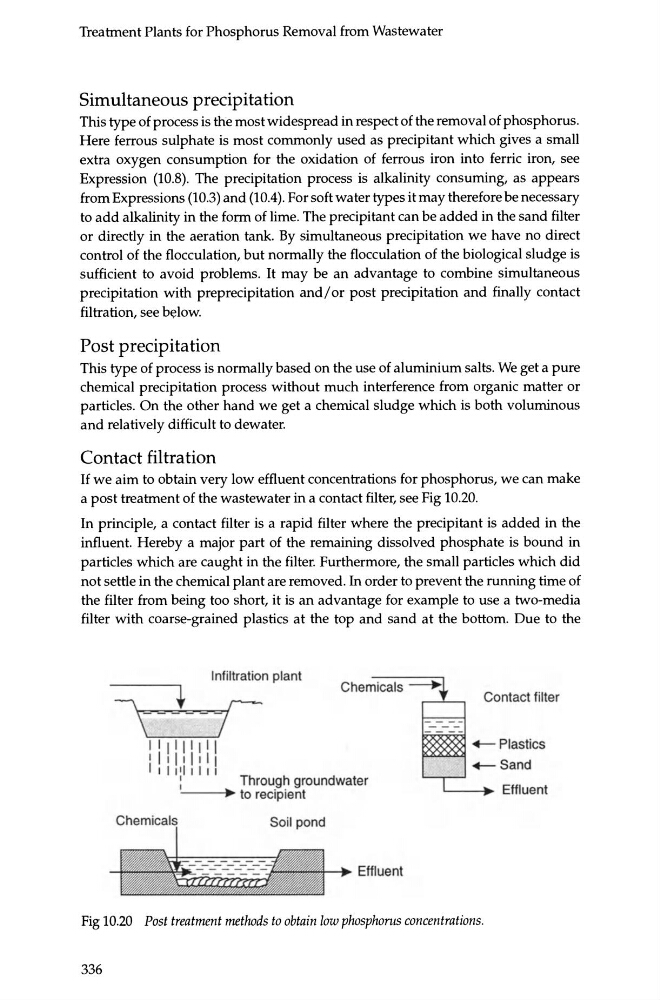
a post treatment of the wastewater in a contact filter, see Fig 10.20.
In principle, a contact filter is a rapid filter where the precipitant is added in the
influent. Hereby a major part of the remaining dissolved phosphate is bound in
particles which are caught in the filter. Furthermore, the small particles which did
not settle in the chemical plant are removed. In order to prevent the running time of
the filter from being too short, it is an advantage for example to use a two-media
filter with coarse-grained plastics at the top and sand at the bottom. Due to the
Infiltration plant
•
~
IIIIIIJII
I I I I I I ill
I I I I'l l II I
:
Through groundwater
:...._---lJia~ to recipient
Soil pond
Effluent
Fig 10.20 Post treatment methods to obtain low phosphon1s concentrations.
336
Contact filter
Simultaneous precipitation
This type of process is the most widespread in respect of the removal of phosphorus.
Here ferrous sulphate is most commonly used as precipitant which gives a small
extra oxygen consumption for the oxidation of ferrous iron into ferric iron, see
Expression (10.8). The precipitation process is alkalinity consuming, as appears
from Expressions (10.3) and (10.4). For soft water types it may therefore be necessary
to add alkalinity in the form of lime. The precipitant can be added in the sand filter
or directly in the aeration tank. By simultaneous precipitation we have no direct
control of the flocculation, but normally the flocculation of the biological sludge is
sufficient to avoid problems. It may be an advantage to combine simultaneous
precipitation with preprecipitation and/ or post precipitation and finally contact
filtration, see bl;!low.
Post precipitation
This type of process is normally based on the use of aluminium salts. We get a pure
chemical precipitation process without much interference from organic matter or
particles. On the other hand we get a chemical sludge which is both voluminous
and relatively difficult to dewater.
Contact filtration
If we aim to obtain very low effluent concentrations for phosphorus, we can make
a post treatment of the wastewater in a contact filter, see Fig 10.20.
In principle, a contact filter is a rapid filter where the precipitant is added in the
influent. Hereby a major part of the remaining dissolved phosphate is bound in
particles which are caught in the filter. Furthermore, the small particles which did
not settle in the chemical plant are removed. In order to prevent the running time of
the filter from being too short, it is an advantage for example to use a two-media
filter with coarse-grained plastics at the top and sand at the bottom. Due to the
Infiltration plant
•
~
IIIIIIJII
I I I I I I ill
I I I I'l l II I
:
Through groundwater
:...._---lJia~ to recipient
Soil pond
Effluent
Fig 10.20 Post treatment methods to obtain low phosphon1s concentrations.
336
Contact filter