

Treatment Plants for Phosphorus Removal from Wastewater
very complex material consisting of amorphous substances combined with adsorbed material. The precipitation may occur around pH 7, but the pH is frequently
increased to 8-10 by addition of Ca(OH)z. There is an apparent need for a more
detailed documentation of the chemical conditions in connection with this precipitation process.
Calcium as a precipitant
Phosphate precipitation with calcium, added as Ca(OH)z or CaO, is misleadingly
termed "lime precipitation" in normal English usage. In a simplified form, the
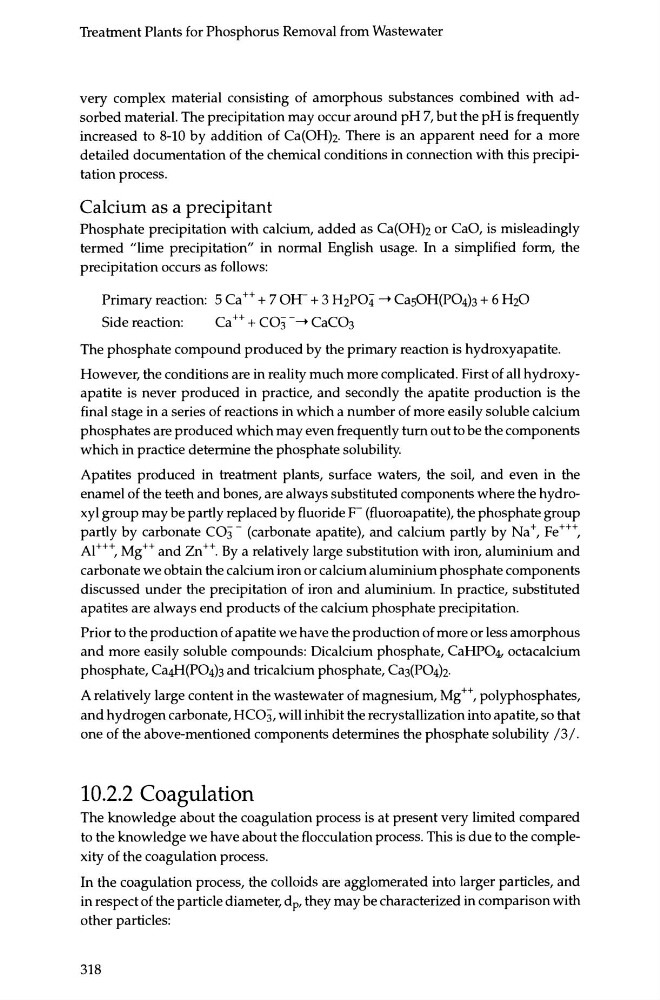
precipitation occurs as follows:
Side reaction:
Ca ++ + C03----. CaC03
The phosphate compound produced by the primary reaction is hydroxyapatite.
However, the conditions are in reality much more complicated. First of all hydroxyapatite is never produced in practice, and secondly the apatite production is the
final stage in a series of reactions in which a number of more easily soluble calcium
phosphates are produced which may even frequently tum out to be the components
which in practice determine the phosphate solubility.
Apatites produced in treatment plants, surface waters, the soil, and even in the
enamel of the teeth and bones, are always substituted components where the hydroxyl group may be partly replaced by fluoride F- (fluoroapatite), the phosphate group
partly by carbonate C03- (carbonate apatite), and calcium partly by Na +, Fe+++,
Al+++, Mg ++and Zn ++. By a relatively large substitution with iron, aluminium and
carbonate we obtain the calcium iron or calcium aluminium phosphate components
discussed under the precipitation of iron and aluminium. In practice, substituted
apatites are always end products of the calcium phosphate precipitation.
Prior to the production of apatite we have the production of more or less amorphous
and more easily soluble compounds: Dicalcium phosphate, CaHP041 octacalcium
phosphate, Ca.¥-I(P04)3 and tricalcium phosphate, Ca3(P04)2.
A relatively large content in the wastewater of magnesium, Mg ++, polyphosphates,
and hydrogen carbonate, HC03, will inhibit the recrystallization into apatite, so that
one of the above-mentioned components determines the phosphate solubility /3/.
10.2.2 Coagulation
The knowledge about the coagulation process is at present very limited compared
to the knowledge we have about the flocculation process. This is due to the complexity of the coagulation process.
In the coagulation process, the colloids are agglomerated into larger particles, and
in respect of the particle diameter, dp, they may be characterized in comparison with
other particles:
318
very complex material consisting of amorphous substances combined with adsorbed material. The precipitation may occur around pH 7, but the pH is frequently
increased to 8-10 by addition of Ca(OH)z. There is an apparent need for a more
detailed documentation of the chemical conditions in connection with this precipitation process.
Calcium as a precipitant
Phosphate precipitation with calcium, added as Ca(OH)z or CaO, is misleadingly
termed "lime precipitation" in normal English usage. In a simplified form, the
precipitation occurs as follows:
Side reaction:
Ca ++ + C03----. CaC03
The phosphate compound produced by the primary reaction is hydroxyapatite.
However, the conditions are in reality much more complicated. First of all hydroxyapatite is never produced in practice, and secondly the apatite production is the
final stage in a series of reactions in which a number of more easily soluble calcium
phosphates are produced which may even frequently tum out to be the components
which in practice determine the phosphate solubility.
Apatites produced in treatment plants, surface waters, the soil, and even in the
enamel of the teeth and bones, are always substituted components where the hydroxyl group may be partly replaced by fluoride F- (fluoroapatite), the phosphate group
partly by carbonate C03- (carbonate apatite), and calcium partly by Na +, Fe+++,
Al+++, Mg ++and Zn ++. By a relatively large substitution with iron, aluminium and
carbonate we obtain the calcium iron or calcium aluminium phosphate components
discussed under the precipitation of iron and aluminium. In practice, substituted
apatites are always end products of the calcium phosphate precipitation.
Prior to the production of apatite we have the production of more or less amorphous
and more easily soluble compounds: Dicalcium phosphate, CaHP041 octacalcium
phosphate, Ca.¥-I(P04)3 and tricalcium phosphate, Ca3(P04)2.
A relatively large content in the wastewater of magnesium, Mg ++, polyphosphates,
and hydrogen carbonate, HC03, will inhibit the recrystallization into apatite, so that
one of the above-mentioned components determines the phosphate solubility /3/.
10.2.2 Coagulation
The knowledge about the coagulation process is at present very limited compared
to the knowledge we have about the flocculation process. This is due to the complexity of the coagulation process.
In the coagulation process, the colloids are agglomerated into larger particles, and
in respect of the particle diameter, dp, they may be characterized in comparison with
other particles:
318