

Design of anaerobic plants
Measurement
Purpose
Normally allowable interval/variation
Process monitoring
Temperature
Maintain constant
± 1°C/d
temperature
Load with organic matter
Prevention against overload + 50 per cent dissolved COD I d
(kg COD/d)
+ 100 per cent suspended COD I d
Process control
Volatile acids, concentration
Detection of instability in the Total: 200-500 gas HAc/m 3
process
HAc: 200-500 gas HAc/m 3
HPr: 50-100 gas HAc/m 3
Gas production
Control of methane bacteria ± 20%/d (a function of influent load of
organic matter)
pH
Control of instability
6-7. Variation±O.S/d
Functional control
Effluent concentration, organic
Control of treatment
Variation± 10%/d
matter
efficiency
Gas production/ quality
Control of produced amount Variation± 20%/ d.
of methane
Methane content 60-75%
Sludge quality(% volatile)
Control of sludge
60-70% normal, variation± 5%
stabilization function
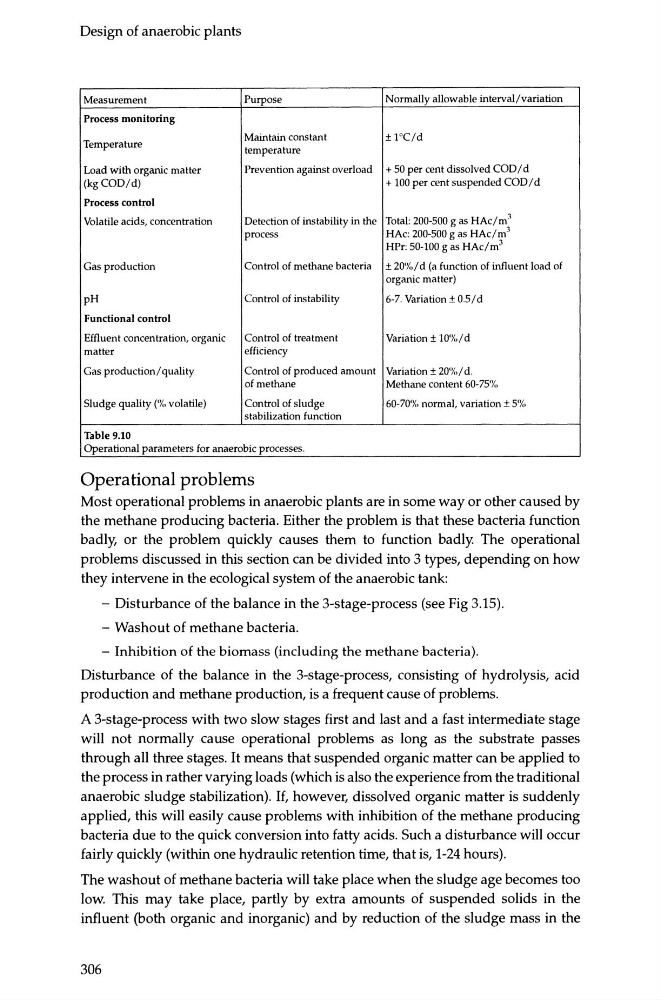
Table 9.10
Operational parameters for anaerobic processes.
Operational problems
Most operational problems in anaerobic plants are in some way or other caused by
the methane producing bacteria. Either the problem is that these bacteria function
badly, or the problem quickly causes them to function badly. The operational
problems discussed in this section can be divided into 3 types, depending on how
they intervene in the ecological system of the anaerobic tank:
- Disturbance of the balance in the 3-stage-process (see Fig 3.15).
- Washout of methane bacteria.
- Inhibition of the biomass (including the methane bacteria).
Disturbance of the balance in the 3-stage-process, consisting of hydrolysis, acid
production and methane production, is a frequent cause of problems.
A 3-stage-process with two slow stages first and last and a fast intermediate stage
will not normally cause operational problems as long as the substrate passes
through all three stages. It means that suspended organic matter can be applied to
the process in rather varying loads (which is also the experience from the traditional
anaerobic sludge stabilization). If, however, dissolved organic matter is suddenly
applied, this will easily cause problems with inhibition of the methane producing
bacteria due to the quick conversion into fatty acids. Such a disturbance will occur
fairly quickly (within one hydraulic retention time, that is, 1-24 hours).
The washout of methane bacteria will take place when the sludge age becomes too
low. This may take place, partly by extra amounts of suspended solids in the
influent (both organic and inorganic) and by reduction of the sludge mass in the
306
Measurement
Purpose
Normally allowable interval/variation
Process monitoring
Temperature
Maintain constant
± 1°C/d
temperature
Load with organic matter
Prevention against overload + 50 per cent dissolved COD I d
(kg COD/d)
+ 100 per cent suspended COD I d
Process control
Volatile acids, concentration
Detection of instability in the Total: 200-500 gas HAc/m 3
process
HAc: 200-500 gas HAc/m 3
HPr: 50-100 gas HAc/m 3
Gas production
Control of methane bacteria ± 20%/d (a function of influent load of
organic matter)
pH
Control of instability
6-7. Variation±O.S/d
Functional control
Effluent concentration, organic
Control of treatment
Variation± 10%/d
matter
efficiency
Gas production/ quality
Control of produced amount Variation± 20%/ d.
of methane
Methane content 60-75%
Sludge quality(% volatile)
Control of sludge
60-70% normal, variation± 5%
stabilization function
Table 9.10
Operational parameters for anaerobic processes.
Operational problems
Most operational problems in anaerobic plants are in some way or other caused by
the methane producing bacteria. Either the problem is that these bacteria function
badly, or the problem quickly causes them to function badly. The operational
problems discussed in this section can be divided into 3 types, depending on how
they intervene in the ecological system of the anaerobic tank:
- Disturbance of the balance in the 3-stage-process (see Fig 3.15).
- Washout of methane bacteria.
- Inhibition of the biomass (including the methane bacteria).
Disturbance of the balance in the 3-stage-process, consisting of hydrolysis, acid
production and methane production, is a frequent cause of problems.
A 3-stage-process with two slow stages first and last and a fast intermediate stage
will not normally cause operational problems as long as the substrate passes
through all three stages. It means that suspended organic matter can be applied to
the process in rather varying loads (which is also the experience from the traditional
anaerobic sludge stabilization). If, however, dissolved organic matter is suddenly
applied, this will easily cause problems with inhibition of the methane producing
bacteria due to the quick conversion into fatty acids. Such a disturbance will occur
fairly quickly (within one hydraulic retention time, that is, 1-24 hours).
The washout of methane bacteria will take place when the sludge age becomes too
low. This may take place, partly by extra amounts of suspended solids in the
influent (both organic and inorganic) and by reduction of the sludge mass in the
306