

Plants for Biological Phosphorus Removal
8.2.3 Biological phosphorus removal with internally
produced easily degradable organic matter
If there is a shortage of easily degradable organic matter (acetic acid etc.) in the
wastewater, it can be produced internally in the plant by a hydrolysis process. At
present, there are very few plants of this type. Fig 8.5 gives a schematic representation of possible plant designs of which only the last one is known from
full-scale plants. In this plant, the hydrolysis which naturally takes place in the
primary sludge is used, both in the primary tank and in a concentration tank.
8.2.4 Biological phosphorus removal without
nitrification-denitrification
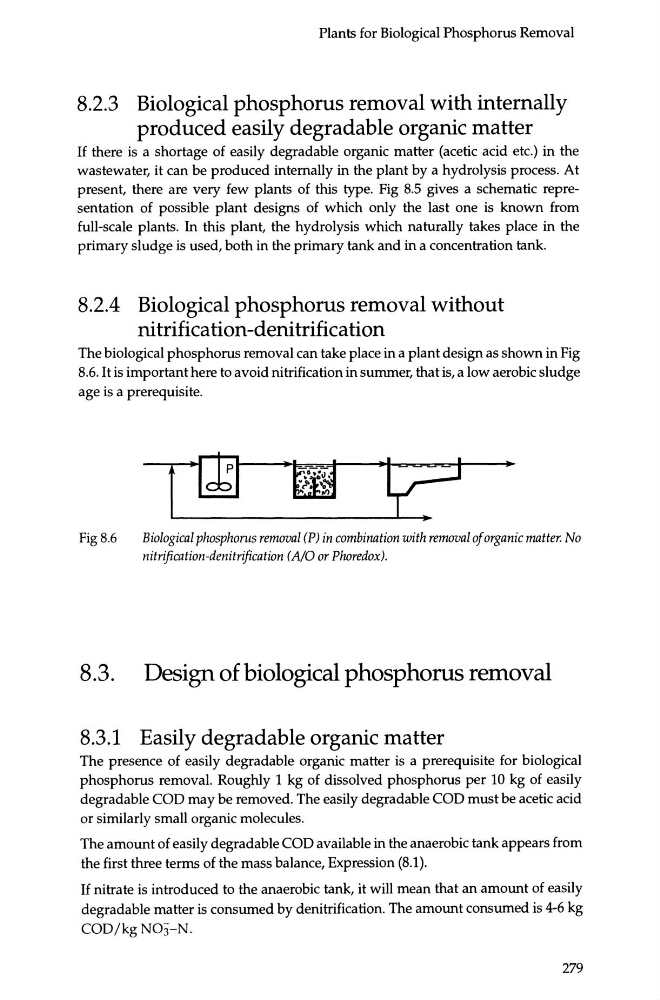
The biological phosphorus removal can take place in a plant design as shown in Fig
8.6.1t is important here to avoid nitrification in summer, that is, a low aerobic sludge
age is a prerequisite.
Fig 8.6
Biological phosphonts removal (P) in combination with removal of organic matter. No
nitrification-denitrification (A/0 or Phoredox).
8.3. Design of biological phosphorus removal
8.3.1 Easily degradable organic matter
The presence of easily degradable organic matter is a prerequisite for biological
phosphorus removal. Roughly 1 kg of dissolved phosphorus per 10 kg of easily
degradable COD may be removed. The easily degradable COD must be acetic acid
or similarly small organic molecules.
The amount of easily degradable COD available in the anaerobic tank appears from
the first three terms of the mass balance, Expression (8.1).
If nitrate is introduced to the anaerobic tank, it will mean that an amount of easily
degradable matter is consumed by denitrification. The amount consumed is 4-6 kg
COD/kg NO)-N.
279
8.2.3 Biological phosphorus removal with internally
produced easily degradable organic matter
If there is a shortage of easily degradable organic matter (acetic acid etc.) in the
wastewater, it can be produced internally in the plant by a hydrolysis process. At
present, there are very few plants of this type. Fig 8.5 gives a schematic representation of possible plant designs of which only the last one is known from
full-scale plants. In this plant, the hydrolysis which naturally takes place in the
primary sludge is used, both in the primary tank and in a concentration tank.
8.2.4 Biological phosphorus removal without
nitrification-denitrification
The biological phosphorus removal can take place in a plant design as shown in Fig
8.6.1t is important here to avoid nitrification in summer, that is, a low aerobic sludge
age is a prerequisite.
Fig 8.6
Biological phosphonts removal (P) in combination with removal of organic matter. No
nitrification-denitrification (A/0 or Phoredox).
8.3. Design of biological phosphorus removal
8.3.1 Easily degradable organic matter
The presence of easily degradable organic matter is a prerequisite for biological
phosphorus removal. Roughly 1 kg of dissolved phosphorus per 10 kg of easily
degradable COD may be removed. The easily degradable COD must be acetic acid
or similarly small organic molecules.
The amount of easily degradable COD available in the anaerobic tank appears from
the first three terms of the mass balance, Expression (8.1).
If nitrate is introduced to the anaerobic tank, it will mean that an amount of easily
degradable matter is consumed by denitrification. The amount consumed is 4-6 kg
COD/kg NO)-N.
279