

Design of denitrifying plants
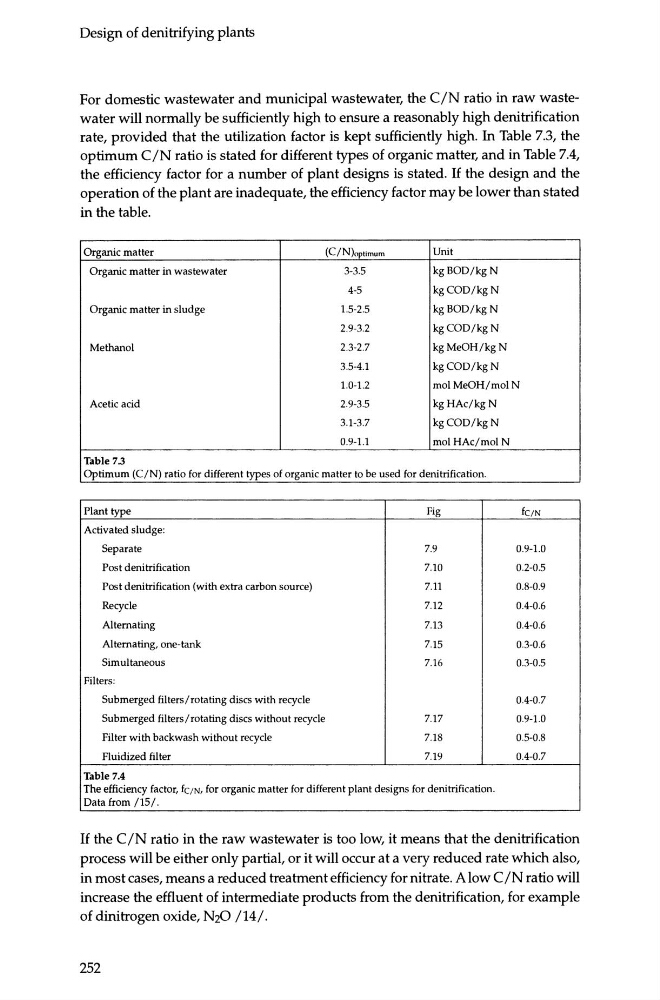
For domestic wastewater and municipal wastewater, the C/N ratio in raw wastewater will normally be sufficiently high to ensure a reasonably high denitrification
rate, provided that the utilization factor is kept sufficiently high. In Table 7.3, the
optimum C/N ratio is stated for different types of organic matter, and in Table 7.4,
the efficiency factor for a number of plant designs is stated. If the design and the
operation of the plant are inadequate, the efficiency factor may be lower than stated
in the table.
Organic matter
(C/N)optimum
Unit
Organic matter in wastewater
3-3.5
kgBOD/kgN
4-5
kgCOD/kgN
Organic matter in sludge
1.5-2.5
kgBOD/kgN
2.9-3.2
kgCOD/kgN
Methanol
2.3-2.7
kgMeOH/kgN
3.5-4.1
kgCOD/kgN
1.0-1.2
mol MeOH/mol N
Acetic acid
2.9-3.5
kgHAc/kgN
3.1-3.7
kgCOD/kgN
0.9-1.1
mol HAc/mol N
Table 7.3
Optimum (C/N) ratio for different types of organic matter to be used for denitrification.
Plant type
Fig
fctN
Activated sludge:
Separate
7.9
0.9-1.0
Post denitrification
7.10
0.2-0.5
Post denitrification (with extra carbon source)
7.11
0.8-0.9
Recycle
7.12
0.4-0.6
Alternating
7.13
0.4-0.6
Alternating, one-tank
7.15
0.3-0.6
Simultaneous
7.16
0.3-0.5
Filters:
Submerged filters/rotating discs with recycle
0.4-0.7
Submerged filters/rotating discs without recycle
7.17
0.9-1.0
Filter with backwash without recycle
7.18
0.5-0.8
Fluidized filter
7.19
0.4-0.7
Table7.4
The efficiency factor, fc;N, for organic matter for different plant designs for denitrification.
Data from /15/.
If the C/N ratio in the raw wastewater is too low, it means that the denitrification
process will be either only partial, or it will occur at a very reduced rate which also,
in most cases, means a reduced treatment efficiency for nitrate. A low C/N ratio will
increase the effluent of intermediate products from the denitrification, for example
of dinitrogen oxide, N20 /14/.
252
For domestic wastewater and municipal wastewater, the C/N ratio in raw wastewater will normally be sufficiently high to ensure a reasonably high denitrification
rate, provided that the utilization factor is kept sufficiently high. In Table 7.3, the
optimum C/N ratio is stated for different types of organic matter, and in Table 7.4,
the efficiency factor for a number of plant designs is stated. If the design and the
operation of the plant are inadequate, the efficiency factor may be lower than stated
in the table.
Organic matter
(C/N)optimum
Unit
Organic matter in wastewater
3-3.5
kgBOD/kgN
4-5
kgCOD/kgN
Organic matter in sludge
1.5-2.5
kgBOD/kgN
2.9-3.2
kgCOD/kgN
Methanol
2.3-2.7
kgMeOH/kgN
3.5-4.1
kgCOD/kgN
1.0-1.2
mol MeOH/mol N
Acetic acid
2.9-3.5
kgHAc/kgN
3.1-3.7
kgCOD/kgN
0.9-1.1
mol HAc/mol N
Table 7.3
Optimum (C/N) ratio for different types of organic matter to be used for denitrification.
Plant type
Fig
fctN
Activated sludge:
Separate
7.9
0.9-1.0
Post denitrification
7.10
0.2-0.5
Post denitrification (with extra carbon source)
7.11
0.8-0.9
Recycle
7.12
0.4-0.6
Alternating
7.13
0.4-0.6
Alternating, one-tank
7.15
0.3-0.6
Simultaneous
7.16
0.3-0.5
Filters:
Submerged filters/rotating discs with recycle
0.4-0.7
Submerged filters/rotating discs without recycle
7.17
0.9-1.0
Filter with backwash without recycle
7.18
0.5-0.8
Fluidized filter
7.19
0.4-0.7
Table7.4
The efficiency factor, fc;N, for organic matter for different plant designs for denitrification.
Data from /15/.
If the C/N ratio in the raw wastewater is too low, it means that the denitrification
process will be either only partial, or it will occur at a very reduced rate which also,
in most cases, means a reduced treatment efficiency for nitrate. A low C/N ratio will
increase the effluent of intermediate products from the denitrification, for example
of dinitrogen oxide, N20 /14/.
252