

Treatment Plants for Denitrification
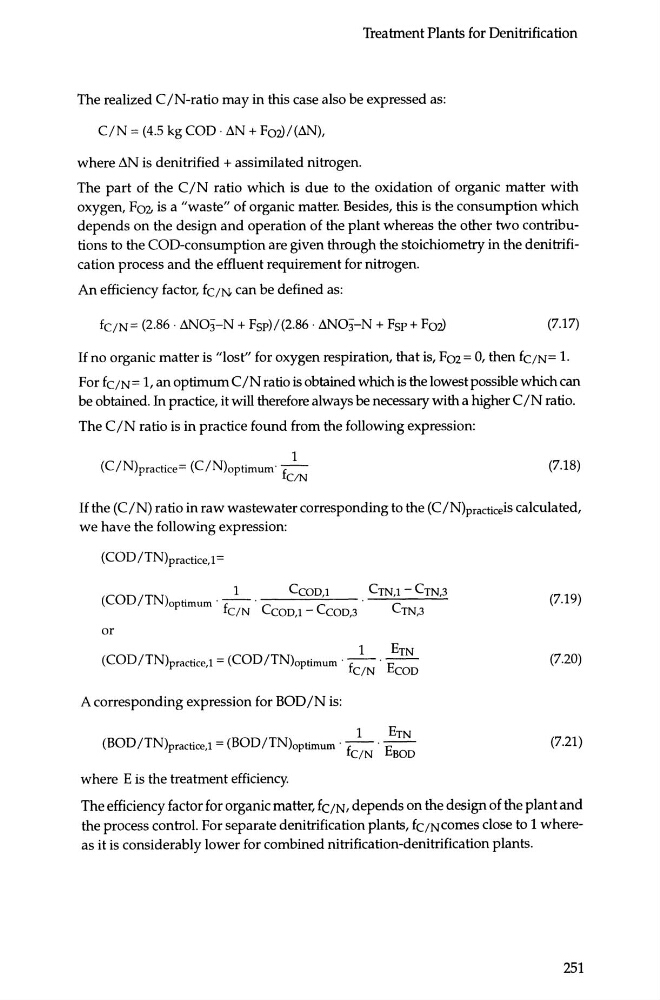
The realized C/N-ratio may in this case also be expressed as:
C/N = (4.5 kg COD· ~N + F02)/(~),
where m is denitrified + assimilated nitrogen.
The part of the C/N ratio which is due to the oxidation of organic matter with
oxygen, Fo2- is a "waste" of organic matter. Besides, this is the consumption which
depends on the design and operation of the plant whereas the other two contributions to the COD-consumption are given through the stoichiometry in the denitrification process and the effluent requirement for nitrogen.
An efficiency factor, fc;N can be defined as:
fc/N = (2.86 · ~N03-N + Fsp) I (2.86 · ~N03-N + Fsp + Foz)
(7.17)
If no organic matter is "lost" for oxygen respiration, that is, Foz = 0, then fc;N= 1.
For fc/N= 1, an optimum C/N ratio is obtained which is the lowest possible which can
be obtained. In practice, it will therefore always be necessary with a higher C/N ratio.
The C/N ratio is in practice found from the following expression:
1
(C/N)practice= (C/N)optimum· -fCIN
(7.18)
If the (C/N) ratio in raw wastewater corresponding to the {C/N)practiceis calculated,
we have the following expression:
(COD /TN)practice,l =
1
CcoD,1
(COD /TN)optimum · -f- · C
C
C/N COD,1 - COD,3
CTN,1- CTN,3
CTN,3
or
1
ETN
(COD /TN)practice 1 = (COD /TN)optimum · - f - · -E-,
C/N COD
A corresponding expression for BOD /N is:
1
ETN
(BOD /TN)practice 1 =(BOD /TN)optimum · -.c- · -E,
IC/N BOD
where E is the treatment efficiency.
(7.19)
(7.20)
(7.21)
The efficiency factor for organic matter, fc!N, depends on the design of the plant and
the process control. For separate denitrification plants, fc;Ncomes close to 1 whereas it is considerably lower for combined nitrification-denitrification plants.
251
The realized C/N-ratio may in this case also be expressed as:
C/N = (4.5 kg COD· ~N + F02)/(~),
where m is denitrified + assimilated nitrogen.
The part of the C/N ratio which is due to the oxidation of organic matter with
oxygen, Fo2- is a "waste" of organic matter. Besides, this is the consumption which
depends on the design and operation of the plant whereas the other two contributions to the COD-consumption are given through the stoichiometry in the denitrification process and the effluent requirement for nitrogen.
An efficiency factor, fc;N can be defined as:
fc/N = (2.86 · ~N03-N + Fsp) I (2.86 · ~N03-N + Fsp + Foz)
(7.17)
If no organic matter is "lost" for oxygen respiration, that is, Foz = 0, then fc;N= 1.
For fc/N= 1, an optimum C/N ratio is obtained which is the lowest possible which can
be obtained. In practice, it will therefore always be necessary with a higher C/N ratio.
The C/N ratio is in practice found from the following expression:
1
(C/N)practice= (C/N)optimum· -fCIN
(7.18)
If the (C/N) ratio in raw wastewater corresponding to the {C/N)practiceis calculated,
we have the following expression:
(COD /TN)practice,l =
1
CcoD,1
(COD /TN)optimum · -f- · C
C
C/N COD,1 - COD,3
CTN,1- CTN,3
CTN,3
or
1
ETN
(COD /TN)practice 1 = (COD /TN)optimum · - f - · -E-,
C/N COD
A corresponding expression for BOD /N is:
1
ETN
(BOD /TN)practice 1 =(BOD /TN)optimum · -.c- · -E,
IC/N BOD
where E is the treatment efficiency.
(7.19)
(7.20)
(7.21)
The efficiency factor for organic matter, fc!N, depends on the design of the plant and
the process control. For separate denitrification plants, fc;Ncomes close to 1 whereas it is considerably lower for combined nitrification-denitrification plants.
251