

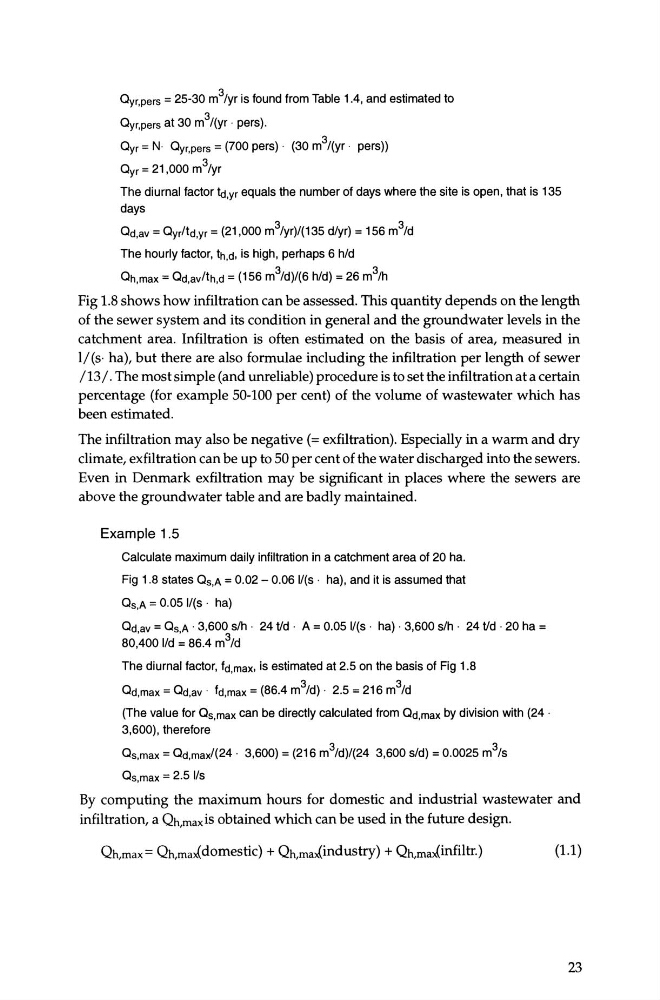
Oyr,pers = 25-30 m 3 /yr is found from Table 1.4, and estimated to
3
Oyr,pers at 30 m /(yr · pers).
3
Oyr = N· Oyr,pers = (700 pers) · (30m /(yr · pers))
3
Oyr = 21,000 m /yr
The diurnal factor tct,yr equals the number of days where the site is open, that is 135
days
0d,av = Oyrltd,yr = (21 ,000 m 3 /yr)/(135 d/yr) = 156 m 3 /d
The hourly factor, tt,,d. is high, perhaps 6 hid
ah,max = 0d,avlth,d = (156 m 3 /d)/(6 hid)= 26 m 3 /h
Fig 1.8 shows how infiltration can be assessed. This quantity depends on the length
of the sewer system and its condition in general and the groundwater levels in the
catchment area. Infiltration is often estimated on the basis of area, measured in
1/(s· ha), but there are also formulae including the infiltration per length of sewer
I 13 I. The most simple (and unreliable) procedure is to set the infiltration at a certain
percentage (for example 50-100 per cent) of the volume of wastewater which has
been estimated.
The infiltration may also be negative (= exfiltration). Especially in a warm and dry
climate, exfiltration can be up to 50 per cent of the water discharged into the sewers.
Even in Denmark exfiltration may be significant in places where the sewers are
above the groundwater table and are badly maintained.
Example 1.5
Calculate maximum daily infiltration in a catchment area of 20 ha.
Fig 1.8 states Os,A = 0.02- 0.06 V(s · ha), and it is assumed that
Os,A = 0.05 1/(s · ha)
0d,av = Os,A · 3,600 s/h · 24 t/d · A = 0.05 1/(s · ha) · 3,600 s/h · 24 tid · 20 ha =
80,400 1/d = 86.4 m 3 /d
The diurnal factor, fd,max. is estimated at 2.5 on the basis of Fig 1.8
0d,max = 0d,av · fd,max = (86.4 m 3 /d) · 2.5 = 216 m 3 /d
(The value for Os,max can be directly calculated from 0d,max by division with (24 ·
3,600), therefore
Os,max = 0d,maxl(24 · 3,600) = (216 m 3 /d)/(24 3,600 s/d) = 0.0025 m 3 /s
Os,max = 2.5 1/s
By computing the maximum hours for domestic and industrial wastewater and
infiltration, a Oh,maxis obtained which can be used in the future design.
Qh,max= Qh,max(domestic) + Oh,max(industry) + Oh,max(infiltr.)
(1.1)
23
3
Oyr,pers at 30 m /(yr · pers).
3
Oyr = N· Oyr,pers = (700 pers) · (30m /(yr · pers))
3
Oyr = 21,000 m /yr
The diurnal factor tct,yr equals the number of days where the site is open, that is 135
days
0d,av = Oyrltd,yr = (21 ,000 m 3 /yr)/(135 d/yr) = 156 m 3 /d
The hourly factor, tt,,d. is high, perhaps 6 hid
ah,max = 0d,avlth,d = (156 m 3 /d)/(6 hid)= 26 m 3 /h
Fig 1.8 shows how infiltration can be assessed. This quantity depends on the length
of the sewer system and its condition in general and the groundwater levels in the
catchment area. Infiltration is often estimated on the basis of area, measured in
1/(s· ha), but there are also formulae including the infiltration per length of sewer
I 13 I. The most simple (and unreliable) procedure is to set the infiltration at a certain
percentage (for example 50-100 per cent) of the volume of wastewater which has
been estimated.
The infiltration may also be negative (= exfiltration). Especially in a warm and dry
climate, exfiltration can be up to 50 per cent of the water discharged into the sewers.
Even in Denmark exfiltration may be significant in places where the sewers are
above the groundwater table and are badly maintained.
Example 1.5
Calculate maximum daily infiltration in a catchment area of 20 ha.
Fig 1.8 states Os,A = 0.02- 0.06 V(s · ha), and it is assumed that
Os,A = 0.05 1/(s · ha)
0d,av = Os,A · 3,600 s/h · 24 t/d · A = 0.05 1/(s · ha) · 3,600 s/h · 24 tid · 20 ha =
80,400 1/d = 86.4 m 3 /d
The diurnal factor, fd,max. is estimated at 2.5 on the basis of Fig 1.8
0d,max = 0d,av · fd,max = (86.4 m 3 /d) · 2.5 = 216 m 3 /d
(The value for Os,max can be directly calculated from 0d,max by division with (24 ·
3,600), therefore
Os,max = 0d,maxl(24 · 3,600) = (216 m 3 /d)/(24 3,600 s/d) = 0.0025 m 3 /s
Os,max = 2.5 1/s
By computing the maximum hours for domestic and industrial wastewater and
infiltration, a Oh,maxis obtained which can be used in the future design.
Qh,max= Qh,max(domestic) + Oh,max(industry) + Oh,max(infiltr.)
(1.1)
23