

The volumes of wastewater
In respect of industrial and public institutions wastewater, the calculation can be
made as shown in Fig 1.7. Here the basis will once again be an annual production
of water which, in respect of industrial wastewater, will often be calculated as the
product of a wastewater production per produced unit and the number of produced
units per year. (For example for breweries: 0.6 m 3 wastewater /hl beer, with a
production of 10 6 hl/yr, yields a volume of wastewater of 0.6 · 10 6 m 3 /yr). Table 1.3
gives an impression of the wastewater production from different industries whereas
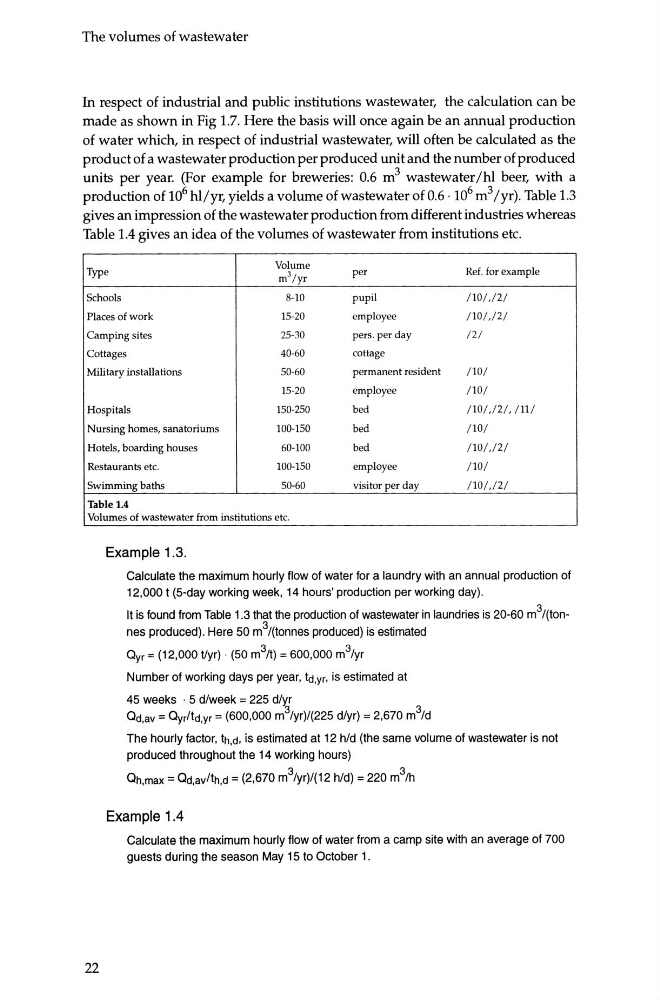
Table 1.4 gives an idea of the volumes of wastewater from institutions etc.
Type
Volume
Ref. for example
m3/yr
per
Schools
8-10
pupil
/10/,/2/
Places of work
15-20
employee
/10/,/2/
Camping sites
25-30
pers. per day
/2/
Cottages
40-60
cottage
Military installations
50-60
permanent resident
/10/
15-20
employee
/10/
Hospitals
150-250
bed
/10/,/2/' /11/
Nursing homes, sanatoriums
100-150
bed
/10/
Hotels, boarding houses
60-100
bed
/10/,/2/
Restaurants etc.
100-150
employee
/10/
Swimming baths
50-60
visitor per day
/10/,/2/
Table1.4
Volumes of wastewater from institutions etc.
Example 1.3.
Calculate the maximum hourly flow of water for a laundry with an annual production of
12,000 t (5-day working week, 14 hours' production per working day).
22
It is found from Table 1.3 that the production of wastewater in laundries is 20-60 m 3 /(tonnes produced). Here 50 m 3 /(tonnes produced) is estimated
Oyr = (12,000 t!yr) · (50 m 3 /t) = 600,000 m 3 /yr
Number of working days per year, td,yr. is estimated at
45 weeks · 5 d/week = 225 dlyr
Oct,av = Oyrltct,yr = (600,000 m 3 /yr)/(225 d/yr) = 2,670 m 3 /d
The hourly factor, th,d. is estimated at 12 hid (the same volume of wastewater is not
produced throughout the 14 working hours)
Oh,max = 0d,avlth,d = (2,670 m 3 /yr)/(12 hid)= 220 m 3 /h
Example 1.4
Calculate the maximum hourly flow of water from a camp site with an average of 700
guests during the season May 15 to October 1.
In respect of industrial and public institutions wastewater, the calculation can be
made as shown in Fig 1.7. Here the basis will once again be an annual production
of water which, in respect of industrial wastewater, will often be calculated as the
product of a wastewater production per produced unit and the number of produced
units per year. (For example for breweries: 0.6 m 3 wastewater /hl beer, with a
production of 10 6 hl/yr, yields a volume of wastewater of 0.6 · 10 6 m 3 /yr). Table 1.3
gives an impression of the wastewater production from different industries whereas
Table 1.4 gives an idea of the volumes of wastewater from institutions etc.
Type
Volume
Ref. for example
m3/yr
per
Schools
8-10
pupil
/10/,/2/
Places of work
15-20
employee
/10/,/2/
Camping sites
25-30
pers. per day
/2/
Cottages
40-60
cottage
Military installations
50-60
permanent resident
/10/
15-20
employee
/10/
Hospitals
150-250
bed
/10/,/2/' /11/
Nursing homes, sanatoriums
100-150
bed
/10/
Hotels, boarding houses
60-100
bed
/10/,/2/
Restaurants etc.
100-150
employee
/10/
Swimming baths
50-60
visitor per day
/10/,/2/
Table1.4
Volumes of wastewater from institutions etc.
Example 1.3.
Calculate the maximum hourly flow of water for a laundry with an annual production of
12,000 t (5-day working week, 14 hours' production per working day).
22
It is found from Table 1.3 that the production of wastewater in laundries is 20-60 m 3 /(tonnes produced). Here 50 m 3 /(tonnes produced) is estimated
Oyr = (12,000 t!yr) · (50 m 3 /t) = 600,000 m 3 /yr
Number of working days per year, td,yr. is estimated at
45 weeks · 5 d/week = 225 dlyr
Oct,av = Oyrltct,yr = (600,000 m 3 /yr)/(225 d/yr) = 2,670 m 3 /d
The hourly factor, th,d. is estimated at 12 hid (the same volume of wastewater is not
produced throughout the 14 working hours)
Oh,max = 0d,avlth,d = (2,670 m 3 /yr)/(12 hid)= 220 m 3 /h
Example 1.4
Calculate the maximum hourly flow of water from a camp site with an average of 700
guests during the season May 15 to October 1.