

Effluent
SNH4 04
So2".
SNH4>04
S02
.
S
5
NH4,0.4 and Seoo < 5
o2
S02
Seoo, 5
So2
Treabnent Plants for Nitrification
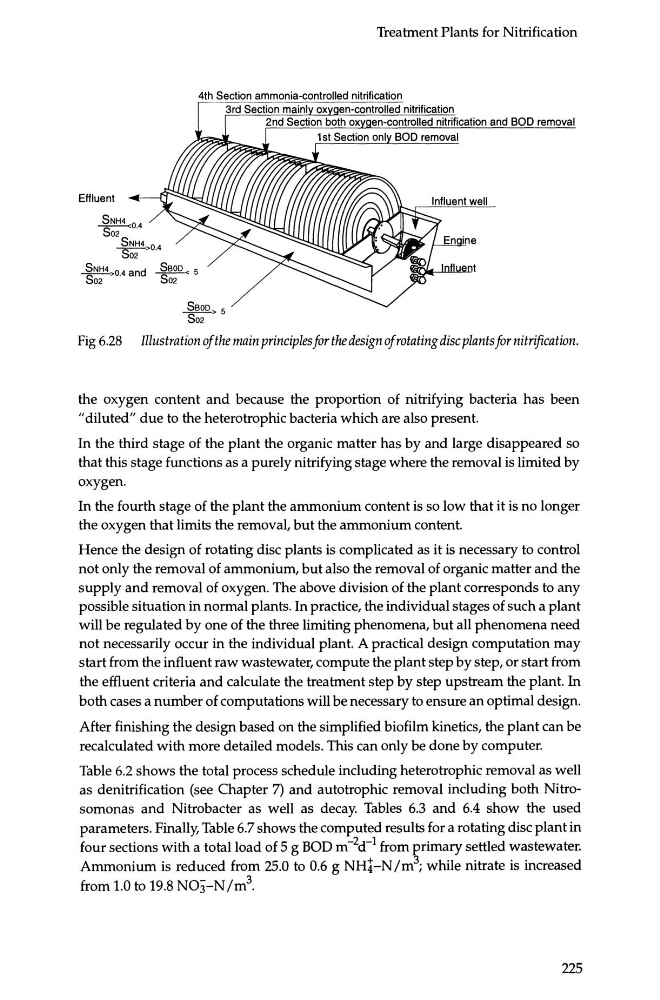
Fig 6.28 Illustration of the main principles for the design of rotating disc plants for nitrification.
the oxygen content and because the proportion of nitrifying bacteria has been
"diluted" due to the heterotrophic bacteria which are also present.
In the third stage of the plant the organic matter has by and large disappeared so
that this stage functions as a purely nitrifying stage where the removal is limited by
oxygen.
In the fourth stage of the plant the ammonium content is so low that it is no longer
the oxygen that limits the removal, but the ammonium content.
Hence the design of rotating disc plants is complicated as it is necessary to control
not only the removal of ammonium, but also the removal of organic matter and the
supply and removal of oxygen. The above division of the plant corresponds to any
possible situation in normal plants. In practice, the individual stages of such a plant
will be regulated by one of the three limiting phenomena, but all phenomena need
not necessarily occur in the individual plant. A practical design computation may
start from the influent raw wastewater, compute the plant step by step, or start from
the effluent criteria and calculate the treabnent step by step upstream the plant. In
both cases a number of computations will be necessary to ensure an optimal design.
After finishing the design based on the simplified biofilm kinetics, the plant can be
recalculated with more detailed models. This can only be done by computer.
Table 6.2 shows the total process schedule including heterotrophic removal as well
as denitrification (see Chapter 7) and autotrophic removal including both Nitrosomonas and Nitrobacter as well as decay. Tables 6.3 and 6.4 show the used
parameters. Finally, Table 6.7 shows the computed results for a rotating disc plant in
four sections with a total load of 5 g BOD m- 2 d- 1 from ~rimary settled wastewater.
Ammonium is reduced from 25.0 to 0.6 g NH!-N/m; while nitrate is increased
from 1.0 to 19.8 N03-N /m 3 .
225
SNH4 04
So2".
SNH4>04
S02
.
S
5
NH4,0.4 and Seoo < 5
o2
S02
Seoo, 5
So2
Treabnent Plants for Nitrification
Fig 6.28 Illustration of the main principles for the design of rotating disc plants for nitrification.
the oxygen content and because the proportion of nitrifying bacteria has been
"diluted" due to the heterotrophic bacteria which are also present.
In the third stage of the plant the organic matter has by and large disappeared so
that this stage functions as a purely nitrifying stage where the removal is limited by
oxygen.
In the fourth stage of the plant the ammonium content is so low that it is no longer
the oxygen that limits the removal, but the ammonium content.
Hence the design of rotating disc plants is complicated as it is necessary to control
not only the removal of ammonium, but also the removal of organic matter and the
supply and removal of oxygen. The above division of the plant corresponds to any
possible situation in normal plants. In practice, the individual stages of such a plant
will be regulated by one of the three limiting phenomena, but all phenomena need
not necessarily occur in the individual plant. A practical design computation may
start from the influent raw wastewater, compute the plant step by step, or start from
the effluent criteria and calculate the treabnent step by step upstream the plant. In
both cases a number of computations will be necessary to ensure an optimal design.
After finishing the design based on the simplified biofilm kinetics, the plant can be
recalculated with more detailed models. This can only be done by computer.
Table 6.2 shows the total process schedule including heterotrophic removal as well
as denitrification (see Chapter 7) and autotrophic removal including both Nitrosomonas and Nitrobacter as well as decay. Tables 6.3 and 6.4 show the used
parameters. Finally, Table 6.7 shows the computed results for a rotating disc plant in
four sections with a total load of 5 g BOD m- 2 d- 1 from ~rimary settled wastewater.
Ammonium is reduced from 25.0 to 0.6 g NH!-N/m; while nitrate is increased
from 1.0 to 19.8 N03-N /m 3 .
225