

Types of plants for nitrification
Fig 6.13 Contact stabilization plant for (partial) nitrification.
The major part of the organic matter is removed in the contact tank, and nitrification
will occur to the extent possible within the allowable time. It is characteristic of this
plant type that the nitrification can be stable without being complete. The stabilization tank ensures the presence of nitrifying bacteria, but the extent of nitrification
depends on the time of contact between wastewater and sludge in the contact tank.
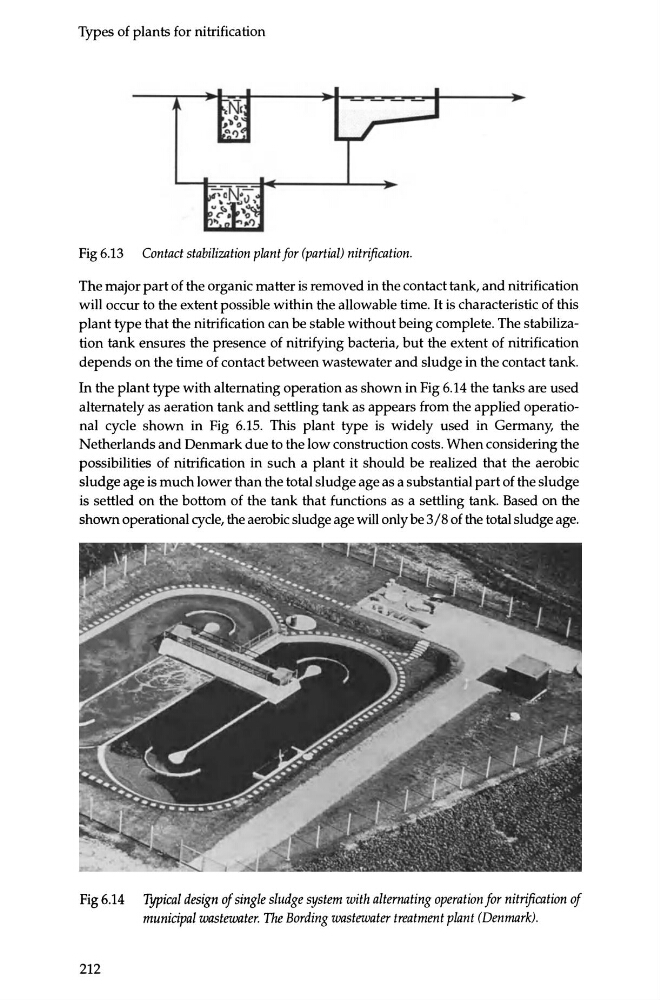
In the plant type with alternating operation as shown in Fig 6.14 the tanks are used
alternately as aeration tank and settling tank as appears from the applied operational cycle shown in Fig 6.15. This plant type is widely used in Germany, the
Netherlands and Denmark due to the low construction costs. When considering the
possibilities of nitrification in such a plant it should be realized that the aerobic
sludge age is much lower than the total sludge age as a substantial part of the sludge
is settled on the bottom of the tank that functions as a settling tank. Based on the
shown operational cycle, the aerobic sludge age will only be 3 I 8 of the total sludge age.
Fig 6.14 Typical design of single sludge system with alternating operation for nitrification of
municipal wastewater. The Barding wastewater treatment plant (Denmark).
212
Fig 6.13 Contact stabilization plant for (partial) nitrification.
The major part of the organic matter is removed in the contact tank, and nitrification
will occur to the extent possible within the allowable time. It is characteristic of this
plant type that the nitrification can be stable without being complete. The stabilization tank ensures the presence of nitrifying bacteria, but the extent of nitrification
depends on the time of contact between wastewater and sludge in the contact tank.
In the plant type with alternating operation as shown in Fig 6.14 the tanks are used
alternately as aeration tank and settling tank as appears from the applied operational cycle shown in Fig 6.15. This plant type is widely used in Germany, the
Netherlands and Denmark due to the low construction costs. When considering the
possibilities of nitrification in such a plant it should be realized that the aerobic
sludge age is much lower than the total sludge age as a substantial part of the sludge
is settled on the bottom of the tank that functions as a settling tank. Based on the
shown operational cycle, the aerobic sludge age will only be 3 I 8 of the total sludge age.
Fig 6.14 Typical design of single sludge system with alternating operation for nitrification of
municipal wastewater. The Barding wastewater treatment plant (Denmark).
212