

Treatment Plants for Nitrification
6.2.2 Single sludge nitrification plants
This is the most common plant type for nitrification. The entire sludge mass has the
same process behaviour, but nevertheless there are various, modified plant types.
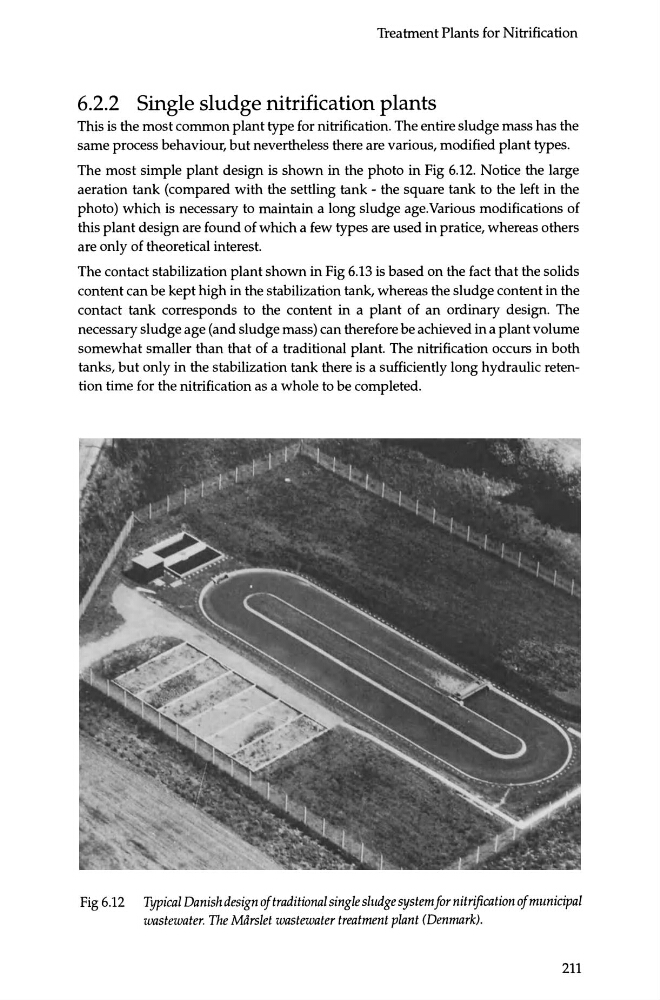
The most simple plant design is shown in the photo in Fig 6.12. Notice the large
aeration tank (compared with the settling tank- the square tank to the left in the
photo) which is necessary to maintain a long sludge age.Various modifications of
this plant design are found of which a few types are used in pratice, whereas others
are only of theoretical interest.
The contact stabilization plant shown in Fig 6.13 is based on the fact that the solids
content can be kept high in the stabilization tank, whereas the sludge content in the
contact tank corresponds to the content in a plant of an ordinary design. The
necessary sludge age (and sludge mass) can therefore be achieved in a plant volume
somewhat smaller than that of a traditional plant. The nitrification occurs in both
tanks, but only in the stabilization tank there is a sufficiently long hydraulic retention time for the nitrification as a whole to be completed.
Fig 6.12 Typical Danish design of traditional single sludge system for nitrification of municipal
wastewater. The Mdrslet wastewater treatment plant (Denmark).
211
6.2.2 Single sludge nitrification plants
This is the most common plant type for nitrification. The entire sludge mass has the
same process behaviour, but nevertheless there are various, modified plant types.
The most simple plant design is shown in the photo in Fig 6.12. Notice the large
aeration tank (compared with the settling tank- the square tank to the left in the
photo) which is necessary to maintain a long sludge age.Various modifications of
this plant design are found of which a few types are used in pratice, whereas others
are only of theoretical interest.
The contact stabilization plant shown in Fig 6.13 is based on the fact that the solids
content can be kept high in the stabilization tank, whereas the sludge content in the
contact tank corresponds to the content in a plant of an ordinary design. The
necessary sludge age (and sludge mass) can therefore be achieved in a plant volume
somewhat smaller than that of a traditional plant. The nitrification occurs in both
tanks, but only in the stabilization tank there is a sufficiently long hydraulic retention time for the nitrification as a whole to be completed.
Fig 6.12 Typical Danish design of traditional single sludge system for nitrification of municipal
wastewater. The Mdrslet wastewater treatment plant (Denmark).
211