

Treatment Plants for Nitrification
Fig 6.8 shows an analytical result of the distribution of active heterotrophic and
autotrophic bacteria in relation to decayed biomass in the biofilm. It appears from
the analysis that most of the biofilm consists of inactive biomass. These results have
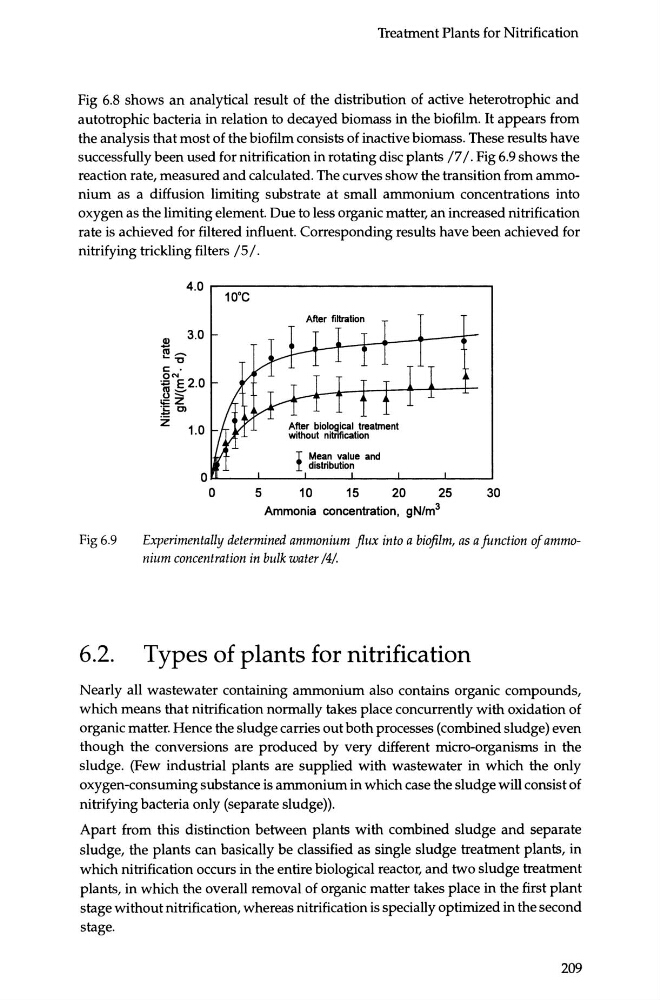
successfully been used for nitrification in rotating disc plants 17 I. Fig 6.9 shows the
reaction rate, measured and calculated. The curves show the transition from ammonium as a diffusion limiting substrate at small ammonium concentrations into
oxygen as the limiting element. Due to less organic matter, an increased nitrification
rate is achieved for filtered influent. Corresponding results have been achieved for
nitrifying trickling filters I 5 I.
Fig6.9
6.2.
4.0 . - - - - - - - - - - - - - - - - - - . ,
.!! 3.0
~=6'
c .
ON
'B~2.o
:g~
z 1.0
10"C
After filtration
I Mean value and
I distribution
o~--L--~-~--~--~-~
0
5
10
15
20
25
30
Ammonia concentration, gN/m 3
Experimentally determined ammonium flux into a biofilm, as a function of ammonium concentration in bulk water /4/.
Types of plants for nitrification
Nearly all wastewater containing ammonium also contains organic compounds,
which means that nitrification normally takes place concurrently with oxidation of
organic matter. Hence the sludge carries out both processes (combined sludge) even
though the conversions are produced by very different micro-organisms in the
sludge. (Few industrial plants are supplied with wastewater in which the only
oxygen-consuming substance is ammonium in which case the sludge will consist of
nitrifying bacteria only (separate sludge)).
Apart from this distinction between plants with combined sludge and separate
sludge, the plants can basically be classified as single sludge treatment plants, in
which nitrification occurs in the entire biological reactor, and two sludge treatment
plants, in which the overall removal of organic matter takes place in the first plant
stage without nitrification, whereas nitrification is specially optimized in the second
stage.
209
Fig 6.8 shows an analytical result of the distribution of active heterotrophic and
autotrophic bacteria in relation to decayed biomass in the biofilm. It appears from
the analysis that most of the biofilm consists of inactive biomass. These results have
successfully been used for nitrification in rotating disc plants 17 I. Fig 6.9 shows the
reaction rate, measured and calculated. The curves show the transition from ammonium as a diffusion limiting substrate at small ammonium concentrations into
oxygen as the limiting element. Due to less organic matter, an increased nitrification
rate is achieved for filtered influent. Corresponding results have been achieved for
nitrifying trickling filters I 5 I.
Fig6.9
6.2.
4.0 . - - - - - - - - - - - - - - - - - - . ,
.!! 3.0
~=6'
c .
ON
'B~2.o
:g~
z 1.0
10"C
After filtration
I Mean value and
I distribution
o~--L--~-~--~--~-~
0
5
10
15
20
25
30
Ammonia concentration, gN/m 3
Experimentally determined ammonium flux into a biofilm, as a function of ammonium concentration in bulk water /4/.
Types of plants for nitrification
Nearly all wastewater containing ammonium also contains organic compounds,
which means that nitrification normally takes place concurrently with oxidation of
organic matter. Hence the sludge carries out both processes (combined sludge) even
though the conversions are produced by very different micro-organisms in the
sludge. (Few industrial plants are supplied with wastewater in which the only
oxygen-consuming substance is ammonium in which case the sludge will consist of
nitrifying bacteria only (separate sludge)).
Apart from this distinction between plants with combined sludge and separate
sludge, the plants can basically be classified as single sludge treatment plants, in
which nitrification occurs in the entire biological reactor, and two sludge treatment
plants, in which the overall removal of organic matter takes place in the first plant
stage without nitrification, whereas nitrification is specially optimized in the second
stage.
209