

Treatment Plants for Nitrification
Component-->
5NH4
SNOJ
502
Xa,A
Xs,N
SALK
Reaction rate r v, ..
Process J.
!.Aerobic
1
1
growth,
1
4.57- Ym•"-"
-7Y-.A J.l.,...•
SNH4
So:z
. X.,.
nitrifying
v~ .... Ym:~x.A
-
1
fxs.N
_!m:!_
Ymax.A
5r.R + J
- fxB.N
14
2. Decay,
nitrifying
-1
-fxB.N
b·· x. ...
bacteria
3. Hydrolysis of
1
-1
ia..A· XNo
organic
matter
Unit
kgN /m 3
kgCOD/m 3
kgN/m 3 eqv/m'
.I
}
·e
~
§
0
.D
"'
bD
..
~
"2
i
l
-g
·e
~
.!!!
..
!::1
~
"'
~
,.,
~
~
)(
"
<
0
"'
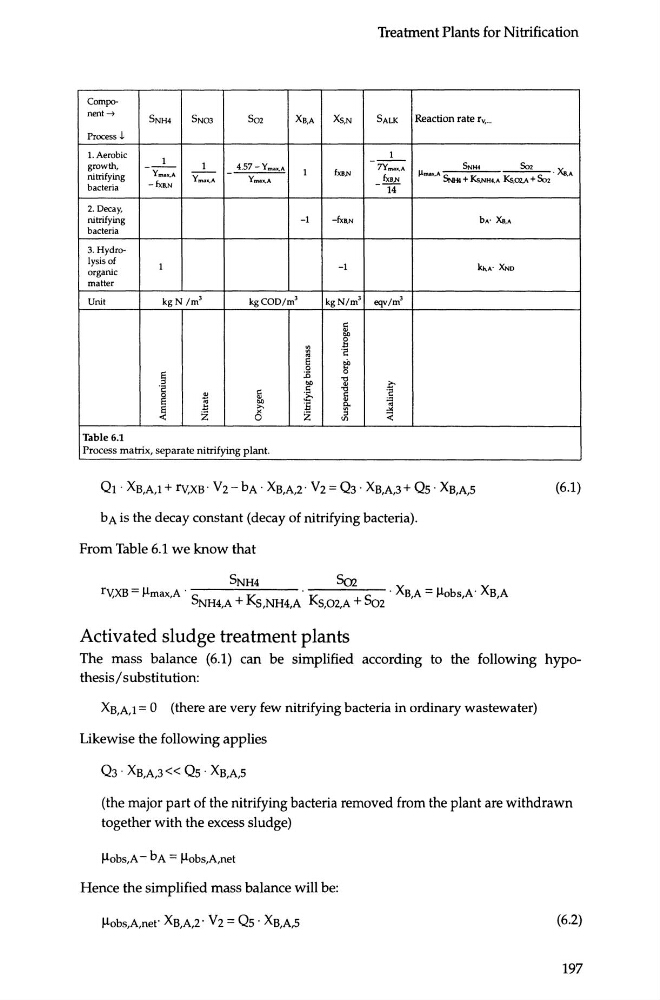
Table6.1
Process matrix, separate nitrifying plant.
Q1 · Xs,A,l + rv,xs · V 2- b A · Xs,A,2 · V 2 = Q3 · Xs,A,3 + Qs · Xs,A,s
(6.1)
b A is the decay constant (decay of nitrifying bacteria).
From Table 6.1 we know that
SNH4
Soz
rv,xB = Jlmax,A. s
+ I
+So . Xs,A = Jlobs,A" Xs,A
NH4,A
,NH4,A S,02,A
2
Activated sludge treatment plants
The mass balance (6.1) can be simplified according to the following hypothesis/ substitution:
Xs,A,l = 0 (there are very few nitrifying bacteria in ordinary wastewater)
Likewise the following applies
Q3 · Xs,A,3 « Qs · Xs,A,S
(the major part of the nitrifying bacteria removed from the plant are withdrawn
together with the excess sludge)
Jl.obs,A- b A = Jl.obs,A,net
Hence the simplified mass balance will be:
Jlobs,A,ner Xs,A,2 · V 2 = Qs · Xs,A,S
(6.2)
197
Component-->
5NH4
SNOJ
502
Xa,A
Xs,N
SALK
Reaction rate r v, ..
Process J.
!.Aerobic
1
1
growth,
1
4.57- Ym•"-"
-7Y-.A J.l.,...•
SNH4
So:z
. X.,.
nitrifying
v~ .... Ym:~x.A
-
1
fxs.N
_!m:!_
Ymax.A
5r.R + J
- fxB.N
14
2. Decay,
nitrifying
-1
-fxB.N
b·· x. ...
bacteria
3. Hydrolysis of
1
-1
ia..A· XNo
organic
matter
Unit
kgN /m 3
kgCOD/m 3
kgN/m 3 eqv/m'
.I
}
·e
~
§
0
.D
"'
bD
..
~
"2
i
l
-g
·e
~
.!!!
..
!::1
~
"'
~
,.,
~
~
)(
"
<
0
"'
Table6.1
Process matrix, separate nitrifying plant.
Q1 · Xs,A,l + rv,xs · V 2- b A · Xs,A,2 · V 2 = Q3 · Xs,A,3 + Qs · Xs,A,s
(6.1)
b A is the decay constant (decay of nitrifying bacteria).
From Table 6.1 we know that
SNH4
Soz
rv,xB = Jlmax,A. s
+ I
+So . Xs,A = Jlobs,A" Xs,A
NH4,A
,NH4,A S,02,A
2
Activated sludge treatment plants
The mass balance (6.1) can be simplified according to the following hypothesis/ substitution:
Xs,A,l = 0 (there are very few nitrifying bacteria in ordinary wastewater)
Likewise the following applies
Q3 · Xs,A,3 « Qs · Xs,A,S
(the major part of the nitrifying bacteria removed from the plant are withdrawn
together with the excess sludge)
Jl.obs,A- b A = Jl.obs,A,net
Hence the simplified mass balance will be:
Jlobs,A,ner Xs,A,2 · V 2 = Qs · Xs,A,S
(6.2)
197