

Mass balances, nitrifying plants
6.1. Mass balances, nitrifying plants
The nitrification process in biological treatment plants occurs either concurrently
with a conversion of organic matter or as a separate process. In both cases the same
micro-organisms are responsible for the oxidation of ammonium into nitrate. Hence
the two processes have much in common.
6.1.1 Separate nitrifying plants
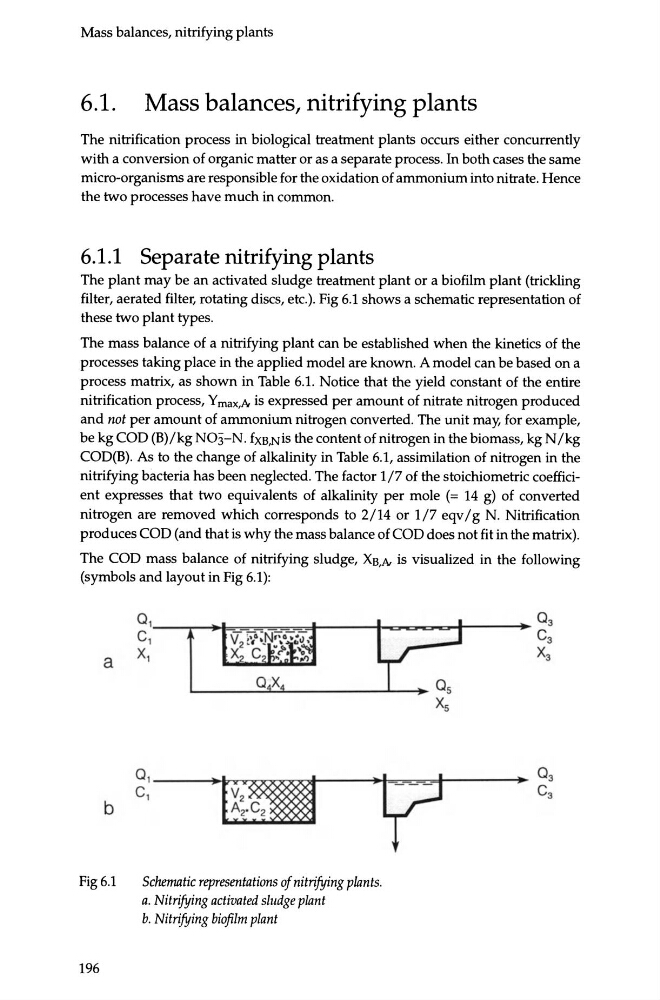
The plant may be an activated sludge treatment plant or a biofilm plant (trickling
filter, aerated filter, rotating discs, etc.). Fig 6.1 shows a schematic representation of
these two plant types.
The mass balance of a nitrifying plant can be established when the kinetics of the
processes taking place in the applied model are known. A model can be based on a
process matrix, as shown in Table 6.1. Notice that the yield constant of the entire
nitrification process, Y max,Ar is expressed per amount of nitrate nitrogen produced
and not per amount of ammonium nitrogen converted. The unit may, for example,
be kg COD (B)/kg N03-N. fxs,Nis the content of nitrogen in the biomass, kg N/kg
COD(B). As to the change of alkalinity in Table 6.1, assimilation of nitrogen in the
nitrifying bacteria has been neglected. The factor 1/7 of the stoichiometric coefficient expresses that two equivalents of alkalinity per mole (= 14 g) of converted
nitrogen are removed which corresponds to 2/14 or 1/7 eqv/g N. Nitrification
produces COD (and that is why the mass balance of COD does not fit in the matrix).
The COD mass balance of nitrifying sludge, Xs,Ar is visualized in the following
(symbols and layout in Fig 6.1):
a
b
Fig 6.1
Schematic representations of nitrifying plants.
a. Nitrifying activated sludge plant
b. Nitrifying biofilm plant
196
6.1. Mass balances, nitrifying plants
The nitrification process in biological treatment plants occurs either concurrently
with a conversion of organic matter or as a separate process. In both cases the same
micro-organisms are responsible for the oxidation of ammonium into nitrate. Hence
the two processes have much in common.
6.1.1 Separate nitrifying plants
The plant may be an activated sludge treatment plant or a biofilm plant (trickling
filter, aerated filter, rotating discs, etc.). Fig 6.1 shows a schematic representation of
these two plant types.
The mass balance of a nitrifying plant can be established when the kinetics of the
processes taking place in the applied model are known. A model can be based on a
process matrix, as shown in Table 6.1. Notice that the yield constant of the entire
nitrification process, Y max,Ar is expressed per amount of nitrate nitrogen produced
and not per amount of ammonium nitrogen converted. The unit may, for example,
be kg COD (B)/kg N03-N. fxs,Nis the content of nitrogen in the biomass, kg N/kg
COD(B). As to the change of alkalinity in Table 6.1, assimilation of nitrogen in the
nitrifying bacteria has been neglected. The factor 1/7 of the stoichiometric coefficient expresses that two equivalents of alkalinity per mole (= 14 g) of converted
nitrogen are removed which corresponds to 2/14 or 1/7 eqv/g N. Nitrification
produces COD (and that is why the mass balance of COD does not fit in the matrix).
The COD mass balance of nitrifying sludge, Xs,Ar is visualized in the following
(symbols and layout in Fig 6.1):
a
b
Fig 6.1
Schematic representations of nitrifying plants.
a. Nitrifying activated sludge plant
b. Nitrifying biofilm plant
196