

Types of plants
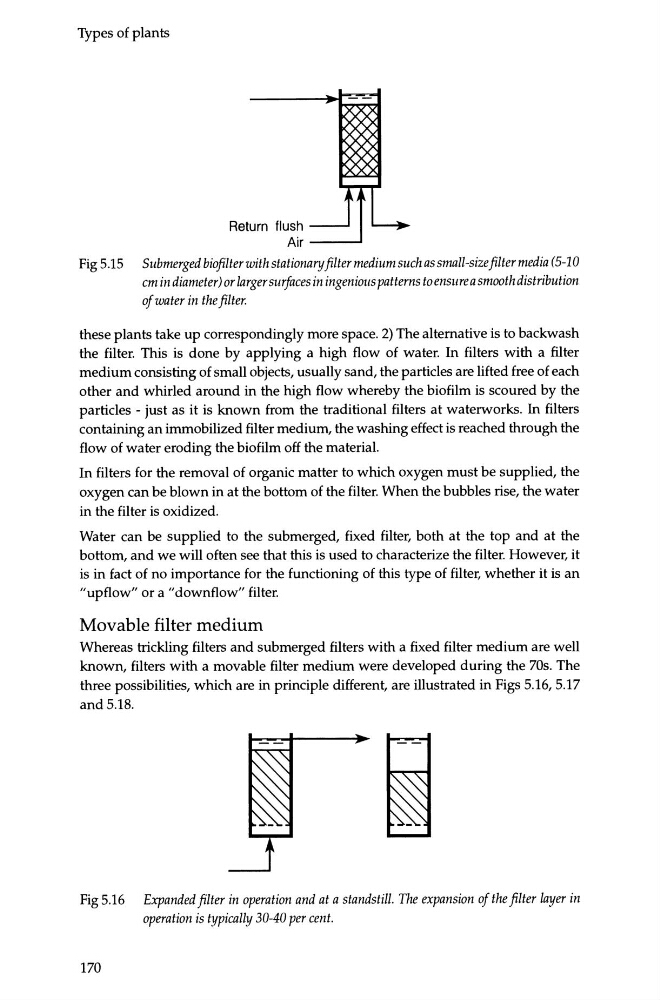
Return flush
Air-----'
Fig 5.15 Submerged biofilter with stationary filter medium such as small-size filter media (5-1 0
em in diameter) or larger surfaces in ingenious patterns to ensure a smooth distribution
of water in the filter.
these plants take up correspondingly more space. 2) The alternative is to backwash
the filter. This is done by applying a high flow of water. In filters with a filter
medium consisting of small objects, usually sand, the particles are lifted free of each
other and whirled around in the high flow whereby the biofilm is scoured by the
particles - just as it is known from the traditional filters at waterworks. In filters
containing an immobilized filter medium, the washing effect is reached through the
flow of water eroding the biofilm off the material.
In filters for the removal of organic matter to which oxygen must be supplied, the
oxygen can be blown in at the bottom of the filter. When the bubbles rise, the water
in the filter is oxidized.
Water can be supplied to the submerged, fixed filter, both at the top and at the
bottom, and we will often see that this is used to characterize the filter. However, it
is in fact of no importance for the functioning of this type of filter, whether it is an
"upflow" or a "downflow" filter.
Movable filter medium
Whereas trickling filters and submerged filters with a fixed filter medium are well
known, filters with a movable filter medium were developed during the 70s. The
three possibilities, which are in principle different, are illustrated in Figs 5.16, 5.17
and5.18.
Fig 5.16 Expanded filter in operation and at a standstill. The expansion of the filter layer in
operation is typically 30-40 per cent.
170
Return flush
Air-----'
Fig 5.15 Submerged biofilter with stationary filter medium such as small-size filter media (5-1 0
em in diameter) or larger surfaces in ingenious patterns to ensure a smooth distribution
of water in the filter.
these plants take up correspondingly more space. 2) The alternative is to backwash
the filter. This is done by applying a high flow of water. In filters with a filter
medium consisting of small objects, usually sand, the particles are lifted free of each
other and whirled around in the high flow whereby the biofilm is scoured by the
particles - just as it is known from the traditional filters at waterworks. In filters
containing an immobilized filter medium, the washing effect is reached through the
flow of water eroding the biofilm off the material.
In filters for the removal of organic matter to which oxygen must be supplied, the
oxygen can be blown in at the bottom of the filter. When the bubbles rise, the water
in the filter is oxidized.
Water can be supplied to the submerged, fixed filter, both at the top and at the
bottom, and we will often see that this is used to characterize the filter. However, it
is in fact of no importance for the functioning of this type of filter, whether it is an
"upflow" or a "downflow" filter.
Movable filter medium
Whereas trickling filters and submerged filters with a fixed filter medium are well
known, filters with a movable filter medium were developed during the 70s. The
three possibilities, which are in principle different, are illustrated in Figs 5.16, 5.17
and5.18.
Fig 5.16 Expanded filter in operation and at a standstill. The expansion of the filter layer in
operation is typically 30-40 per cent.
170