

Activated Sludge Treatment Plants
Symbol
Unit
Quantity
Treatment efficiency for
E
%
80-95
BOD, COD and SS
Recycle ratio
R
%
50-100
Sludge index
SVI
ml/g
50-150
Oxygen respiration, 20° C
rx,m
g~/(kgVSS h)
5-40
(activated sludge)
Sludge percentage
-
%
50-80
.
Temperature, min.
T
oc
6-10
wastewater and activated
sludge
Temperature, max.
T
oc
18-22
wastewater and activated
sludge
•in periods of melting snow the min. temperature may be 1-2°C
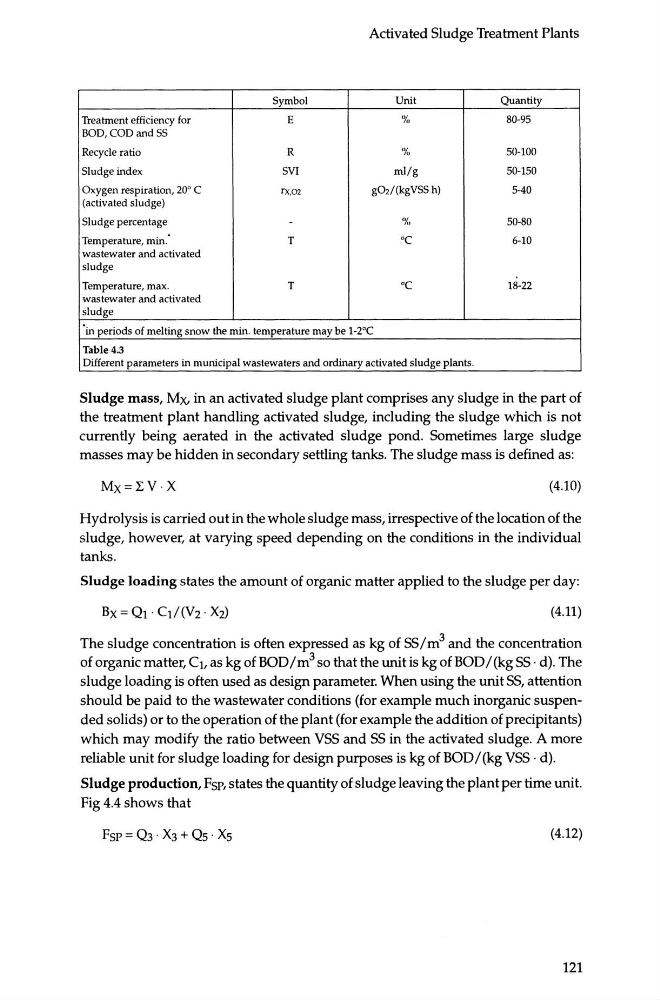
Table4.3
Different parameters in municipal wastewaters and ordinary activated sludge plants.
Sludge mass, Mx, in an activated sludge plant comprises any sludge in the part of
the treatment plant handling activated sludge, including the sludge which is not
currently being aerated in the activated sludge pond. Sometimes large sludge
masses may be hidden in secondary settling tanks. The sludge mass is defined as:
Mx=~V ·X
(4.10)
Hydrolysis is carried out in the whole sludge mass, irrespective of the location of the
sludge, however, at varying speed depending on the conditions in the individual
tanks.
Sludge loading states the amount of organic matter applied to the sludge per day:
(4.11)
The sludge concentration is often expressed as kg of SS/m 3 and the concentration
of organic matter, C1, as kg ofBOD/m 3 so that the unit is kg ofBOD/(kg SS ·d). The
sludge loading is often used as design parameter. When using the unit SS, attention
should be paid to the wastewater conditions (for example much inorganic suspended solids) or to the operation of the plant (for example the addition of precipitants)
which may modify the ratio between VSS and SS in the activated sludge. A more
reliable unit for sludge loading for design purposes is kg of BOD I (kg VSS · d).
Sludge production, Fsp, states the quantity of sludge leaving the plant per time unit.
Fig 4.4 shows that
Fsp = Q3 · X3 + Qs · Xs
(4.12)
121
Symbol
Unit
Quantity
Treatment efficiency for
E
%
80-95
BOD, COD and SS
Recycle ratio
R
%
50-100
Sludge index
SVI
ml/g
50-150
Oxygen respiration, 20° C
rx,m
g~/(kgVSS h)
5-40
(activated sludge)
Sludge percentage
-
%
50-80
.
Temperature, min.
T
oc
6-10
wastewater and activated
sludge
Temperature, max.
T
oc
18-22
wastewater and activated
sludge
•in periods of melting snow the min. temperature may be 1-2°C
Table4.3
Different parameters in municipal wastewaters and ordinary activated sludge plants.
Sludge mass, Mx, in an activated sludge plant comprises any sludge in the part of
the treatment plant handling activated sludge, including the sludge which is not
currently being aerated in the activated sludge pond. Sometimes large sludge
masses may be hidden in secondary settling tanks. The sludge mass is defined as:
Mx=~V ·X
(4.10)
Hydrolysis is carried out in the whole sludge mass, irrespective of the location of the
sludge, however, at varying speed depending on the conditions in the individual
tanks.
Sludge loading states the amount of organic matter applied to the sludge per day:
(4.11)
The sludge concentration is often expressed as kg of SS/m 3 and the concentration
of organic matter, C1, as kg ofBOD/m 3 so that the unit is kg ofBOD/(kg SS ·d). The
sludge loading is often used as design parameter. When using the unit SS, attention
should be paid to the wastewater conditions (for example much inorganic suspended solids) or to the operation of the plant (for example the addition of precipitants)
which may modify the ratio between VSS and SS in the activated sludge. A more
reliable unit for sludge loading for design purposes is kg of BOD I (kg VSS · d).
Sludge production, Fsp, states the quantity of sludge leaving the plant per time unit.
Fig 4.4 shows that
Fsp = Q3 · X3 + Qs · Xs
(4.12)
121