

Concepts and definitions of the activated sludge process
4.2. Concepts and definitions of the
activated sludge process
Several concepts and definitions are related to activated sludge plants. Some of the
concepts and definitions are not very applicable and logical, but it is useful to know
what they mean when others use them. Some of the concepts are briefly explained
below.
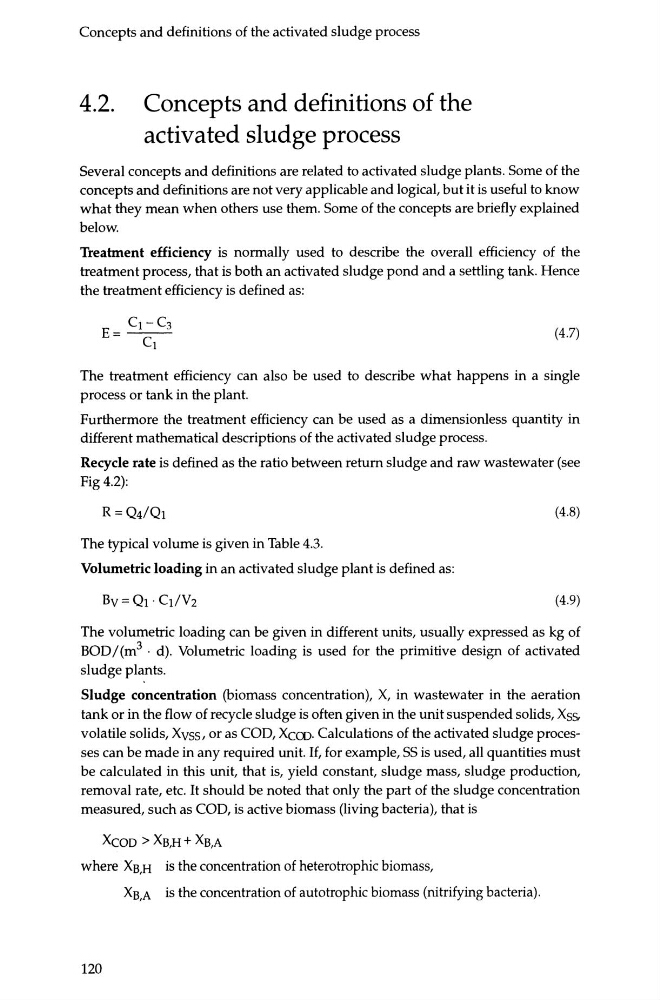
Treatment efficiency is normally used to describe the overall efficiency of the
treatment process, that is both an activated sludge pond and a settling tank. Hence
the treatment efficiency is defined as:
(4.7)
The treatment efficiency can also be used to describe what happens in a single
process or tank in the plant.
Furthermore the treatment efficiency can be used as a dimensionless quantity in
different mathematical descriptions of the activated sludge process.
Recycle rate is defined as the ratio between return sludge and raw wastewater (see
Fig4.2):
(4.8)
The typical volume is given in Table 4.3.
Volumetric loading in an activated sludge plant is defined as:
(4.9)
The volumetric loading can be given in different units, usually expressed as kg of
BOD/{m 3 · d). Volumetric loading is used for the primitive design of activated
sludge plants.
Sludge concentration (biomass concentration), X, in wastewater in the aeration
tank or in the flow of recycle sludge is often given in the unit suspended solids, Xss,.
volatile solids, Xvss, or as COD, Xcoo. Calculations of the activated sludge processes can be made in any required unit. If, for example, SS is used, all quantities must
be calculated in this unit, that is, yield constant, sludge mass, sludge production,
removal rate, etc. It should be noted that only the part of the sludge concentration
measured, such as COD, is active biomass (living bacteria), that is
Xcoo > Xa,H + Xa,A
where Xa,H is the concentration of heterotrophic biomass,
Xa,A is the concentration of autotrophic biomass (nitrifying bacteria).
120
4.2. Concepts and definitions of the
activated sludge process
Several concepts and definitions are related to activated sludge plants. Some of the
concepts and definitions are not very applicable and logical, but it is useful to know
what they mean when others use them. Some of the concepts are briefly explained
below.
Treatment efficiency is normally used to describe the overall efficiency of the
treatment process, that is both an activated sludge pond and a settling tank. Hence
the treatment efficiency is defined as:
(4.7)
The treatment efficiency can also be used to describe what happens in a single
process or tank in the plant.
Furthermore the treatment efficiency can be used as a dimensionless quantity in
different mathematical descriptions of the activated sludge process.
Recycle rate is defined as the ratio between return sludge and raw wastewater (see
Fig4.2):
(4.8)
The typical volume is given in Table 4.3.
Volumetric loading in an activated sludge plant is defined as:
(4.9)
The volumetric loading can be given in different units, usually expressed as kg of
BOD/{m 3 · d). Volumetric loading is used for the primitive design of activated
sludge plants.
Sludge concentration (biomass concentration), X, in wastewater in the aeration
tank or in the flow of recycle sludge is often given in the unit suspended solids, Xss,.
volatile solids, Xvss, or as COD, Xcoo. Calculations of the activated sludge processes can be made in any required unit. If, for example, SS is used, all quantities must
be calculated in this unit, that is, yield constant, sludge mass, sludge production,
removal rate, etc. It should be noted that only the part of the sludge concentration
measured, such as COD, is active biomass (living bacteria), that is
Xcoo > Xa,H + Xa,A
where Xa,H is the concentration of heterotrophic biomass,
Xa,A is the concentration of autotrophic biomass (nitrifying bacteria).
120