

Basic Biological Processes
3.7.7 The influence of the environmental factors,
anaerobic processes
Temperature
The temperature dependency of the anaerobic processes corresponds to what is
known from the aerobic processes, hence Expression (3.16) can be used. The generally slow reaction rate for anaerobic processes calls for a very long hydraulic
retention time and a very long sludge retention time. In many cases, this makes it
economically profitable to allow the processes to occur at high temperatures as large
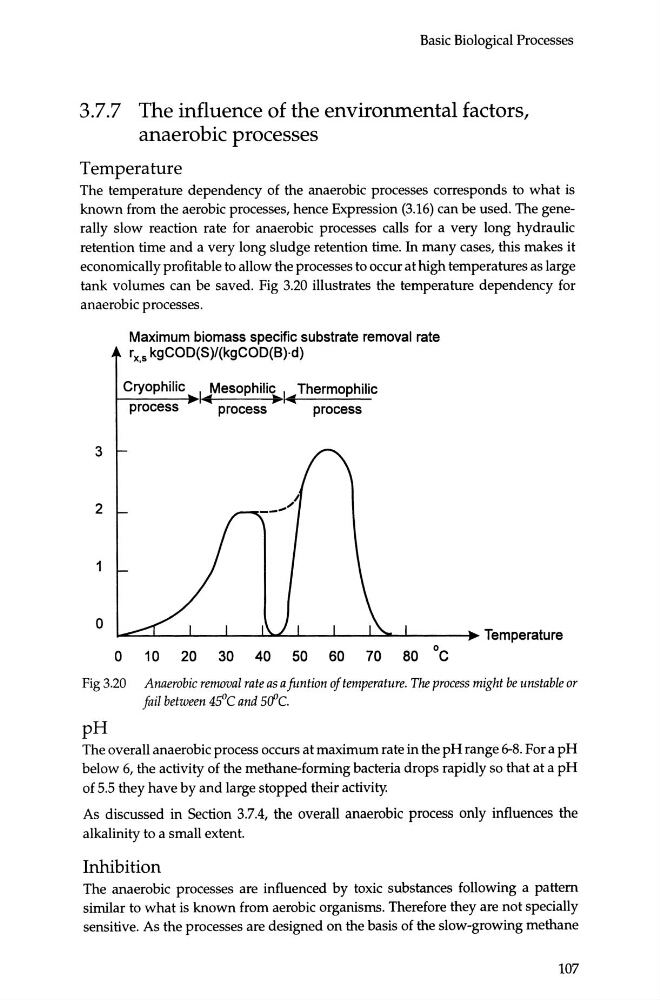
tank volumes can be saved. Fig 3.20 illustrates the temperature dependency for
anaerobic processes.
3
2
0
Maximum biomass specific substrate removal rate
rx,s kgCOD(S)/(kgCOD(B)·d)
Cryophilic 1 Mesophilic 1 Thermophilic
.....
... .....
process
process
process
0 10 20 30 40 50 60 70 80 °C
Fig 3.20 Anaerobic removal rate as a funtion of temperature. The process might be unstable or
fail between 45°C and SrfC.
pH
The overall anaerobic process occurs at maximum rate in the pH range 6-8. For a pH
below 6, the activity of the methane-forming bacteria drops rapidly so that at a pH
of 5.5 they have by and large stopped their activity.
As discussed in Section 3.7.4, the overall anaerobic process only influences the
alkalinity to a small extent.
Inhibition
The anaerobic processes are influenced by toxic substances following a pattern
similar to what is known from aerobic organisms. Therefore they are not specially
sensitive. As the processes are designed on the basis of the slow-growing methane
107
3.7.7 The influence of the environmental factors,
anaerobic processes
Temperature
The temperature dependency of the anaerobic processes corresponds to what is
known from the aerobic processes, hence Expression (3.16) can be used. The generally slow reaction rate for anaerobic processes calls for a very long hydraulic
retention time and a very long sludge retention time. In many cases, this makes it
economically profitable to allow the processes to occur at high temperatures as large
tank volumes can be saved. Fig 3.20 illustrates the temperature dependency for
anaerobic processes.
3
2
0
Maximum biomass specific substrate removal rate
rx,s kgCOD(S)/(kgCOD(B)·d)
Cryophilic 1 Mesophilic 1 Thermophilic
.....
... .....
process
process
process
0 10 20 30 40 50 60 70 80 °C
Fig 3.20 Anaerobic removal rate as a funtion of temperature. The process might be unstable or
fail between 45°C and SrfC.
pH
The overall anaerobic process occurs at maximum rate in the pH range 6-8. For a pH
below 6, the activity of the methane-forming bacteria drops rapidly so that at a pH
of 5.5 they have by and large stopped their activity.
As discussed in Section 3.7.4, the overall anaerobic process only influences the
alkalinity to a small extent.
Inhibition
The anaerobic processes are influenced by toxic substances following a pattern
similar to what is known from aerobic organisms. Therefore they are not specially
sensitive. As the processes are designed on the basis of the slow-growing methane
107