

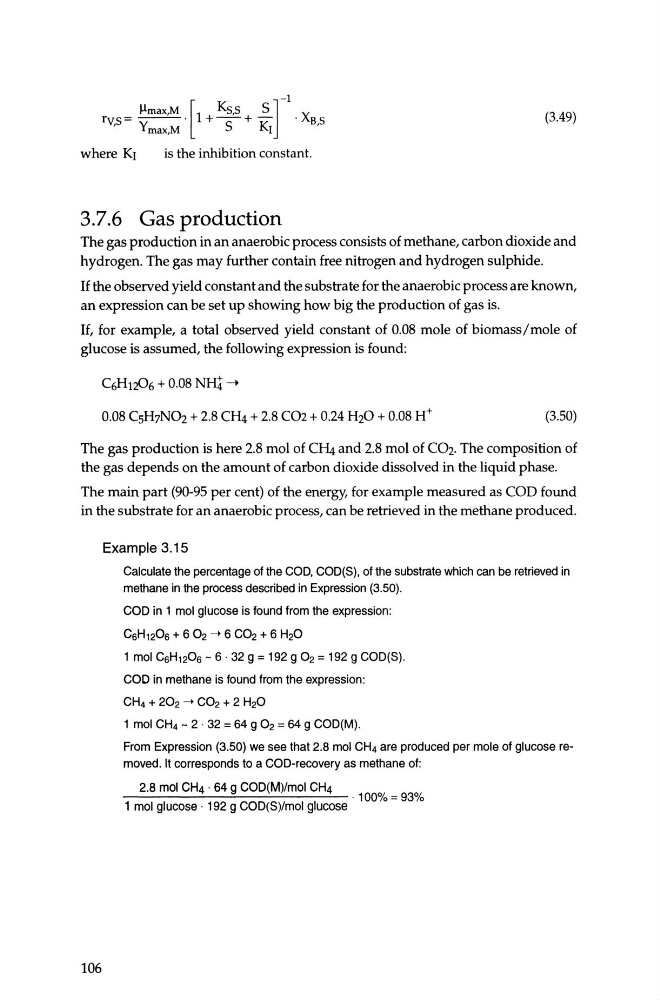
-1
llmax,M [ 1 Ks,s
S ]
X
rv,s= - - - · +--+- · B,s
Ymax,M
S
Ky
(3.49)
where K1
is the inhibition constant.
3.7.6 Gas production
The gas production in an anaerobic process consists of methane, carbon dioxide and
hydrogen. The gas may further contain free nitrogen and hydrogen sulphide.
If the observed yield constant and the substrate for the anaerobic process are known,
an expression can be set up showing how big the production of gas is.
If, for example, a total observed yield constant of 0.08 mole of biomass/mole of
glucose is assumed, the following expression is found:
C~t:P6 + 0.08 NJ-I!--+
0.08 CsH7NOz + 2.8 CH4 + 2.8 C02 + 0.24 H20 + 0.08 H+
(3.50)
The gas production is here 2.8 mol of C~ and 2.8 mol of C02. The composition of
the gas depends on the amount of carbon dioxide dissolved in the liquid phase.
The main part (90-95 per cent) of the energy, for example measured as COD found
in the substrate for an anaerobic process, can be retrieved in the methane produced.
106
Example 3.15
Calculate the percentage of the COD, COD(S), of the substrate which can be retrieved in
methane in the process described in Expression (3.50).
COD in 1 mol glucose is found from the expression:
CsH120s + 6 02 -> 6 C02 + 6 H20
1 mol C6H120 6 - 6 · 32 g = 192 g 0 2 = 192 g COD(S).
COD in methane is found from the expression:
CH4 + 202 -> C02 + 2 H20
1 mol CH4 - 2 · 32 = 64 g 0 2 = 64 g COD(M).
From Expression (3.50) we see that 2.8 mol CH4 are produced per mole of glucose removed. It corresponds to a COD-recovery as methane of:
2.8 mol CH4 · 64 g COD(M)/mol CH4
_ _ _ _ ___;,_....:. _ ___;,_:__--:-....:...- . 100% = 93%
1 mol glucose · 192 g COD(S)/mol glucose
llmax,M [ 1 Ks,s
S ]
X
rv,s= - - - · +--+- · B,s
Ymax,M
S
Ky
(3.49)
where K1
is the inhibition constant.
3.7.6 Gas production
The gas production in an anaerobic process consists of methane, carbon dioxide and
hydrogen. The gas may further contain free nitrogen and hydrogen sulphide.
If the observed yield constant and the substrate for the anaerobic process are known,
an expression can be set up showing how big the production of gas is.
If, for example, a total observed yield constant of 0.08 mole of biomass/mole of
glucose is assumed, the following expression is found:
C~t:P6 + 0.08 NJ-I!--+
0.08 CsH7NOz + 2.8 CH4 + 2.8 C02 + 0.24 H20 + 0.08 H+
(3.50)
The gas production is here 2.8 mol of C~ and 2.8 mol of C02. The composition of
the gas depends on the amount of carbon dioxide dissolved in the liquid phase.
The main part (90-95 per cent) of the energy, for example measured as COD found
in the substrate for an anaerobic process, can be retrieved in the methane produced.
106
Example 3.15
Calculate the percentage of the COD, COD(S), of the substrate which can be retrieved in
methane in the process described in Expression (3.50).
COD in 1 mol glucose is found from the expression:
CsH120s + 6 02 -> 6 C02 + 6 H20
1 mol C6H120 6 - 6 · 32 g = 192 g 0 2 = 192 g COD(S).
COD in methane is found from the expression:
CH4 + 202 -> C02 + 2 H20
1 mol CH4 - 2 · 32 = 64 g 0 2 = 64 g COD(M).
From Expression (3.50) we see that 2.8 mol CH4 are produced per mole of glucose removed. It corresponds to a COD-recovery as methane of:
2.8 mol CH4 · 64 g COD(M)/mol CH4
_ _ _ _ ___;,_....:. _ ___;,_:__--:-....:...- . 100% = 93%
1 mol glucose · 192 g COD(S)/mol glucose