

Basic Biological Processes
CH3COOH + 0.012 NH! + 0.012 OW__.
0.012 CsH7N02 + 0.97 CH4 + 0.97 C02 + 0.048 H20
(3.46)
The total maximum yield constant for an anaerobic process is 0.25-0.35 kg
COD(B)/kg COD(S). Note that by calculating in COD-units, the yield constants of
the two steps can be added directly.
In practice, the total observed yield constant will be low due to the low load under
which the anaerobic processes operate. It will frequently be 0.05-0.10 kg COD(B)/kg
COD(S).
3.7.3 Nutrients, anaerobic processes
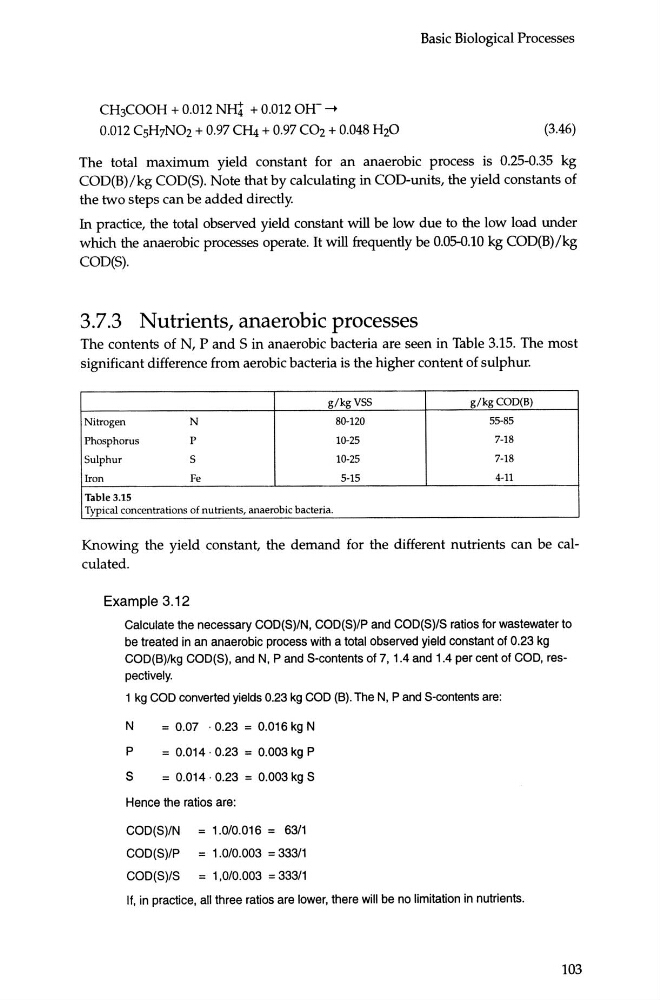
The contents of N, P and S in anaerobic bacteria are seen in Table 3.15. The most
significant difference from aerobic bacteria is the higher content of sulphur.
g/kgVSS
g/kgCOD(B)
Nitrogen
N
80-120
55-85
Phosphorus
p
10-25
7-18
Sulphur
s
10-25
7-18
Iron
Fe
5-15
4-11
Table 3.15
Typical concentrations of nutrients, anaerobic bacteria.
Knowing the yield constant, the demand for the different nutrients can be calculated.
Example 3.12
Calculate the necessary COD(S)/N, COD(S)/P and COD(S)/S ratios for wastewater to
be treated in an anaerobic process with a total observed yield constant of 0.23 kg
COD( B)/kg COD(S), and N, P and S-contents of 7, 1.4 and 1.4 per cent of COD, respectively.
1 kg COD converted yields 0.23 kg COD (B). The N, P and S-contents are:
N
= 0.07 · 0.23 = 0.016 kg N
p
= 0.014. 0.23 = 0.003 kg p
s
= 0.014. 0.23 = 0.003 kg s
Hence the ratios are:
COD(S)/N
= 1.0/0.016 = 63/1
COD(S)/P
= 1.0/0.003 = 333/1
COD(S)/S
= 1,0/0.003 = 333/1
If, in practice, all three ratios are lower, there will be no limitation in nutrients.
103
CH3COOH + 0.012 NH! + 0.012 OW__.
0.012 CsH7N02 + 0.97 CH4 + 0.97 C02 + 0.048 H20
(3.46)
The total maximum yield constant for an anaerobic process is 0.25-0.35 kg
COD(B)/kg COD(S). Note that by calculating in COD-units, the yield constants of
the two steps can be added directly.
In practice, the total observed yield constant will be low due to the low load under
which the anaerobic processes operate. It will frequently be 0.05-0.10 kg COD(B)/kg
COD(S).
3.7.3 Nutrients, anaerobic processes
The contents of N, P and S in anaerobic bacteria are seen in Table 3.15. The most
significant difference from aerobic bacteria is the higher content of sulphur.
g/kgVSS
g/kgCOD(B)
Nitrogen
N
80-120
55-85
Phosphorus
p
10-25
7-18
Sulphur
s
10-25
7-18
Iron
Fe
5-15
4-11
Table 3.15
Typical concentrations of nutrients, anaerobic bacteria.
Knowing the yield constant, the demand for the different nutrients can be calculated.
Example 3.12
Calculate the necessary COD(S)/N, COD(S)/P and COD(S)/S ratios for wastewater to
be treated in an anaerobic process with a total observed yield constant of 0.23 kg
COD( B)/kg COD(S), and N, P and S-contents of 7, 1.4 and 1.4 per cent of COD, respectively.
1 kg COD converted yields 0.23 kg COD (B). The N, P and S-contents are:
N
= 0.07 · 0.23 = 0.016 kg N
p
= 0.014. 0.23 = 0.003 kg p
s
= 0.014. 0.23 = 0.003 kg s
Hence the ratios are:
COD(S)/N
= 1.0/0.016 = 63/1
COD(S)/P
= 1.0/0.003 = 333/1
COD(S)/S
= 1,0/0.003 = 333/1
If, in practice, all three ratios are lower, there will be no limitation in nutrients.
103