

Anaerobic processes
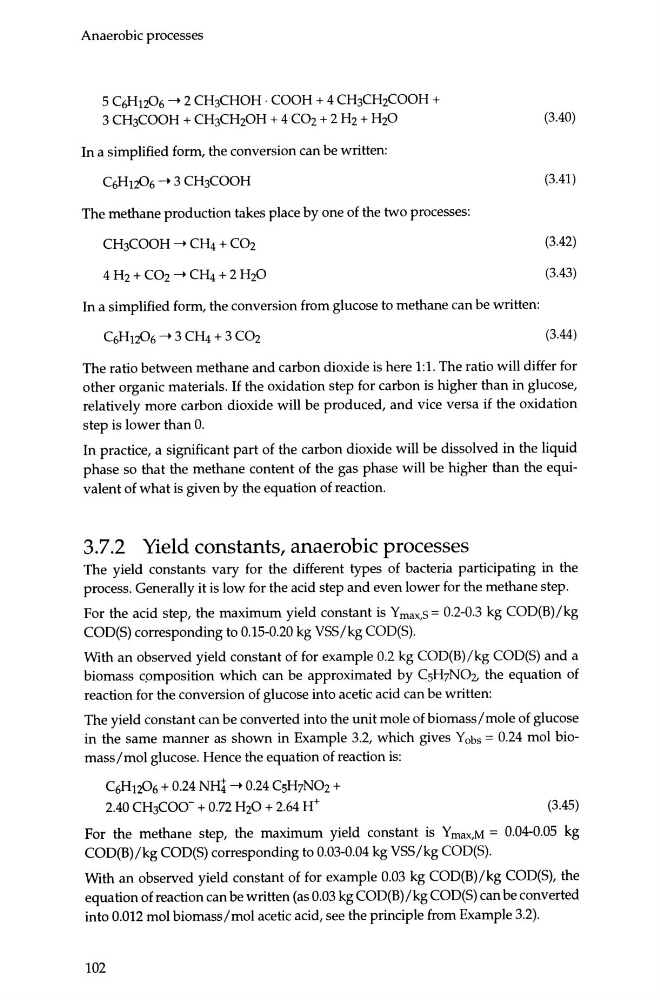
5 C6H1206 ----+ 2 CH3CHOH · COOH + 4 CH3CH2COOH +
3 CH3COOH + CH3CH20H + 4 C02 + 2 H2 + H20
In a simplified form, the conversion can be written:
The methane production takes place by one of the two processes:
4 H2 + C02 ----+ CH4 + 2 H20
In a simplified form, the conversion from glucose to methane can be written:
(3.40)
(3.41)
(3.42)
(3.43)
(3.44)
The ratio between methane and carbon dioxide is here 1:1. The ratio will differ for
other organic materials. If the oxidation step for carbon is higher than in glucose,
relatively more carbon dioxide will be produced, and vice versa if the oxidation
step is lower than 0.
In practice, a significant part of the carbon dioxide will be dissolved in the liquid
phase so that the methane content of the gas phase will be higher than the equivalent of what is given by the equation of reaction.
3.7.2 Yield constants, anaerobic processes
The yield constants vary for the different types of bacteria participating in the
process. Generally it is low for the acid step and even lower for the methane step.
For the acid step, the maximum yield constant is Y max,S = 0.2-0.3 kg COD(B) /kg
COD(S) corresponding to 0.15-0.20 kg VSS/kg COD(S).
With an observed yield constant of for example 0.2 kg COD(B)/kg COD(S) and a
biomass cpmposition which can be approximated by CsH7NOz., the equation of
reaction for the conversion of glucose into acetic acid can be written:
The yield constant can be converted into the unit mole of biomass I mole of glucose
in the same manner as shown in Example 3.2, which gives Yobs = 0.24 mol biomass/mol glucose. Hence the equation of reaction is:
C6H1206 + 0.24 NHt----+ 0.24 CsH7N02 +
2.40 CH 3 Coo- + 0.72 H 2 0 + 2.64 H+
(3.45)
For the methane step, the maximum yield constant is Ymax,M = 0.04-0.05 kg
COD(B)/kg COD(S) corresponding to 0.03-0.04 kg VSS/kg COD(S).
With an observed yield constant of for example O.Q3 kg COD(B)/kg COD(S), the
equation of reaction can be written (as O.Q3 kg COD(B)/kg COD(S) can be converted
into 0.012 mol biomass/mol acetic acid, see the principle from Example 3.2).
102
5 C6H1206 ----+ 2 CH3CHOH · COOH + 4 CH3CH2COOH +
3 CH3COOH + CH3CH20H + 4 C02 + 2 H2 + H20
In a simplified form, the conversion can be written:
The methane production takes place by one of the two processes:
4 H2 + C02 ----+ CH4 + 2 H20
In a simplified form, the conversion from glucose to methane can be written:
(3.40)
(3.41)
(3.42)
(3.43)
(3.44)
The ratio between methane and carbon dioxide is here 1:1. The ratio will differ for
other organic materials. If the oxidation step for carbon is higher than in glucose,
relatively more carbon dioxide will be produced, and vice versa if the oxidation
step is lower than 0.
In practice, a significant part of the carbon dioxide will be dissolved in the liquid
phase so that the methane content of the gas phase will be higher than the equivalent of what is given by the equation of reaction.
3.7.2 Yield constants, anaerobic processes
The yield constants vary for the different types of bacteria participating in the
process. Generally it is low for the acid step and even lower for the methane step.
For the acid step, the maximum yield constant is Y max,S = 0.2-0.3 kg COD(B) /kg
COD(S) corresponding to 0.15-0.20 kg VSS/kg COD(S).
With an observed yield constant of for example 0.2 kg COD(B)/kg COD(S) and a
biomass cpmposition which can be approximated by CsH7NOz., the equation of
reaction for the conversion of glucose into acetic acid can be written:
The yield constant can be converted into the unit mole of biomass I mole of glucose
in the same manner as shown in Example 3.2, which gives Yobs = 0.24 mol biomass/mol glucose. Hence the equation of reaction is:
C6H1206 + 0.24 NHt----+ 0.24 CsH7N02 +
2.40 CH 3 Coo- + 0.72 H 2 0 + 2.64 H+
(3.45)
For the methane step, the maximum yield constant is Ymax,M = 0.04-0.05 kg
COD(B)/kg COD(S) corresponding to 0.03-0.04 kg VSS/kg COD(S).
With an observed yield constant of for example O.Q3 kg COD(B)/kg COD(S), the
equation of reaction can be written (as O.Q3 kg COD(B)/kg COD(S) can be converted
into 0.012 mol biomass/mol acetic acid, see the principle from Example 3.2).
102