

data; they fail to devote adequate time and effort required to quality assure (QA),
quality control (QC), manage, and ultimately utilize those data.
Fortunately, advances in software to acquire, process, model, and publish water
data have resulted in simplified data management, analysis, and information sharing
to enable better decisions for the sustainable management of water resources.
Common components of these software suites include capabilities for time series
and discrete data analysis and management, rating curve development, modeling
and forecasting, and data publishing with real-time alarming and alerting capability
for changing conditions. Modern software systems can be deployed both in the
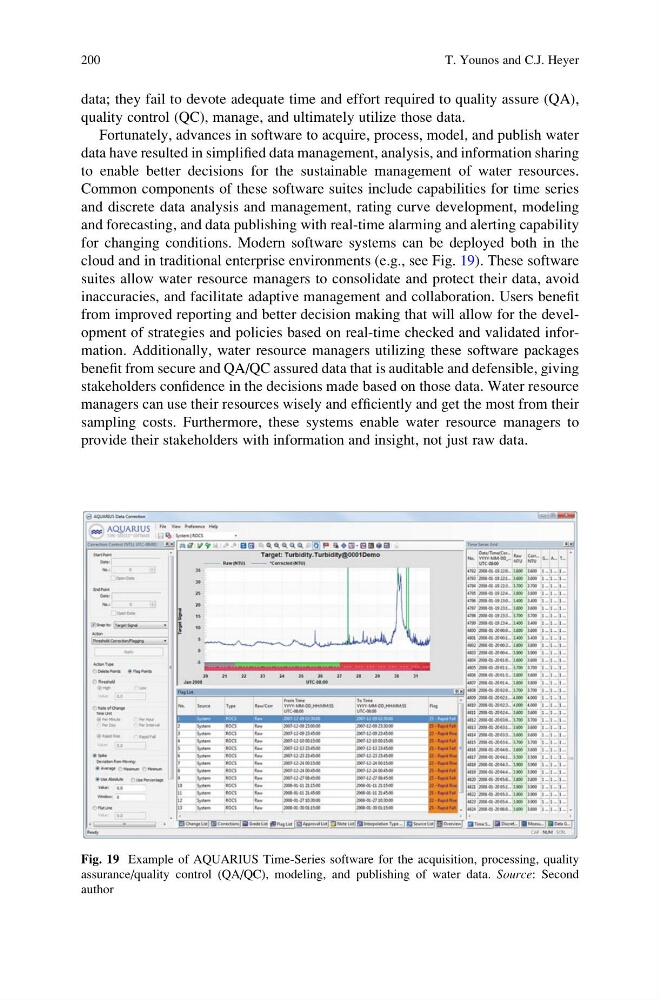
cloud and in traditional enterprise environments (e.g., see Fig. 19). These software
suites allow water resource managers to consolidate and protect their data, avoid
inaccuracies, and facilitate adaptive management and collaboration. Users benefit
from improved reporting and better decision making that will allow for the development of strategies and policies based on real-time checked and validated information. Additionally, water resource managers utilizing these software packages
benefit from secure and QA/QC assured data that is auditable and defensible, giving
stakeholders confidence in the decisions made based on those data. Water resource
managers can use their resources wisely and efficiently and get the most from their
sampling costs. Furthermore, these systems enable water resource managers to
provide their stakeholders with information and insight, not just raw data.
Fig. 19 Example of AQUARIUS Time-Series software for the acquisition, processing, quality
assurance/quality control (QA/QC), modeling, and publishing of water data. Source: Second
author
200
T. Younos and C.J. Heyer
quality control (QC), manage, and ultimately utilize those data.
Fortunately, advances in software to acquire, process, model, and publish water
data have resulted in simplified data management, analysis, and information sharing
to enable better decisions for the sustainable management of water resources.
Common components of these software suites include capabilities for time series
and discrete data analysis and management, rating curve development, modeling
and forecasting, and data publishing with real-time alarming and alerting capability
for changing conditions. Modern software systems can be deployed both in the
cloud and in traditional enterprise environments (e.g., see Fig. 19). These software
suites allow water resource managers to consolidate and protect their data, avoid
inaccuracies, and facilitate adaptive management and collaboration. Users benefit
from improved reporting and better decision making that will allow for the development of strategies and policies based on real-time checked and validated information. Additionally, water resource managers utilizing these software packages
benefit from secure and QA/QC assured data that is auditable and defensible, giving
stakeholders confidence in the decisions made based on those data. Water resource
managers can use their resources wisely and efficiently and get the most from their
sampling costs. Furthermore, these systems enable water resource managers to
provide their stakeholders with information and insight, not just raw data.
Fig. 19 Example of AQUARIUS Time-Series software for the acquisition, processing, quality
assurance/quality control (QA/QC), modeling, and publishing of water data. Source: Second
author
200
T. Younos and C.J. Heyer