

and
b b λ
ð Þ ¼ 0:5b w λ
ð Þ þ b
Ã
b, ph λ
ð ÞC chla þ b
Ã
b, NAP λ
ð ÞC NAP
ð4Þ
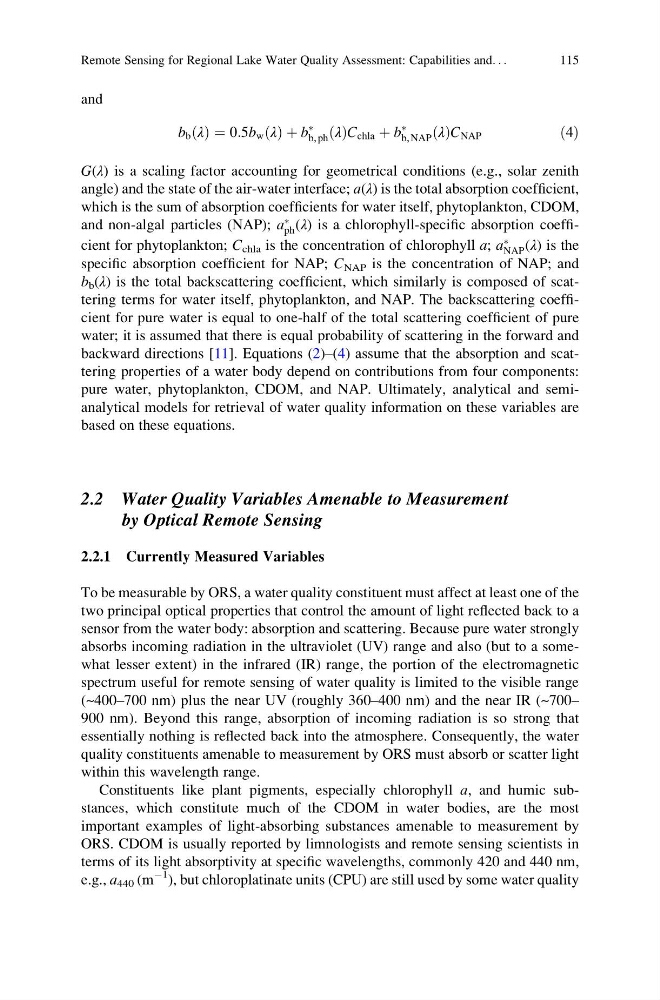
G(λ) is a scaling factor accounting for geometrical conditions (e.g., solar zenith
angle) and the state of the air-water interface; a(λ) is the total absorption coefficient,
which is the sum of absorption coefficients for water itself, phytoplankton, CDOM,
and non-algal particles (NAP); a
Ã
ph (λ) is a chlorophyll-specific absorption coefficient for phytoplankton; C chla is the concentration of chlorophyll a; a
Ã
NAP (λ) is the
specific absorption coefficient for NAP; C NAP is the concentration of NAP; and
b b (λ) is the total backscattering coefficient, which similarly is composed of scattering terms for water itself, phytoplankton, and NAP. The backscattering coefficient for pure water is equal to one-half of the total scattering coefficient of pure
water; it is assumed that there is equal probability of scattering in the forward and
backward directions [11]. Equations (2)–(4) assume that the absorption and scattering properties of a water body depend on contributions from four components:
pure water, phytoplankton, CDOM, and NAP. Ultimately, analytical and semianalytical models for retrieval of water quality information on these variables are
based on these equations.
2.2 Water Quality Variables Amenable to Measurement
by Optical Remote Sensing
2.2.1 Currently Measured Variables
To be measurable by ORS, a water quality constituent must affect at least one of the
two principal optical properties that control the amount of light reflected back to a
sensor from the water body: absorption and scattering. Because pure water strongly
absorbs incoming radiation in the ultraviolet (UV) range and also (but to a somewhat lesser extent) in the infrared (IR) range, the portion of the electromagnetic
spectrum useful for remote sensing of water quality is limited to the visible range
(~400–700 nm) plus the near UV (roughly 360–400 nm) and the near IR (~700–
900 nm). Beyond this range, absorption of incoming radiation is so strong that
essentially nothing is reflected back into the atmosphere. Consequently, the water
quality constituents amenable to measurement by ORS must absorb or scatter light
within this wavelength range.
Constituents like plant pigments, especially chlorophyll a, and humic substances, which constitute much of the CDOM in water bodies, are the most
important examples of light-absorbing substances amenable to measurement by
ORS. CDOM is usually reported by limnologists and remote sensing scientists in
terms of its light absorptivity at specific wavelengths, commonly 420 and 440 nm,
e.g., a 440 (m
À1 ), but chloroplatinate units (CPU) are still used by some water quality
Remote Sensing for Regional Lake Water Quality Assessment: Capabilities and. . .
115
b b λ
ð Þ ¼ 0:5b w λ
ð Þ þ b
Ã
b, ph λ
ð ÞC chla þ b
Ã
b, NAP λ
ð ÞC NAP
ð4Þ
G(λ) is a scaling factor accounting for geometrical conditions (e.g., solar zenith
angle) and the state of the air-water interface; a(λ) is the total absorption coefficient,
which is the sum of absorption coefficients for water itself, phytoplankton, CDOM,
and non-algal particles (NAP); a
Ã
ph (λ) is a chlorophyll-specific absorption coefficient for phytoplankton; C chla is the concentration of chlorophyll a; a
Ã
NAP (λ) is the
specific absorption coefficient for NAP; C NAP is the concentration of NAP; and
b b (λ) is the total backscattering coefficient, which similarly is composed of scattering terms for water itself, phytoplankton, and NAP. The backscattering coefficient for pure water is equal to one-half of the total scattering coefficient of pure
water; it is assumed that there is equal probability of scattering in the forward and
backward directions [11]. Equations (2)–(4) assume that the absorption and scattering properties of a water body depend on contributions from four components:
pure water, phytoplankton, CDOM, and NAP. Ultimately, analytical and semianalytical models for retrieval of water quality information on these variables are
based on these equations.
2.2 Water Quality Variables Amenable to Measurement
by Optical Remote Sensing
2.2.1 Currently Measured Variables
To be measurable by ORS, a water quality constituent must affect at least one of the
two principal optical properties that control the amount of light reflected back to a
sensor from the water body: absorption and scattering. Because pure water strongly
absorbs incoming radiation in the ultraviolet (UV) range and also (but to a somewhat lesser extent) in the infrared (IR) range, the portion of the electromagnetic
spectrum useful for remote sensing of water quality is limited to the visible range
(~400–700 nm) plus the near UV (roughly 360–400 nm) and the near IR (~700–
900 nm). Beyond this range, absorption of incoming radiation is so strong that
essentially nothing is reflected back into the atmosphere. Consequently, the water
quality constituents amenable to measurement by ORS must absorb or scatter light
within this wavelength range.
Constituents like plant pigments, especially chlorophyll a, and humic substances, which constitute much of the CDOM in water bodies, are the most
important examples of light-absorbing substances amenable to measurement by
ORS. CDOM is usually reported by limnologists and remote sensing scientists in
terms of its light absorptivity at specific wavelengths, commonly 420 and 440 nm,
e.g., a 440 (m
À1 ), but chloroplatinate units (CPU) are still used by some water quality
Remote Sensing for Regional Lake Water Quality Assessment: Capabilities and. . .
115