

waters and marine systems; these differences resulted in the development of two
closely related but separate fields of study (e.g., also see [8]).
2.1 Inherent and Apparent Optical Properties
and the Radiative Transfer Equation
When a photon of light interacts with matter, it can either disappear (energy
converted to heat or a chemical bond), which is called absorption, or it can change
its direction and/or energy, which is called scattering. The absorption and scattering
properties of natural waters are the basis for use of ORS in measurement of inland
water quality and can be expressed in terms of inherent optical properties (IOPs) and
apparent optical properties (AOPs). IOPs depend only on the water medium and are
independent of the available light field. Three important IOPs relative to ORS are the
absorption coefficient, volume scattering function, and beam attenuation coefficient,
all of which are wavelength dependent. The beam attenuation coefficient “c” is the
sum of terms for the absorption “a” and scattering “b” of light in the medium:
c λ
ð Þ ¼ a λ
ð Þ þ b λ
ð Þ
ð1Þ
where (λ) means a term is a function of wavelength; both a(λ) and b(λ) are functions
of the nature and concentrations of substances in natural waters.
AOPs depend on the IOPs and also on the directional structure of the ambient
light field in the medium. The most important AOPs relative to ORS are the
irradiance reflectance and various diffuse attenuation coefficients. Signals received
by satellite sensors for ORS ultimately get converted to irradiance reflectance
values and to a closely related property called “remote sensing reflectance,”
hereafter referred to as R rs . Radiative transfer theory provides the connection
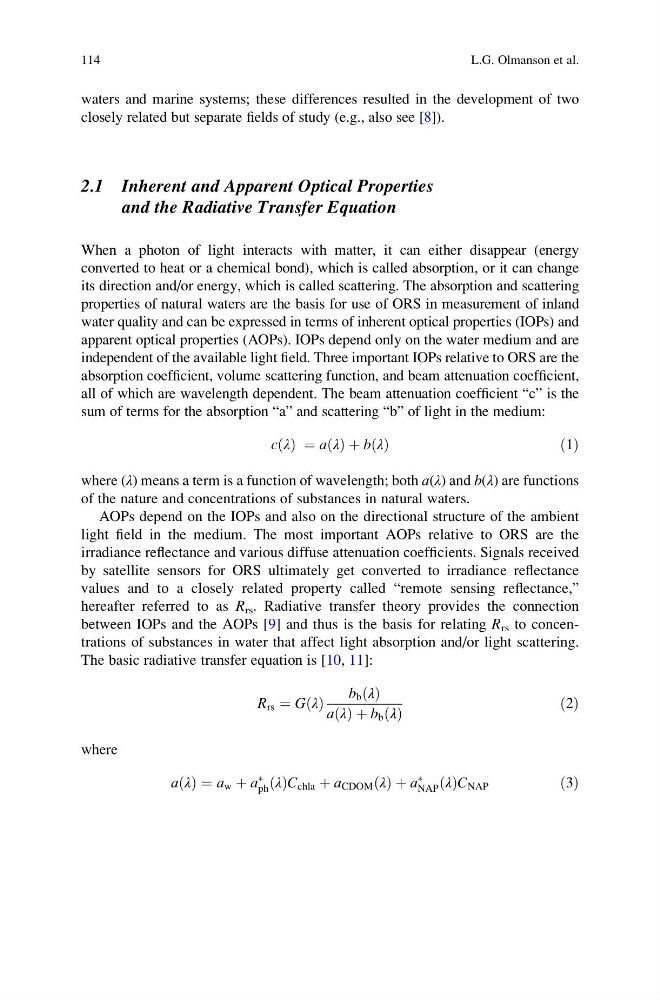
between IOPs and the AOPs [9] and thus is the basis for relating R rs to concentrations of substances in water that affect light absorption and/or light scattering.
The basic radiative transfer equation is [10, 11]:
R rs ¼ G λ
ð Þ
b b λ
ð Þ
a λ
ð Þ þ b b λ
ð Þ
ð2Þ
where
a λ
ð Þ ¼ a w þ a
Ã
ph λ
ð ÞC chla þ a CDOM λ
ð Þ þ a
Ã
NAP λ
ð ÞC NAP
ð3Þ
114
L.G. Olmanson et al.
closely related but separate fields of study (e.g., also see [8]).
2.1 Inherent and Apparent Optical Properties
and the Radiative Transfer Equation
When a photon of light interacts with matter, it can either disappear (energy
converted to heat or a chemical bond), which is called absorption, or it can change
its direction and/or energy, which is called scattering. The absorption and scattering
properties of natural waters are the basis for use of ORS in measurement of inland
water quality and can be expressed in terms of inherent optical properties (IOPs) and
apparent optical properties (AOPs). IOPs depend only on the water medium and are
independent of the available light field. Three important IOPs relative to ORS are the
absorption coefficient, volume scattering function, and beam attenuation coefficient,
all of which are wavelength dependent. The beam attenuation coefficient “c” is the
sum of terms for the absorption “a” and scattering “b” of light in the medium:
c λ
ð Þ ¼ a λ
ð Þ þ b λ
ð Þ
ð1Þ
where (λ) means a term is a function of wavelength; both a(λ) and b(λ) are functions
of the nature and concentrations of substances in natural waters.
AOPs depend on the IOPs and also on the directional structure of the ambient
light field in the medium. The most important AOPs relative to ORS are the
irradiance reflectance and various diffuse attenuation coefficients. Signals received
by satellite sensors for ORS ultimately get converted to irradiance reflectance
values and to a closely related property called “remote sensing reflectance,”
hereafter referred to as R rs . Radiative transfer theory provides the connection
between IOPs and the AOPs [9] and thus is the basis for relating R rs to concentrations of substances in water that affect light absorption and/or light scattering.
The basic radiative transfer equation is [10, 11]:
R rs ¼ G λ
ð Þ
b b λ
ð Þ
a λ
ð Þ þ b b λ
ð Þ
ð2Þ
where
a λ
ð Þ ¼ a w þ a
Ã
ph λ
ð ÞC chla þ a CDOM λ
ð Þ þ a
Ã
NAP λ
ð ÞC NAP
ð3Þ
114
L.G. Olmanson et al.