

• A double cropping agricultural practice, with wheat as dominant winter crop
(mean monthly NDVI peak occurring in early spring, from April to May),
followed by a summer crop mainly consisting of paddy rice agriculture (mean
monthly NDVI peak occurring in summer, from July to September depending on
the year). Intensity and position of crop peak conditions were variable in relation
to meteorological conditions as well as agricultural practices (i.e., differences in
crop varieties and fertilization practices).
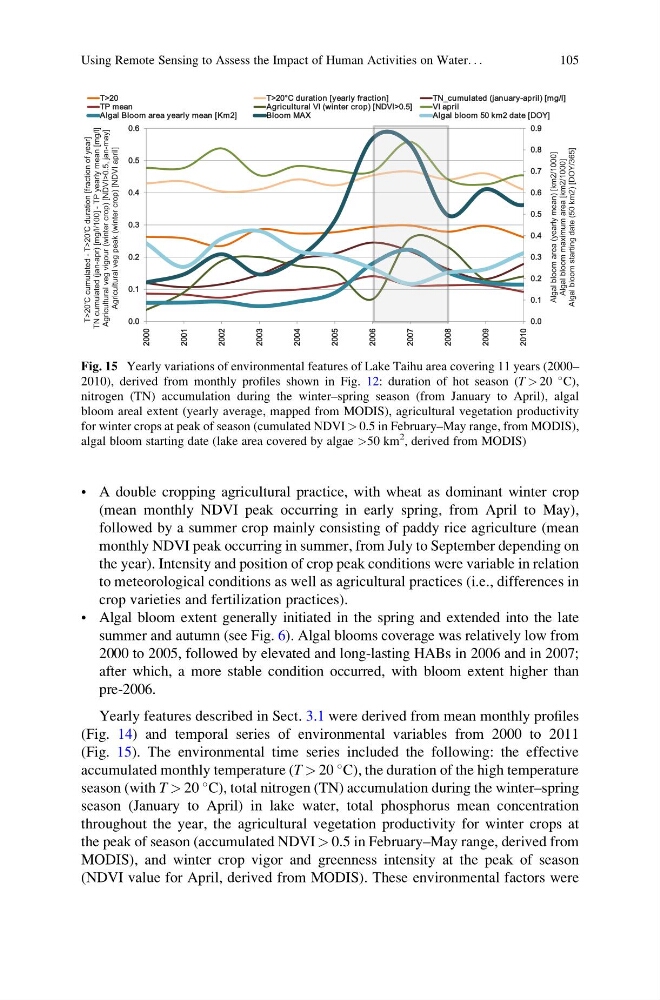
• Algal bloom extent generally initiated in the spring and extended into the late
summer and autumn (see Fig. 6). Algal blooms coverage was relatively low from
2000 to 2005, followed by elevated and long-lasting HABs in 2006 and in 2007;
after which, a more stable condition occurred, with bloom extent higher than
pre-2006.
Yearly features described in Sect. 3.1 were derived from mean monthly profiles
(Fig. 14) and temporal series of environmental variables from 2000 to 2011
(Fig. 15). The environmental time series included the following: the effective
accumulated monthly temperature (T > 20
C), the duration of the high temperature
season (with T > 20
C), total nitrogen (TN) accumulation during the winter–spring
season (January to April) in lake water, total phosphorus mean concentration
throughout the year, the agricultural vegetation productivity for winter crops at
the peak of season (accumulated NDVI > 0.5 in February–May range, derived from
MODIS), and winter crop vigor and greenness intensity at the peak of season
(NDVI value for April, derived from MODIS). These environmental factors were
0 0.0
0.1
0.2
0.3
0.4
0.5
0.6
0.7
0.8
0.9
0.0
0.1
0.2
0.3
0.4
0.5
0.6
2000
2001
2002
2003
2004
2005
2006
2007
2008
2009
2010
Algal bloom area (yearly mean) [km2/1000]
Algal bloom maximum area [km2/1000]
Algal bloom starting date (50 km2) [DOY/365]
T>20˚C cumulated - T>20˚C duration [fraction of year]
TN cumulated (jan-apr) [mg/l/100] - TP yearly mean [mg/l]
Agricultural veg vigour (winter crop) [NDVI>0.5, jan-may]
Agricultural veg peak (winter crop) [NDVI april]
T>20
T>20°C duration [yearly fraction]
TN_cumulated (january-april) [mg/l]
TP mean
Agricultural VI (winter crop) [NDVI>0.5]
VI april
Algal Bloom area yearly mean [Km2]
Bloom MAX
Algal bloom 50 km2 date [DOY]
Fig. 15 Yearly variations of environmental features of Lake Taihu area covering 11 years (2000–
2010), derived from monthly profiles shown in Fig. 12: duration of hot season (T > 20
C),
nitrogen (TN) accumulation during the winter–spring season (from January to April), algal
bloom areal extent (yearly average, mapped from MODIS), agricultural vegetation productivity
for winter crops at peak of season (cumulated NDVI > 0.5 in February–May range, from MODIS),
algal bloom starting date (lake area covered by algae >50 km
2
, derived from MODIS)
Using Remote Sensing to Assess the Impact of Human Activities on Water. . .
105
(mean monthly NDVI peak occurring in early spring, from April to May),
followed by a summer crop mainly consisting of paddy rice agriculture (mean
monthly NDVI peak occurring in summer, from July to September depending on
the year). Intensity and position of crop peak conditions were variable in relation
to meteorological conditions as well as agricultural practices (i.e., differences in
crop varieties and fertilization practices).
• Algal bloom extent generally initiated in the spring and extended into the late
summer and autumn (see Fig. 6). Algal blooms coverage was relatively low from
2000 to 2005, followed by elevated and long-lasting HABs in 2006 and in 2007;
after which, a more stable condition occurred, with bloom extent higher than
pre-2006.
Yearly features described in Sect. 3.1 were derived from mean monthly profiles
(Fig. 14) and temporal series of environmental variables from 2000 to 2011
(Fig. 15). The environmental time series included the following: the effective
accumulated monthly temperature (T > 20
C), the duration of the high temperature
season (with T > 20
C), total nitrogen (TN) accumulation during the winter–spring
season (January to April) in lake water, total phosphorus mean concentration
throughout the year, the agricultural vegetation productivity for winter crops at
the peak of season (accumulated NDVI > 0.5 in February–May range, derived from
MODIS), and winter crop vigor and greenness intensity at the peak of season
(NDVI value for April, derived from MODIS). These environmental factors were
0 0.0
0.1
0.2
0.3
0.4
0.5
0.6
0.7
0.8
0.9
0.0
0.1
0.2
0.3
0.4
0.5
0.6
2000
2001
2002
2003
2004
2005
2006
2007
2008
2009
2010
Algal bloom area (yearly mean) [km2/1000]
Algal bloom maximum area [km2/1000]
Algal bloom starting date (50 km2) [DOY/365]
T>20˚C cumulated - T>20˚C duration [fraction of year]
TN cumulated (jan-apr) [mg/l/100] - TP yearly mean [mg/l]
Agricultural veg vigour (winter crop) [NDVI>0.5, jan-may]
Agricultural veg peak (winter crop) [NDVI april]
T>20
T>20°C duration [yearly fraction]
TN_cumulated (january-april) [mg/l]
TP mean
Agricultural VI (winter crop) [NDVI>0.5]
VI april
Algal Bloom area yearly mean [Km2]
Bloom MAX
Algal bloom 50 km2 date [DOY]
Fig. 15 Yearly variations of environmental features of Lake Taihu area covering 11 years (2000–
2010), derived from monthly profiles shown in Fig. 12: duration of hot season (T > 20
C),
nitrogen (TN) accumulation during the winter–spring season (from January to April), algal
bloom areal extent (yearly average, mapped from MODIS), agricultural vegetation productivity
for winter crops at peak of season (cumulated NDVI > 0.5 in February–May range, from MODIS),
algal bloom starting date (lake area covered by algae >50 km
2
, derived from MODIS)
Using Remote Sensing to Assess the Impact of Human Activities on Water. . .
105