

588
Paran (Plate 27.5 ) is fabricated in a conical
form by knitting bamboo slits (1.0 mm thick)
together with the help of cane string. The bamboo
slits are strengthened with thicker bamboo slits
placed in between. On the inner side of the trap, a
V-shaped door with a narrow slit (1.5–2.0 mm
wide) is kept. The slits at the upper free end are
tied with a string in such a way that the fi sh are
taken out with bare hand simply by loosening it.
The fi sh enters the trap through the slit after being
obstructed by any means. The fi sherman takes
out the catches after 8–10 h of its placement.
This type of trap is generally operated in the
Beel between October and March. The main
catches in the trap are Puntius chola , Mystus vittatus , Clupisoma atherinoides and Parambassis
baculis .
Khati bundh (Plate 27.6 ) is fabricated in the
form of a mat by knitting bamboo slits (height
2.5–8.0 m) with coconut coirs without leaving
any gap in between the bamboo slits. The standard length (SL) of a Khati is usually 4.5 m. The
Khati is inserted into the Beel bottom for obstructing the movement of both big and small varieties
of fi shes throughout the year, and the fi sh are
caught by the traps placed along its sides.
27.3.5 Trawls
Among the trawls of Sone Beel, operation of
‘Chhat jal’ had been initiated by the fi shermen
belonging to the ‘Maimal’ community since very
ancient times (Kar 1990 ). Pelain, on the other
hand, is mainly a domestic gear used by all the
four fi shing communities of the Beel, namely,
Kaibarta, Patni, Maimal and Namasudra. An
account of the two types of trawls is given below:
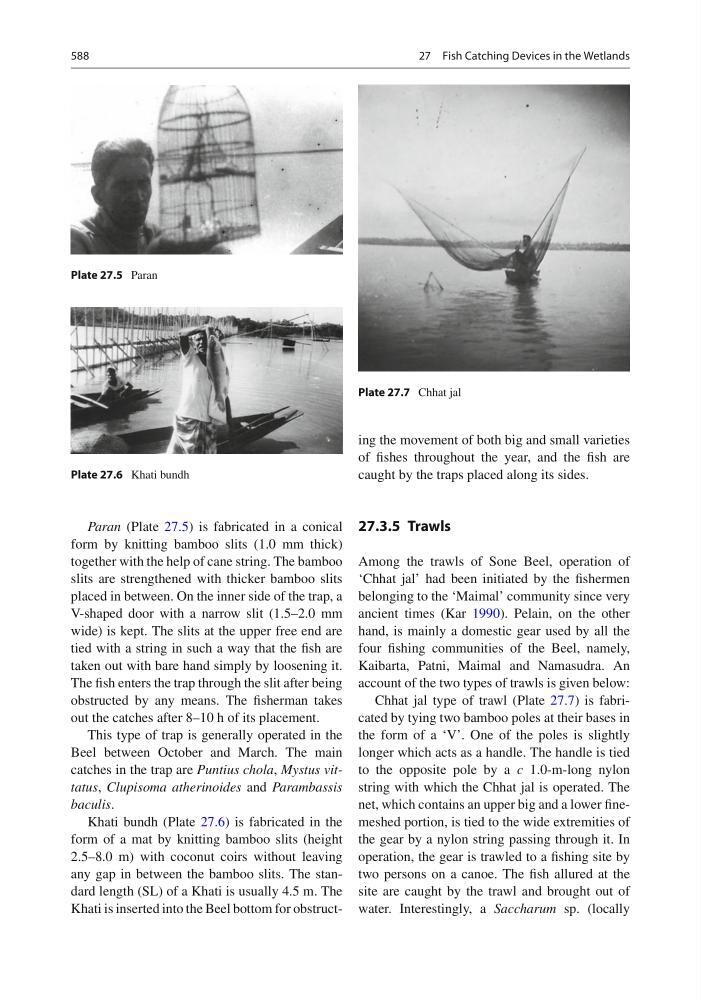
Chhat jal type of trawl (Plate 27.7 ) is fabricated by tying two bamboo poles at their bases in
the form of a ‘V’. One of the poles is slightly
longer which acts as a handle. The handle is tied
to the opposite pole by a c 1.0-m-long nylon
string with which the Chhat jal is operated. The
net, which contains an upper big and a lower fi nemeshed portion, is tied to the wide extremities of
the gear by a nylon string passing through it. In
operation, the gear is trawled to a fi shing site by
two persons on a canoe. The fi sh allured at the
site are caught by the trawl and brought out of
water. Interestingly, a Saccharum sp. (locally
Plate 27.7 Chhat jal
Plate 27.5 Paran
Plate 27.6 Khati bundh
27 Fish Catching Devices in the Wetlands