

550
25.1.4 Other Wetlands in Australia
The following are signifi cant among the other
wetlands of Australia.
25.1.4.1 Boondall Wetlands
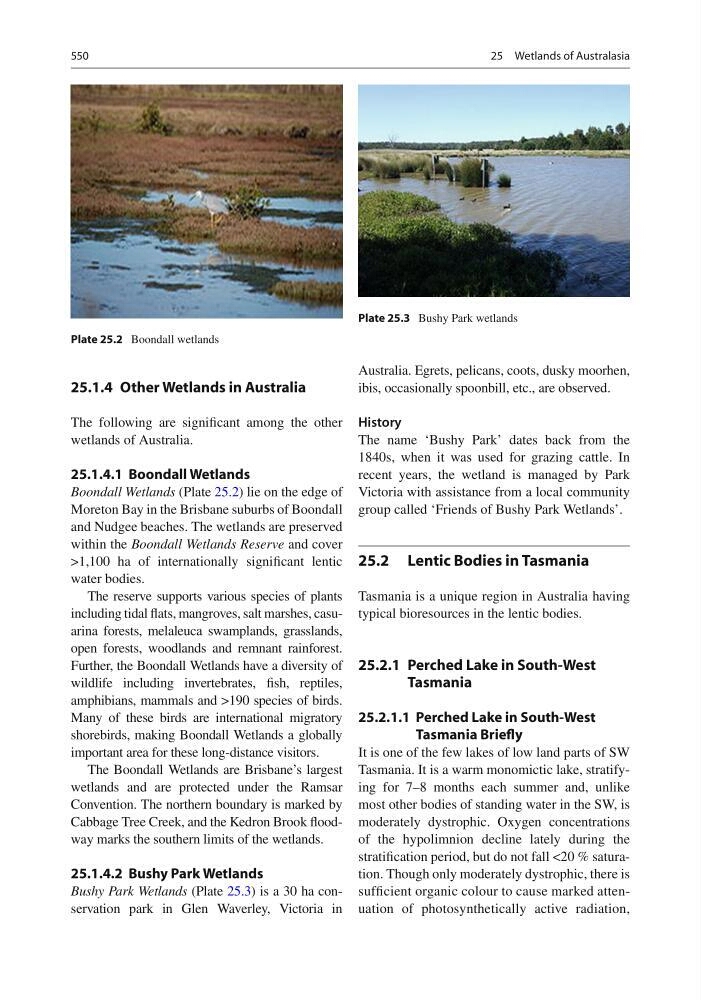
Boondall Wetlands (Plate 25.2 ) lie on the edge of
Moreton Bay in the Brisbane suburbs of Boondall
and Nudgee beaches. The wetlands are preserved
within the Boondall Wetlands Reserve and cover
>1,100 ha of internationally signifi cant lentic
water bodies.
The reserve supports various species of plants
including tidal fl ats, mangroves, salt marshes, casuarina forests, melaleuca swamplands, grasslands,
open forests, woodlands and remnant rainforest.
Further, the Boondall Wetlands have a diversity of
wildlife including invertebrates, fi sh, reptiles,
amphibians, mammals and >190 species of birds.
Many of these birds are international migratory
shorebirds, making Boondall Wetlands a globally
important area for these long-distance visitors.
The Boondall Wetlands are Brisbane’s largest
wetlands and are protected under the Ramsar
Convention. The northern boundary is marked by
Cabbage Tree Creek, and the Kedron Brook fl oodway marks the southern limits of the wetlands.
25.1.4.2 Bushy Park Wetlands
Bushy Park Wetlands (Plate 25.3 ) is a 30 ha conservation park in Glen Waverley, Victoria in
Australia. Egrets, pelicans, coots, dusky moorhen,
ibis, occasionally spoonbill, etc., are observed.
History
The name ‘Bushy Park’ dates back from the
1840s, when it was used for grazing cattle. In
recent years, the wetland is managed by Park
Victoria with assistance from a local community
group called ‘Friends of Bushy Park Wetlands’.
25.2 Lentic Bodies in Tasmania
Tasmania is a unique region in Australia having
typical bioresources in the lentic bodies.
25.2.1 Perched Lake in South-West
Tasmania
25.2.1.1 Perched Lake in South- West
Tasmania Briefl y
It is one of the few lakes of low land parts of SW
Tasmania. It is a warm monomictic lake, stratifying for 7–8 months each summer and, unlike
most other bodies of standing water in the SW, is
moderately dystrophic. Oxygen concentrations
of the hypolimnion decline lately during the
stratifi cation period, but do not fall <20 % saturation. Though only moderately dystrophic, there is
suffi cient organic colour to cause marked attenuation of photosynthetically active radiation,
Plate 25.2 Boondall wetlands
Plate 25.3 Bushy Park wetlands
25 Wetlands of Australasia