

549
(b) To increase community capacity for the management and conservation of wetlands both
on private- and public-owned lands
(c) To secure long-term conservation of wetlands (specifi cally on private properties)
through the adoption of voluntary management agreements
25.1.3.3 Solution
This ‘Wetland Watch project’ aims to take a bottom- up approach to wetland conservation. By
working with landowners and community groups
and by targeting high conservation value wetlands that are not under statutory protection,
WWF will make efforts for long-term biodiversity conservation and raise a wetland protection
ethics within the local communities.
By working in partnership with local authorities, the Water Corporation (WC), Swan Catchment
Council (SCC), Department of Conservation and
Land Management (DCLM) and Department of
Environment (DoE) (formerly Water and Rivers
Commission), WWF will ensure that the Wetland
Watch project is strategic, complementary and
holistic in its approach to wetland conservation.
25.1.3.4 Beeliar Wetlands
The Beeliar Wetlands are made up of two chains
of lakes and wetlands that run parallel to the west
coast of western Australia. They are situated on
the coastal plain between the Darling Escarpment
and the Indian Ocean. The name ‘Beeliar’ was
the name given to the area by the Aboriginal people that lived and hunted in the area.
The fi rst chain of lakes and wetlands lie about
1–3 km inland from the Indian Ocean. The lakes in
this chain are mostly saline and often described as
‘seasonal’ because they often dry up during summer months. The second chain is situated a further
6–8 km inland and includes several large perennial
FW lakes. The Beeliar Wetlands is located in the
southwest portion of the metropolitan area of
Perth, western Australia. The northernmost point
is located in the suburb of Mount Pleasant just
south of the Swan River. The wetlands stretch
about 25 km south to the suburb of Baldivis.
The wetlands have been identifi ed as supporting native fl ora and fauna and vital to maintaining
the biodiversity of the region. Located in, and
surrounded as they are, by encroaching suburbs
in the metropolitan area of a rapidly expanding
city, the wetlands are under threat from development. The government of the State of Western
Australia has incorporated the remnants of the
wetlands including some 19 lakes and many
other wetlands into the ‘Beeliar Regional Park’
managed by its Department of Environment and
Conservation. The park comprises a number of
separate portions and is not one continuous
expanse of land.
25.1.3.5 Brixton Street Wetlands
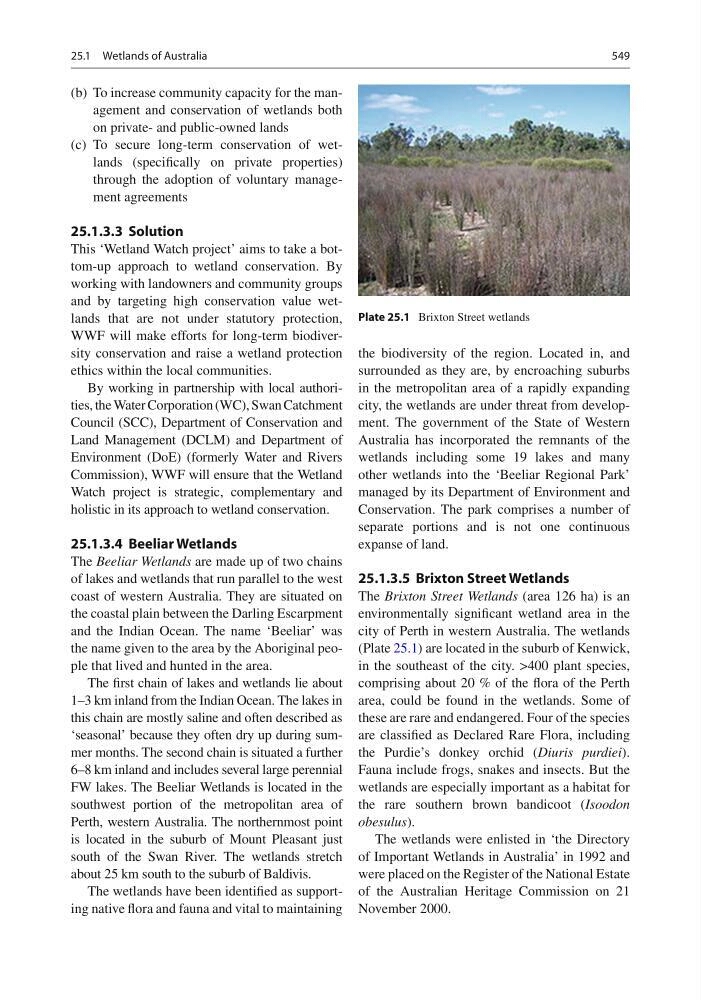
The Brixton Street Wetlands (area 126 ha) is an
environmentally signifi cant wetland area in the
city of Perth in western Australia. The wetlands
(Plate 25.1 ) are located in the suburb of Kenwick,
in the southeast of the city. >400 plant species,
comprising about 20 % of the fl ora of the Perth
area, could be found in the wetlands. Some of
these are rare and endangered. Four of the species
are classifi ed as Declared Rare Flora, including
the Purdie’s donkey orchid ( Diuris purdiei ).
Fauna include frogs, snakes and insects. But the
wetlands are especially important as a habitat for
the rare southern brown bandicoot ( Isoodon
obesulus ).
The wetlands were enlisted in ‘the Directory
of Important Wetlands in Australia’ in 1992 and
were placed on the Register of the National Estate
of the Australian Heritage Commission on 21
November 2000.
Plate 25.1 Brixton Street wetlands
25.1 Wetlands of Australia