

524
23.7.7 Wetlands of Peru
A beautiful background exists behind the wetlands
of Peru and its conservation. At 28, Joana
Manrique (28 years approx.) was a victim of
severe domestic violence. Being a sufferer, she
developed affection towards ‘nature’ and her
‘organisms’. Subsequently, she raised an organisation, which put forward proposals to save the
wetlands. The wetlands were considered to be the
planet’s kidneys, recalled Joana of her memories
of the seven-hectare bird sanctuary. As a result of
Joana and her colleagues’ efforts, ‘Los Ojos del
Alma’ was granted GEF/UNDP funding as part of
UNDP’s post-earthquake reconstruction project.
With the support of volunteers, the organisation
is now ready to advocate for the protection and
re-forestation of native plant species. The San
Andrés wetlands are also home to hundreds of
birds and serve as a destination for birds migrating south. ‘Contributing to society’ is very much
a part of Joana’s discourse. Possibly, she cannot
see. But she knows that ‘Los Ojos del Alma’ will
provide a sustainable way to do so.
23.7.7.1 The Puerto Viejo Wetlands
Flamingos, grebes, blue herons and ospreys are
some of the 94 bird species which live either
the year-round or on a temporary basis in this
important marine ecosystem along the Peruvian
coast, just 70 km from Lima. Amidst the tough
climatic conditions that predominate this
coastal area, this oasis periodically repeats its
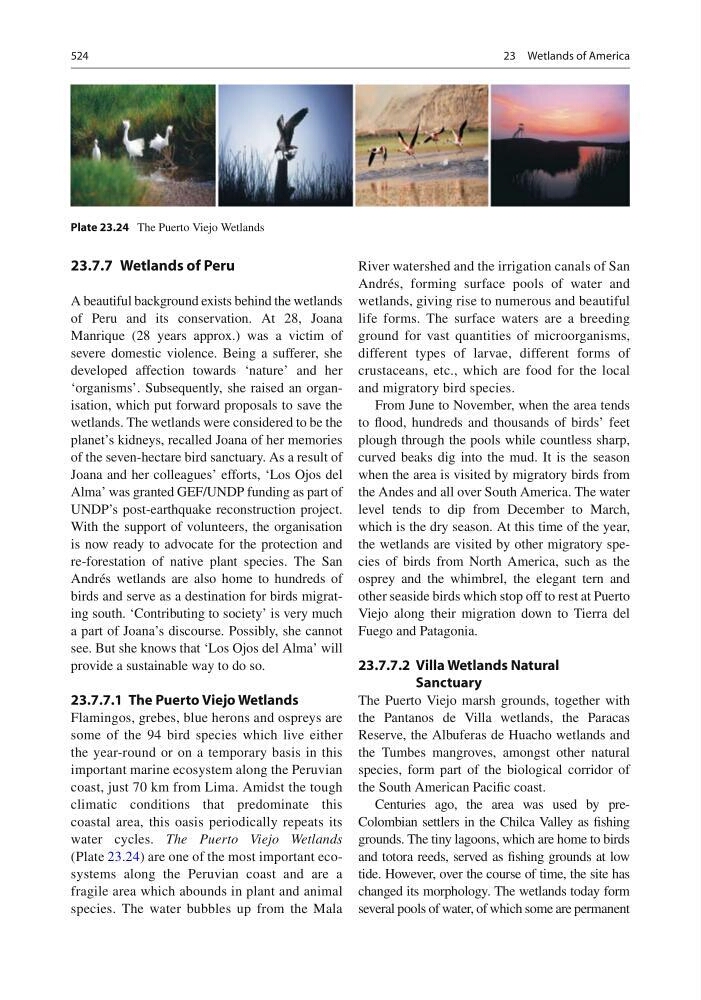
water cycles. The Puerto Viejo Wetlands
(Plate 23.24 ) are one of the most important ecosystems along the Peruvian coast and are a
fragile area which abounds in plant and animal
species. The water bubbles up from the Mala
River watershed and the irrigation canals of San
Andrés, forming surface pools of water and
wetlands, giving rise to numerous and beautiful
life forms. The surface waters are a breeding
ground for vast quantities of microorganisms,
different types of larvae, different forms of
crustaceans, etc., which are food for the local
and migratory bird species.
From June to November, when the area tends
to fl ood, hundreds and thousands of birds’ feet
plough through the pools while countless sharp,
curved beaks dig into the mud. It is the season
when the area is visited by migratory birds from
the Andes and all over South America. The water
level tends to dip from December to March,
which is the dry season. At this time of the year,
the wetlands are visited by other migratory species of birds from North America, such as the
osprey and the whimbrel, the elegant tern and
other seaside birds which stop off to rest at Puerto
Viejo along their migration down to Tierra del
Fuego and Patagonia.
23.7.7.2 Villa Wetlands Natural
Sanctuary
The Puerto Viejo marsh grounds, together with
the Pantanos de Villa wetlands, the Paracas
Reserve, the Albuferas de Huacho wetlands and
the Tumbes mangroves, amongst other natural
species, form part of the biological corridor of
the South American Pacifi c coast.
Centuries ago, the area was used by preColombian settlers in the Chilca Valley as fi shing
grounds. The tiny lagoons, which are home to birds
and totora reeds, served as fi shing grounds at low
tide. However, over the course of time, the site has
changed its morphology. The wetlands today form
several pools of water, of which some are permanent
Plate 23.24 The Puerto Viejo Wetlands
23 Wetlands of America
23.7.7 Wetlands of Peru
A beautiful background exists behind the wetlands
of Peru and its conservation. At 28, Joana
Manrique (28 years approx.) was a victim of
severe domestic violence. Being a sufferer, she
developed affection towards ‘nature’ and her
‘organisms’. Subsequently, she raised an organisation, which put forward proposals to save the
wetlands. The wetlands were considered to be the
planet’s kidneys, recalled Joana of her memories
of the seven-hectare bird sanctuary. As a result of
Joana and her colleagues’ efforts, ‘Los Ojos del
Alma’ was granted GEF/UNDP funding as part of
UNDP’s post-earthquake reconstruction project.
With the support of volunteers, the organisation
is now ready to advocate for the protection and
re-forestation of native plant species. The San
Andrés wetlands are also home to hundreds of
birds and serve as a destination for birds migrating south. ‘Contributing to society’ is very much
a part of Joana’s discourse. Possibly, she cannot
see. But she knows that ‘Los Ojos del Alma’ will
provide a sustainable way to do so.
23.7.7.1 The Puerto Viejo Wetlands
Flamingos, grebes, blue herons and ospreys are
some of the 94 bird species which live either
the year-round or on a temporary basis in this
important marine ecosystem along the Peruvian
coast, just 70 km from Lima. Amidst the tough
climatic conditions that predominate this
coastal area, this oasis periodically repeats its
water cycles. The Puerto Viejo Wetlands
(Plate 23.24 ) are one of the most important ecosystems along the Peruvian coast and are a
fragile area which abounds in plant and animal
species. The water bubbles up from the Mala
River watershed and the irrigation canals of San
Andrés, forming surface pools of water and
wetlands, giving rise to numerous and beautiful
life forms. The surface waters are a breeding
ground for vast quantities of microorganisms,
different types of larvae, different forms of
crustaceans, etc., which are food for the local
and migratory bird species.
From June to November, when the area tends
to fl ood, hundreds and thousands of birds’ feet
plough through the pools while countless sharp,
curved beaks dig into the mud. It is the season
when the area is visited by migratory birds from
the Andes and all over South America. The water
level tends to dip from December to March,
which is the dry season. At this time of the year,
the wetlands are visited by other migratory species of birds from North America, such as the
osprey and the whimbrel, the elegant tern and
other seaside birds which stop off to rest at Puerto
Viejo along their migration down to Tierra del
Fuego and Patagonia.
23.7.7.2 Villa Wetlands Natural
Sanctuary
The Puerto Viejo marsh grounds, together with
the Pantanos de Villa wetlands, the Paracas
Reserve, the Albuferas de Huacho wetlands and
the Tumbes mangroves, amongst other natural
species, form part of the biological corridor of
the South American Pacifi c coast.
Centuries ago, the area was used by preColombian settlers in the Chilca Valley as fi shing
grounds. The tiny lagoons, which are home to birds
and totora reeds, served as fi shing grounds at low
tide. However, over the course of time, the site has
changed its morphology. The wetlands today form
several pools of water, of which some are permanent
Plate 23.24 The Puerto Viejo Wetlands
23 Wetlands of America