

523
Rivers to allow ocean-going ships to travel further
inland could affect the hydrology (fl ooding and
drainage cycles) of the region and, therefore, the
ecosystem as well.
Protected Areas
Pantanal Matogrossense National Park
A portion of the Pantanal in Brazil has been protected as the Pantanal Matogrossense National
Park. This 1,35,000-ha park was established in
September 1981. It is located in the municipality
of Poconé in the State of Mato Grosso, between
the mouths of the Baía de São Marcos and the
Gurupi River. This park has been designated as a
Ramsar site since 24 May 1993.
SESC Pantanal Private Natural Heritage
Reserve
The SESC Pantanal Private Natural Heritage
Reserve ( Reserva Particular do Patrimonio
Natural SESC Pantanal ) is a privately owned
reserve in Brazil, established in 1998. It has an
area of 87,870 ha. It is located in the northeastern
portion, known as ‘Poconé’ Pantanal, not far
from the Pantanal National Park. It is a mix of
permanent rivers, seasonal streams, permanent
and seasonal fl oodplain freshwater lakes, shrubdominated wetlands and seasonally fl ooded forests. All these are dedicated to nature preservation
and designated as a Ramsar site.
23.7.6 Wetlands of Argentina
There are signifi cant wetlands in Argentina. An
account is given below.
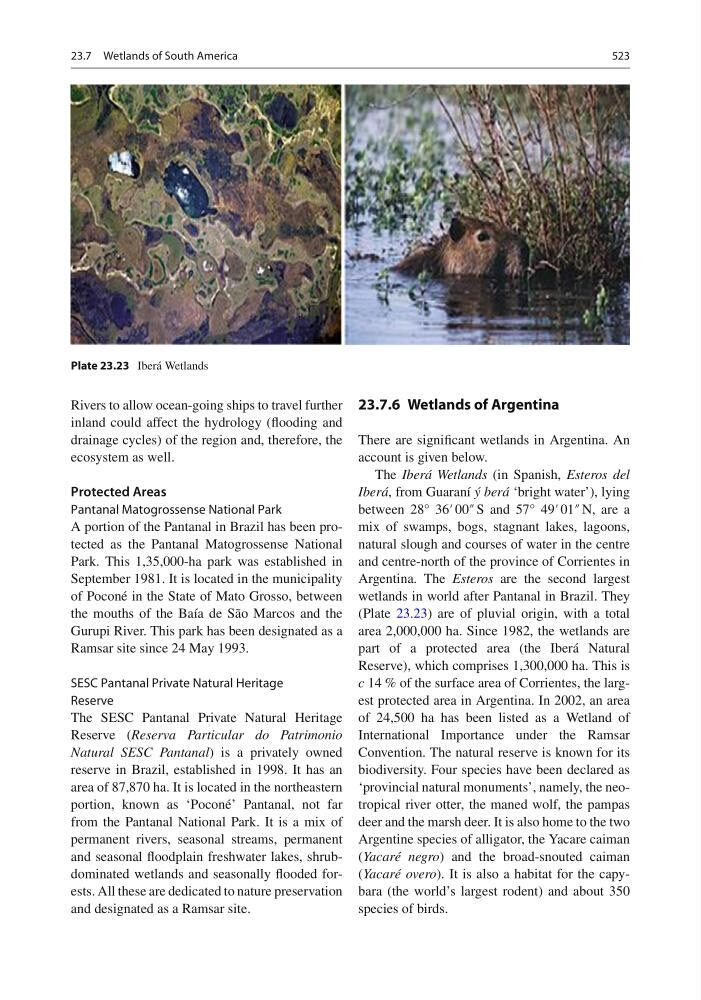
The Iberá Wetlands (in Spanish, Esteros del
Iberá , from Guaraní ý berá ‘bright water’), lying
between 28° 36′ 00″ S and 57° 49′ 01″ N, are a
mix of swamps, bogs, stagnant lakes, lagoons,
natural slough and courses of water in the centre
and centre-north of the province of Corrientes in
Argentina. The Esteros are the second largest
wetlands in world after Pantanal in Brazil. They
(Plate 23.23 ) are of pluvial origin, with a total
area 2,000,000 ha. Since 1982, the wetlands are
part of a protected area (the Iberá Natural
Reserve), which comprises 1,300,000 ha. This is
c 14 % of the surface area of Corrientes, the largest protected area in Argentina. In 2002, an area
of 24,500 ha has been listed as a Wetland of
International Importance under the Ramsar
Convention. The natural reserve is known for its
biodiversity. Four species have been declared as
‘provincial natural monuments’, namely, the neotropical river otter, the maned wolf, the pampas
deer and the marsh deer. It is also home to the two
Argentine species of alligator, the Yacare caiman
( Yacaré negro ) and the broad-snouted caiman
( Yacaré overo ). It is also a habitat for the capybara (the world’s largest rodent) and about 350
species of birds.
Plate 23.23 Iberá Wetlands
23.7 Wetlands of South America
Rivers to allow ocean-going ships to travel further
inland could affect the hydrology (fl ooding and
drainage cycles) of the region and, therefore, the
ecosystem as well.
Protected Areas
Pantanal Matogrossense National Park
A portion of the Pantanal in Brazil has been protected as the Pantanal Matogrossense National
Park. This 1,35,000-ha park was established in
September 1981. It is located in the municipality
of Poconé in the State of Mato Grosso, between
the mouths of the Baía de São Marcos and the
Gurupi River. This park has been designated as a
Ramsar site since 24 May 1993.
SESC Pantanal Private Natural Heritage
Reserve
The SESC Pantanal Private Natural Heritage
Reserve ( Reserva Particular do Patrimonio
Natural SESC Pantanal ) is a privately owned
reserve in Brazil, established in 1998. It has an
area of 87,870 ha. It is located in the northeastern
portion, known as ‘Poconé’ Pantanal, not far
from the Pantanal National Park. It is a mix of
permanent rivers, seasonal streams, permanent
and seasonal fl oodplain freshwater lakes, shrubdominated wetlands and seasonally fl ooded forests. All these are dedicated to nature preservation
and designated as a Ramsar site.
23.7.6 Wetlands of Argentina
There are signifi cant wetlands in Argentina. An
account is given below.
The Iberá Wetlands (in Spanish, Esteros del
Iberá , from Guaraní ý berá ‘bright water’), lying
between 28° 36′ 00″ S and 57° 49′ 01″ N, are a
mix of swamps, bogs, stagnant lakes, lagoons,
natural slough and courses of water in the centre
and centre-north of the province of Corrientes in
Argentina. The Esteros are the second largest
wetlands in world after Pantanal in Brazil. They
(Plate 23.23 ) are of pluvial origin, with a total
area 2,000,000 ha. Since 1982, the wetlands are
part of a protected area (the Iberá Natural
Reserve), which comprises 1,300,000 ha. This is
c 14 % of the surface area of Corrientes, the largest protected area in Argentina. In 2002, an area
of 24,500 ha has been listed as a Wetland of
International Importance under the Ramsar
Convention. The natural reserve is known for its
biodiversity. Four species have been declared as
‘provincial natural monuments’, namely, the neotropical river otter, the maned wolf, the pampas
deer and the marsh deer. It is also home to the two
Argentine species of alligator, the Yacare caiman
( Yacaré negro ) and the broad-snouted caiman
( Yacaré overo ). It is also a habitat for the capybara (the world’s largest rodent) and about 350
species of birds.
Plate 23.23 Iberá Wetlands
23.7 Wetlands of South America