

503
created by periodic fl ooding along the mouth of
the Ohio River. Originally, the Axe Lake had an
area of 60 ha.
The Kentucky State Nature Preserves
Commission, with assistance from The Nature
Conservancy, have identifi ed Axe Lake as the
centrepiece of an expanded long-term project to
protect 1,200 ha of bald cypress/tupelo swamplands which is now called the Axe Lake Swamp
wetlands complex . This protected area is known
to support at least eight rare plant and animal
species. The site has been recognised as a priority wetland in the North American Waterfowl
Management Plan. Some of the plant and animal species are bald cypress ( Taxodium distichum ), great blue heron ( Ardea herodias ), great
egret ( Casmerodius albus ), wood duck ( Aix
sponsa ), etc.
23.2.1.10 Wetlands of Maryland State
Birds Mill Swamp
It lies between 38° 52′ 54″ N and 76° 34′ 28″ W,
just west of the Chesapeake Bay in Anne Arundel
County on the Atlantic coastal plain region of
Maryland in the USA. Like most swamps surrounding the Chesapeake Bay, this small freshwater wetland is classifi ed as a bald cypress
swamp. It is a habitat of many species of insects,
amphibians, reptiles and birds. There is also a
rich diversity of AM. Unlike many swamps, it is
not much intervened by humans except for a few
dirt trails nearby.
23.2.1.11 Wetlands of Massachusetts
Hockomock Swamp
It is an enormous wetland (area 2,400 ha) covering much of the northern part of southeastern
Massachusetts. It is considered as the second
largest wetland in the state. It acts as a natural
fl ood control mechanism for the region.
23.2.1.12 Wetlands of Michigan State
Huron Swamp
This heavily forested wetland lies between
42° 42′ 40″ N and 83° 29′ 44″ W in Springfi eld
Township, in Michigan’s Oakland County,
about 15 km northwest of the city of Pontiac. It
is a part of the local Indian Springs Metropark,
which is a component of the Huron–Clinton
Metropark system. The big lake is to the northwest. The Huron River originates within the
Huron Swamp.
23.2.1.13 Wetland of Minnesota State
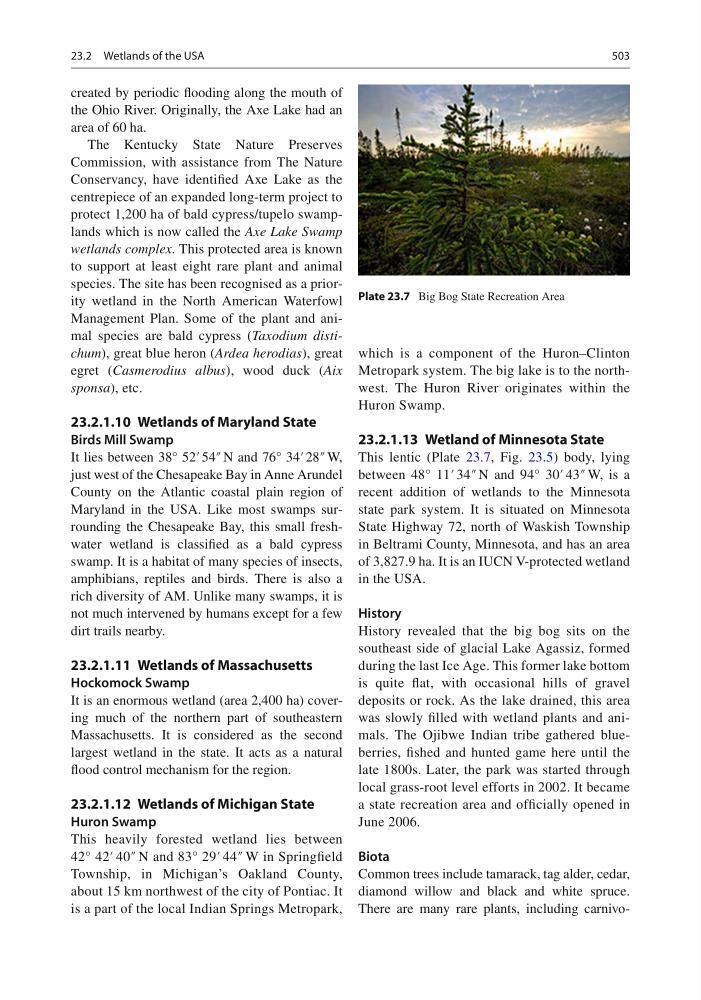
This lentic (Plate 23.7 , Fig. 23.5 ) body, lying
between 48° 11′ 34″ N and 94° 30′ 43″ W, is a
recent addition of wetlands to the Minnesota
state park system. It is situated on Minnesota
State Highway 72, north of Waskish Township
in Beltrami County, Minnesota, and has an area
of 3,827.9 ha. It is an IUCN V-protected wetland
in the USA.
History
History revealed that the big bog sits on the
southeast side of glacial Lake Agassiz, formed
during the last Ice Age. This former lake bottom
is quite fl at, with occasional hills of gravel
deposits or rock. As the lake drained, this area
was slowly fi lled with wetland plants and animals. The Ojibwe Indian tribe gathered blueberries, fi shed and hunted game here until the
late 1800s. Later, the park was started through
local grass- root level efforts in 2002. It became
a state recreation area and offi cially opened in
June 2006.
Biota
Common trees include tamarack, tag alder, cedar,
diamond willow and black and white spruce.
There are many rare plants, including carnivoPlate 23.7 Big Bog State Recreation Area
23.2 Wetlands of the USA
created by periodic fl ooding along the mouth of
the Ohio River. Originally, the Axe Lake had an
area of 60 ha.
The Kentucky State Nature Preserves
Commission, with assistance from The Nature
Conservancy, have identifi ed Axe Lake as the
centrepiece of an expanded long-term project to
protect 1,200 ha of bald cypress/tupelo swamplands which is now called the Axe Lake Swamp
wetlands complex . This protected area is known
to support at least eight rare plant and animal
species. The site has been recognised as a priority wetland in the North American Waterfowl
Management Plan. Some of the plant and animal species are bald cypress ( Taxodium distichum ), great blue heron ( Ardea herodias ), great
egret ( Casmerodius albus ), wood duck ( Aix
sponsa ), etc.
23.2.1.10 Wetlands of Maryland State
Birds Mill Swamp
It lies between 38° 52′ 54″ N and 76° 34′ 28″ W,
just west of the Chesapeake Bay in Anne Arundel
County on the Atlantic coastal plain region of
Maryland in the USA. Like most swamps surrounding the Chesapeake Bay, this small freshwater wetland is classifi ed as a bald cypress
swamp. It is a habitat of many species of insects,
amphibians, reptiles and birds. There is also a
rich diversity of AM. Unlike many swamps, it is
not much intervened by humans except for a few
dirt trails nearby.
23.2.1.11 Wetlands of Massachusetts
Hockomock Swamp
It is an enormous wetland (area 2,400 ha) covering much of the northern part of southeastern
Massachusetts. It is considered as the second
largest wetland in the state. It acts as a natural
fl ood control mechanism for the region.
23.2.1.12 Wetlands of Michigan State
Huron Swamp
This heavily forested wetland lies between
42° 42′ 40″ N and 83° 29′ 44″ W in Springfi eld
Township, in Michigan’s Oakland County,
about 15 km northwest of the city of Pontiac. It
is a part of the local Indian Springs Metropark,
which is a component of the Huron–Clinton
Metropark system. The big lake is to the northwest. The Huron River originates within the
Huron Swamp.
23.2.1.13 Wetland of Minnesota State
This lentic (Plate 23.7 , Fig. 23.5 ) body, lying
between 48° 11′ 34″ N and 94° 30′ 43″ W, is a
recent addition of wetlands to the Minnesota
state park system. It is situated on Minnesota
State Highway 72, north of Waskish Township
in Beltrami County, Minnesota, and has an area
of 3,827.9 ha. It is an IUCN V-protected wetland
in the USA.
History
History revealed that the big bog sits on the
southeast side of glacial Lake Agassiz, formed
during the last Ice Age. This former lake bottom
is quite fl at, with occasional hills of gravel
deposits or rock. As the lake drained, this area
was slowly fi lled with wetland plants and animals. The Ojibwe Indian tribe gathered blueberries, fi shed and hunted game here until the
late 1800s. Later, the park was started through
local grass- root level efforts in 2002. It became
a state recreation area and offi cially opened in
June 2006.
Biota
Common trees include tamarack, tag alder, cedar,
diamond willow and black and white spruce.
There are many rare plants, including carnivoPlate 23.7 Big Bog State Recreation Area
23.2 Wetlands of the USA