

502
lake (Herdendorf 1987 ). However, a number of
wetlands existed as marshes and they were
managed for waterfowls at the western end of
Lake Erie. It comprised extensive swamps and
marshes with some higher drier ground interspersed. It occupied the former southwestern part
of glacial Lake Maumee which is a Holocene
precursor to Lake Erie. Once upon a time, the
Great Black Swamp was a combination of
marshland and forested swamps which was about
160 km long and 40 km wide in a southwesterly
direction from the lake and had an area of about
4,000 km
2
. Now, there is possibility of some
changes in the dimension of the swamp. Today, it
is a highly productive farmland being gradually
drained and settled in the second half of the
ninetieth century.
The area was not a continuous swamp but
rather characterised by a variety of vegetation
types (Kaatz 1955 ). Deciduous swamp forests
predominated the lowest, flattest areas which
were prone to permanent inundation and were
characterised especially by species of ash,
elm, cottonwood and sycamore. The area contained non-forested wetlands, particularly
marsh and wet prairies, with marshes being
particularly extensive along the Lake Erie
shoreline between Toledo and Sandusky.
In the 1850s, the states began an organised
attempt to drain the swamp for agricultural use
and ease of travel. Various projects were undertaken over a 40-year period. The area was
largely settled over the next three decades.
The development of railways and roads and a
local drainage tile industry is thought to have
contributed greatly to drainage and settlement
(Kaatz 1955 ).
Other works could be found in Prince and
D’Itri ( 1985 ), Herdendorf ( 1987 ), Krieger et al.
( 1992 ), Mitsch ( 1989 , 1992), and Mitsch et al.
( 1994a , b , 2000 ).
23.2.1.8 Wetlands of Kansas State
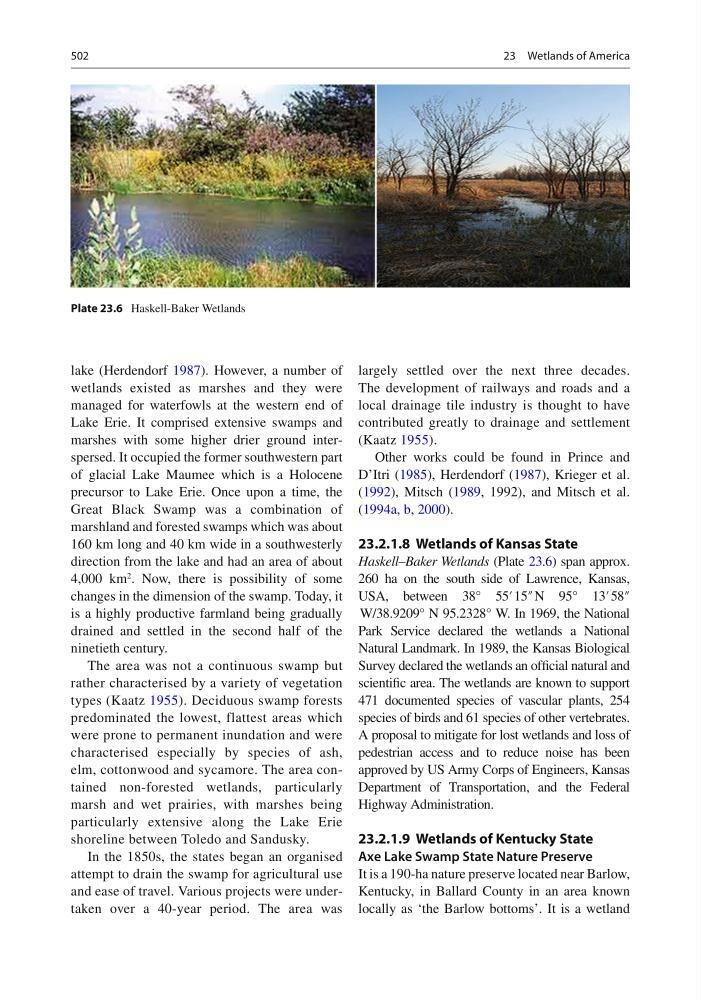
Haskell – Baker Wetlands (Plate 23.6 ) span approx.
260 ha on the south side of Lawrence, Kansas,
USA, between 38° 55′ 15″ N 95° 13′ 58″
W/38.9209° N 95.2328° W. In 1969, the National
Park Service declared the wetlands a National
Natural Landmark. In 1989, the Kansas Biological
Survey declared the wetlands an offi cial natural and
scientifi c area. The wetlands are known to support
471 documented species of vascular plants, 254
species of birds and 61 species of other vertebrates.
A proposal to mitigate for lost wetlands and loss of
pedestrian access and to reduce noise has been
approved by US Army Corps of Engineers, Kansas
Department of Transportation, and the Federal
Highway Administration.
23.2.1.9 Wetlands of Kentucky State
Axe Lake Swamp State Nature Preserve
It is a 190-ha nature preserve located near Barlow,
Kentucky, in Ballard County in an area known
locally as ‘the Barlow bottoms’. It is a wetland
Plate 23.6 Haskell-Baker Wetlands
23 Wetlands of America
lake (Herdendorf 1987 ). However, a number of
wetlands existed as marshes and they were
managed for waterfowls at the western end of
Lake Erie. It comprised extensive swamps and
marshes with some higher drier ground interspersed. It occupied the former southwestern part
of glacial Lake Maumee which is a Holocene
precursor to Lake Erie. Once upon a time, the
Great Black Swamp was a combination of
marshland and forested swamps which was about
160 km long and 40 km wide in a southwesterly
direction from the lake and had an area of about
4,000 km
2
. Now, there is possibility of some
changes in the dimension of the swamp. Today, it
is a highly productive farmland being gradually
drained and settled in the second half of the
ninetieth century.
The area was not a continuous swamp but
rather characterised by a variety of vegetation
types (Kaatz 1955 ). Deciduous swamp forests
predominated the lowest, flattest areas which
were prone to permanent inundation and were
characterised especially by species of ash,
elm, cottonwood and sycamore. The area contained non-forested wetlands, particularly
marsh and wet prairies, with marshes being
particularly extensive along the Lake Erie
shoreline between Toledo and Sandusky.
In the 1850s, the states began an organised
attempt to drain the swamp for agricultural use
and ease of travel. Various projects were undertaken over a 40-year period. The area was
largely settled over the next three decades.
The development of railways and roads and a
local drainage tile industry is thought to have
contributed greatly to drainage and settlement
(Kaatz 1955 ).
Other works could be found in Prince and
D’Itri ( 1985 ), Herdendorf ( 1987 ), Krieger et al.
( 1992 ), Mitsch ( 1989 , 1992), and Mitsch et al.
( 1994a , b , 2000 ).
23.2.1.8 Wetlands of Kansas State
Haskell – Baker Wetlands (Plate 23.6 ) span approx.
260 ha on the south side of Lawrence, Kansas,
USA, between 38° 55′ 15″ N 95° 13′ 58″
W/38.9209° N 95.2328° W. In 1969, the National
Park Service declared the wetlands a National
Natural Landmark. In 1989, the Kansas Biological
Survey declared the wetlands an offi cial natural and
scientifi c area. The wetlands are known to support
471 documented species of vascular plants, 254
species of birds and 61 species of other vertebrates.
A proposal to mitigate for lost wetlands and loss of
pedestrian access and to reduce noise has been
approved by US Army Corps of Engineers, Kansas
Department of Transportation, and the Federal
Highway Administration.
23.2.1.9 Wetlands of Kentucky State
Axe Lake Swamp State Nature Preserve
It is a 190-ha nature preserve located near Barlow,
Kentucky, in Ballard County in an area known
locally as ‘the Barlow bottoms’. It is a wetland
Plate 23.6 Haskell-Baker Wetlands
23 Wetlands of America