

500
ern side of Trail Ridge, before turning east to the
Atlantic.
Flora and Fauna
The Okefenokee Swamp is home to many wading birds, such as herons, egrets, ibises, cranes
and bitterns. It is also a preferred habitat for
amphibians and reptiles such as toads, frogs, turtles, lizards, snakes as well as the American alligators. Notably, it is also a critical habitat for the
Florida black bear. In addition, the Okefenokee
Swamp has many species of carnivorous plants,
including many species of Utricularia ,
Sarracenia psittacina and the giant Sarracenia
minor var. okefenokeensis .
Further details of the Okefenokee Swamp
may be found in Cohen et al. ( 1984 ), Patten
( 1994 a), etc.
23.2.1.5 Wetlands of Hawaii State
Kawai Nui Marsh (Plate 23.5 ) has an area of
>320 ha and is said to be the largest wetland in
the Hawaiian Islands. This marsh has been designated as a Ramsar site. Kawai nui means ‘the big
water’ in Hawaiian. It certainly refl ects the fact
that this marsh was a large, possibly marine or
estuarine, body of water at the time when the area
was fi rst settled by Polynesians. Today, nearly all
of the marsh is covered by vegetation. The marsh
outlet is through a man-made channel called
Oneawa Channel .
23.2.1.6 Wetlands of Illinois State
Wauconda Bog Nature Preserve
It is a tamarack bog, located between 42° 15′ 14″ N
88° 07′ 49″ W/42.2539° N 88.1302° W, in
Wauconda, a suburb of Chicago, in Lake County,
Illinois. It is a National Natural Landmark.
Biological History
This wetland is said to be formed by the
Wisconsin glaciation, the most recent of the socalled ice ages to affect the Illinois landscape.
Core samples have been extracted from the peat
layers contained within the bog, and they have
told a vivid story of climate change in central
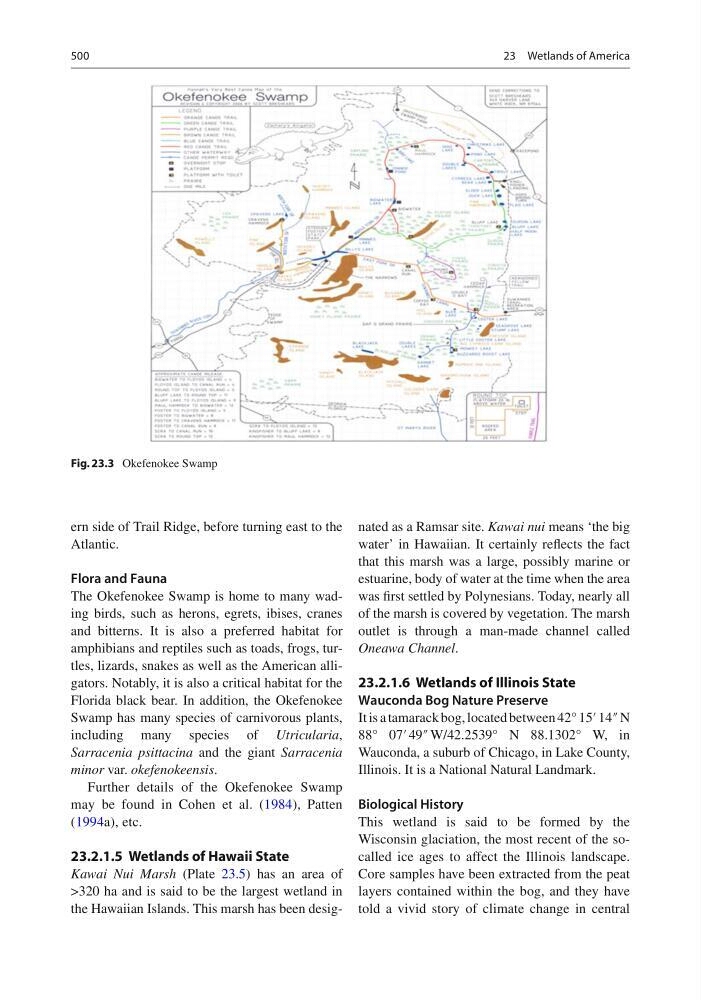
Fig. 23.3 Okefenokee Swamp
23 Wetlands of America
ern side of Trail Ridge, before turning east to the
Atlantic.
Flora and Fauna
The Okefenokee Swamp is home to many wading birds, such as herons, egrets, ibises, cranes
and bitterns. It is also a preferred habitat for
amphibians and reptiles such as toads, frogs, turtles, lizards, snakes as well as the American alligators. Notably, it is also a critical habitat for the
Florida black bear. In addition, the Okefenokee
Swamp has many species of carnivorous plants,
including many species of Utricularia ,
Sarracenia psittacina and the giant Sarracenia
minor var. okefenokeensis .
Further details of the Okefenokee Swamp
may be found in Cohen et al. ( 1984 ), Patten
( 1994 a), etc.
23.2.1.5 Wetlands of Hawaii State
Kawai Nui Marsh (Plate 23.5 ) has an area of
>320 ha and is said to be the largest wetland in
the Hawaiian Islands. This marsh has been designated as a Ramsar site. Kawai nui means ‘the big
water’ in Hawaiian. It certainly refl ects the fact
that this marsh was a large, possibly marine or
estuarine, body of water at the time when the area
was fi rst settled by Polynesians. Today, nearly all
of the marsh is covered by vegetation. The marsh
outlet is through a man-made channel called
Oneawa Channel .
23.2.1.6 Wetlands of Illinois State
Wauconda Bog Nature Preserve
It is a tamarack bog, located between 42° 15′ 14″ N
88° 07′ 49″ W/42.2539° N 88.1302° W, in
Wauconda, a suburb of Chicago, in Lake County,
Illinois. It is a National Natural Landmark.
Biological History
This wetland is said to be formed by the
Wisconsin glaciation, the most recent of the socalled ice ages to affect the Illinois landscape.
Core samples have been extracted from the peat
layers contained within the bog, and they have
told a vivid story of climate change in central
Fig. 23.3 Okefenokee Swamp
23 Wetlands of America