

497
crest. Over the years, the dam deteriorated,
allowing water to seep through it and causing the
marsh to dry out in the autumn and refi ll during
the winter rains. The deterioration was partly due
to rodent holes and partly due to stumps left by
the felling of eucalyptus trees that were planted
on both sides of the embankment.
Because of its seasonality, the marsh was
colonised by California red-legged frogs, a
threatened species. Government agencies grew
concerned that if the marsh did not dry out
every year, bullfrogs might establish themselves in the marsh, displacing the red-legged
frogs. California State Parks, therefore, repaired
the dam in such a way as to preserve the marsh’s
seasonality.
23.2.1.3 Wetlands of Florida State
Barley Barber Swamp (Plate 23.3 , Fig. 23.2 ) lies
between 27° 02′ 47″ N 80° 35′ 14″ W and
27.04639° N 80.58722° W and was once a vast
bald cypress forest and waterway in the Greater
Everglades watershed. It is a 180-ha parcel of
land surrounded by Florida Power & Light’s
(FPL) Martin County power plant. The swamp is
located just over 1.6 km east of Lake Okeechobee
and due west of Indiantown, Florida. The oldgrowth cypress swamp is named after Barley
Barber, a man who lived in the area at the turn of
the twentieth century. Little is known of the man
Barley Barber except that he left the region after
he had ‘trouble with the law’. The primary feature of the Barley Barber Swamp is its ancient
bald cypress trees. This is considered to be more
than 1,000 years old.
Flora and Fauna
One of the oldest bald cypress ( Taxodium distichum ) trees in the entire southeastern USA sits
in Barley Barber Swamp. It is estimated to
be >1,000 years old, stands 27 m tall and has a
circumference of 10 m. Barley Barber is
home to a pair of nesting bald eagles, American
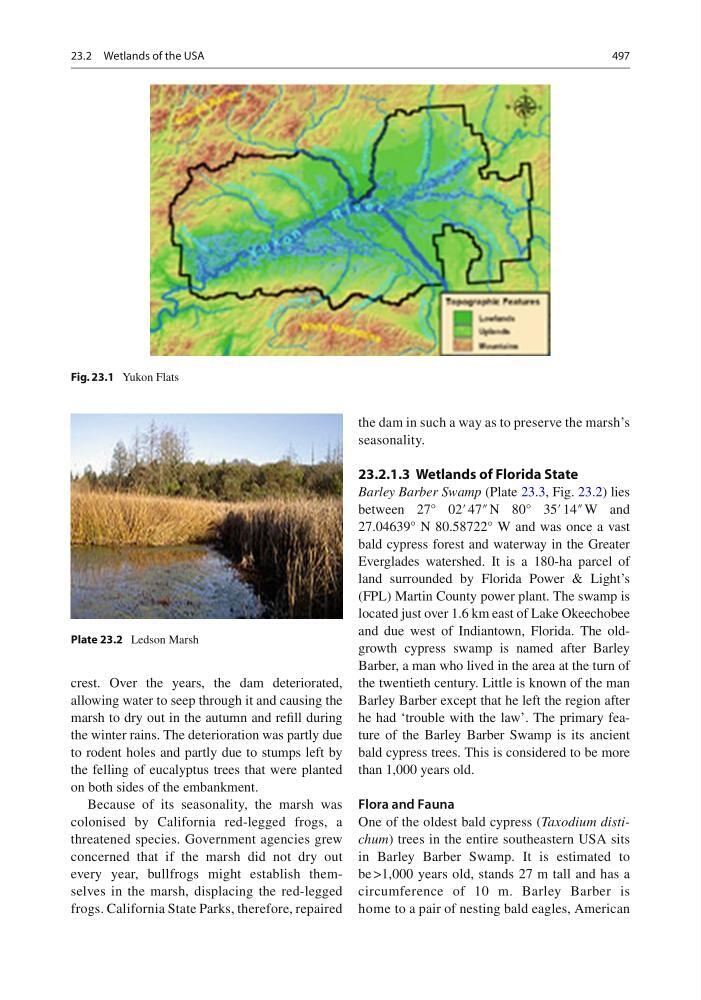
Fig. 23.1 Yukon Flats
Plate 23.2 Ledson Marsh
23.2 Wetlands of the USA
crest. Over the years, the dam deteriorated,
allowing water to seep through it and causing the
marsh to dry out in the autumn and refi ll during
the winter rains. The deterioration was partly due
to rodent holes and partly due to stumps left by
the felling of eucalyptus trees that were planted
on both sides of the embankment.
Because of its seasonality, the marsh was
colonised by California red-legged frogs, a
threatened species. Government agencies grew
concerned that if the marsh did not dry out
every year, bullfrogs might establish themselves in the marsh, displacing the red-legged
frogs. California State Parks, therefore, repaired
the dam in such a way as to preserve the marsh’s
seasonality.
23.2.1.3 Wetlands of Florida State
Barley Barber Swamp (Plate 23.3 , Fig. 23.2 ) lies
between 27° 02′ 47″ N 80° 35′ 14″ W and
27.04639° N 80.58722° W and was once a vast
bald cypress forest and waterway in the Greater
Everglades watershed. It is a 180-ha parcel of
land surrounded by Florida Power & Light’s
(FPL) Martin County power plant. The swamp is
located just over 1.6 km east of Lake Okeechobee
and due west of Indiantown, Florida. The oldgrowth cypress swamp is named after Barley
Barber, a man who lived in the area at the turn of
the twentieth century. Little is known of the man
Barley Barber except that he left the region after
he had ‘trouble with the law’. The primary feature of the Barley Barber Swamp is its ancient
bald cypress trees. This is considered to be more
than 1,000 years old.
Flora and Fauna
One of the oldest bald cypress ( Taxodium distichum ) trees in the entire southeastern USA sits
in Barley Barber Swamp. It is estimated to
be >1,000 years old, stands 27 m tall and has a
circumference of 10 m. Barley Barber is
home to a pair of nesting bald eagles, American
Fig. 23.1 Yukon Flats
Plate 23.2 Ledson Marsh
23.2 Wetlands of the USA