

485
The 3.4-ha Gmöser Moor was declared as a natural preserve in 1987 by the local authorities of
Upper Austria. However, a path around the area
has, since then, given the visitor the opportunity
of observing rare fl ora and fauna.
22.9.1 Fauna
Some of the animals are severely endangered
although all are under protection. Nevertheless,
the unique Gmöser Moor biotope contains
amphibians, such as yellow-bellied toads
( Bombina variegata ), which are decidedly
aquatic, and reptiles, such as the grass snake
( Natrix natrix ), which live in damp forests,
swamp and moorlands. In addition, quite a
large number of bird species find the best conditions for breeding and have been observed
for a number of years. The fieldfare ( Turdus
pilaris ) is to be found here with the only
breeding colony of the whole area. The
whinchat ( Saxicola rubetra ) can be found in
the surrounding meadows, as it is a typical
meadow bird, which breeds on the ground. In
the surroundings of the Gmöser Moor, this
bird could be observed only once or twice during the breeding time. The whinchat is also a
summer guest in Austria and spends the winter
in Africa. The Eurasian nuthatch ( Sitta europaea ) is a resident bird for the whole year
round. It breeds in caves and draws the observer’s attention to itself by being able to crawl.
The golden oriole ( Oriolus oriolus ) visits the
wetland only as a summer guest at the end of
April during its return journey from Africa. It
breeds only irregularly in Gmös, whereby its
nest is strictly obscured high up in the trees.
The male bird could be easily recognised by
its bright yellow and black feathers. Other
observed birds are hoopoe ( Upupa epops ),
aquatic warbler ( Acrocephalus paludicola ),
grey heron ( Ardea cinerea ), etc. Further, the
unique biotope structures and the climatic features in the moor landscape result in an
extremely diverse insect world, which serves
as a source of food for the birds of the area.
Different types of dragonflies and mosquitoes
( Culicidae ) could be found.
22.10 Wetlands of Italy
There are quite a large number of lentic bodies in
Italy. An account of some of these is briefl y given
below.
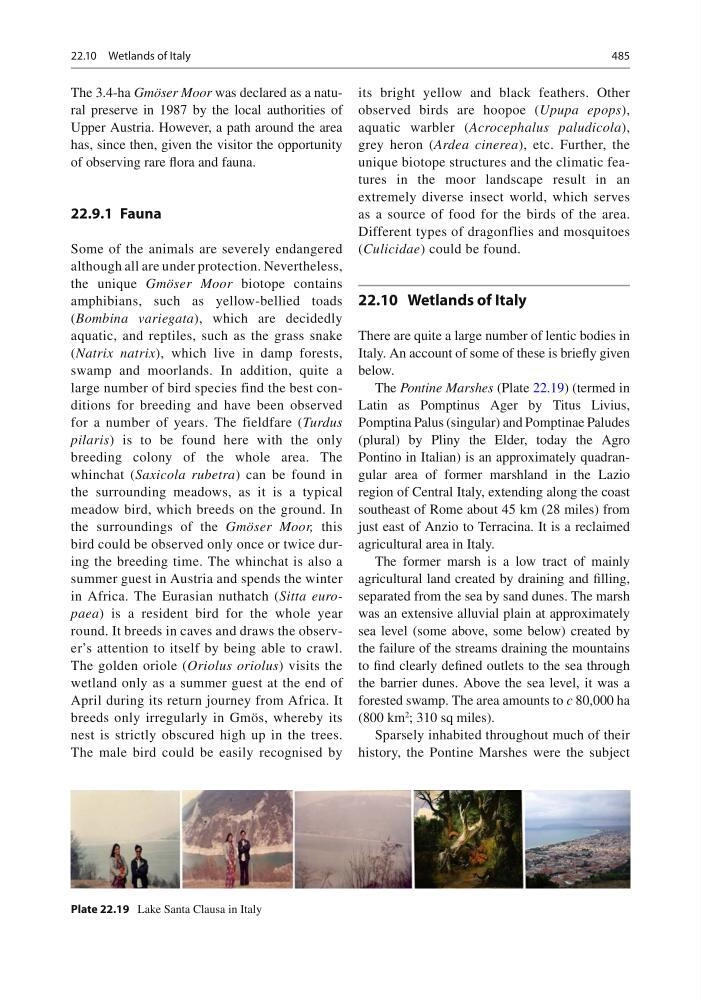
The Pontine Marshes (Plate 22.19 ) (termed in
Latin as Pomptinus Ager by Titus Livius,
Pomptina Palus (singular) and Pomptinae Paludes
(plural) by Pliny the Elder, today the Agro
Pontino in Italian) is an approximately quadrangular area of former marshland in the Lazio
region of Central Italy, extending along the coast
southeast of Rome about 45 km (28 miles) from
just east of Anzio to Terracina. It is a reclaimed
agricultural area in Italy.
The former marsh is a low tract of mainly
agricultural land created by draining and fi lling,
separated from the sea by sand dunes. The marsh
was an extensive alluvial plain at approximately
sea level (some above, some below) created by
the failure of the streams draining the mountains
to fi nd clearly defi ned outlets to the sea through
the barrier dunes. Above the sea level, it was a
forested swamp. The area amounts to c 80,000 ha
(800 km
2 ; 310 sq miles).
Sparsely inhabited throughout much of their
history, the Pontine Marshes were the subject
Plate 22.19 Lake Santa Clausa in Italy
22.10 Wetlands of Italy
The 3.4-ha Gmöser Moor was declared as a natural preserve in 1987 by the local authorities of
Upper Austria. However, a path around the area
has, since then, given the visitor the opportunity
of observing rare fl ora and fauna.
22.9.1 Fauna
Some of the animals are severely endangered
although all are under protection. Nevertheless,
the unique Gmöser Moor biotope contains
amphibians, such as yellow-bellied toads
( Bombina variegata ), which are decidedly
aquatic, and reptiles, such as the grass snake
( Natrix natrix ), which live in damp forests,
swamp and moorlands. In addition, quite a
large number of bird species find the best conditions for breeding and have been observed
for a number of years. The fieldfare ( Turdus
pilaris ) is to be found here with the only
breeding colony of the whole area. The
whinchat ( Saxicola rubetra ) can be found in
the surrounding meadows, as it is a typical
meadow bird, which breeds on the ground. In
the surroundings of the Gmöser Moor, this
bird could be observed only once or twice during the breeding time. The whinchat is also a
summer guest in Austria and spends the winter
in Africa. The Eurasian nuthatch ( Sitta europaea ) is a resident bird for the whole year
round. It breeds in caves and draws the observer’s attention to itself by being able to crawl.
The golden oriole ( Oriolus oriolus ) visits the
wetland only as a summer guest at the end of
April during its return journey from Africa. It
breeds only irregularly in Gmös, whereby its
nest is strictly obscured high up in the trees.
The male bird could be easily recognised by
its bright yellow and black feathers. Other
observed birds are hoopoe ( Upupa epops ),
aquatic warbler ( Acrocephalus paludicola ),
grey heron ( Ardea cinerea ), etc. Further, the
unique biotope structures and the climatic features in the moor landscape result in an
extremely diverse insect world, which serves
as a source of food for the birds of the area.
Different types of dragonflies and mosquitoes
( Culicidae ) could be found.
22.10 Wetlands of Italy
There are quite a large number of lentic bodies in
Italy. An account of some of these is briefl y given
below.
The Pontine Marshes (Plate 22.19 ) (termed in
Latin as Pomptinus Ager by Titus Livius,
Pomptina Palus (singular) and Pomptinae Paludes
(plural) by Pliny the Elder, today the Agro
Pontino in Italian) is an approximately quadrangular area of former marshland in the Lazio
region of Central Italy, extending along the coast
southeast of Rome about 45 km (28 miles) from
just east of Anzio to Terracina. It is a reclaimed
agricultural area in Italy.
The former marsh is a low tract of mainly
agricultural land created by draining and fi lling,
separated from the sea by sand dunes. The marsh
was an extensive alluvial plain at approximately
sea level (some above, some below) created by
the failure of the streams draining the mountains
to fi nd clearly defi ned outlets to the sea through
the barrier dunes. Above the sea level, it was a
forested swamp. The area amounts to c 80,000 ha
(800 km
2 ; 310 sq miles).
Sparsely inhabited throughout much of their
history, the Pontine Marshes were the subject
Plate 22.19 Lake Santa Clausa in Italy
22.10 Wetlands of Italy