

483
Belgium. A large part of the wetland lies within
the German–Belgian natural park Hohes Venn–
Eifel . The author in the picture is on the shore of a
frozen lake at a place called Titije in Germany.
The High Fens consist mainly of moorland
and forest. It is a very rainy (1,500–1,700 mm per
year) and swampy region. Several rivers have
their source in the Hautes Fagnes, namely , the
Vesdre, Hoëgne, Warche, Gileppe, Eau Rouge,
Amblève, Our, Kyll and Rur. There are also several artifi cial lakes in the region.
22.7.3 Rhine River Delta
(and The Netherlands)
The Rhine River is a highly managed river and a
major transportation artery in Europe. As with
other rivers, the River Rhine also forms delta near
its confl uence with the sea. The delta may be
home to many plants and animals.
Concomitantly, the word ‘Netherlands’ comes
from the word ‘Nederland’, which means ‘low
country’. The Dutch language did not have a word
for ‘wetlands’. The English word was adopted in
the 1970s. The Netherlands is one of the most
hydraulically controlled on the Earth. It has recently
been estimated that c 16 % of the Netherlands is
wetland. The Dutch have given importance to the
idea of the signifi cance of wetlands and have
declared that c 7 % of the country has internationally important Ramsar wetlands (Woff 1993 ). The
earlier Dutch tradition was to control water in this
close-to-sea-level environment. Today, a number of
governmental initiatives have been designed to
encourage some amount of water to enter or at least
remain on the lands. It may be mentioned here that
thousands of hectares had been reclaimed from the
Zuiderzee earlier in this century. Today, some of
these areas are reverting back to wetlands. The
Oostvaardersplassen in the Flevoland polder was
originally made as a site for industrial development
in the early 1968. It was then artifi cially fl ooded for
making a wildlife sanctuary. This 5,600-ha site is
now a habitat for about 250 species (about 90 species having breeding grounds) of birds, e.g. herons,
cormorants and spoonbills.
22.8 Wetlands of Switzerland
There are quite a large number of lentic bodies in
Switzerland. Some of the signifi cant ones are
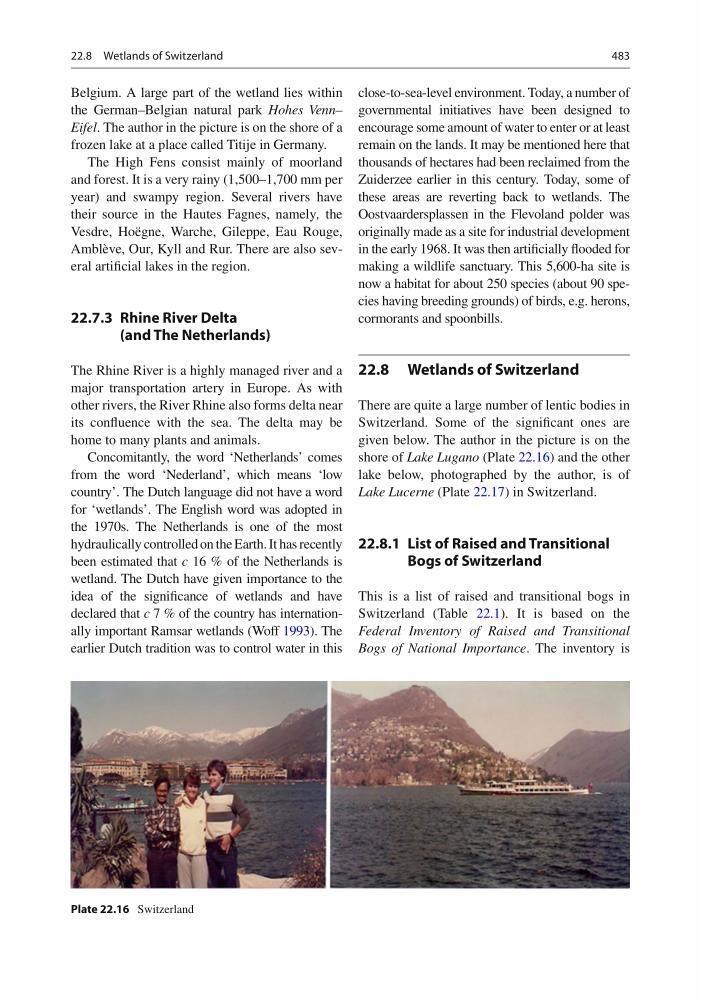
given below. The author in the picture is on the
shore of Lake Lugano (Plate 22.16 ) and the other
lake below, photographed by the author, is of
Lake Lucerne (Plate 22.17 ) in Switzerland.
22.8.1 List of Raised and Transitional
Bogs of Switzerland
This is a list of raised and transitional bogs in
Switzerland (Table 22.1 ). It is based on the
Federal Inventory of Raised and Transitional
Bogs of National Importance . The inventory is
Plate 22.16 Switzerland
22.8 Wetlands of Switzerland
Belgium. A large part of the wetland lies within
the German–Belgian natural park Hohes Venn–
Eifel . The author in the picture is on the shore of a
frozen lake at a place called Titije in Germany.
The High Fens consist mainly of moorland
and forest. It is a very rainy (1,500–1,700 mm per
year) and swampy region. Several rivers have
their source in the Hautes Fagnes, namely , the
Vesdre, Hoëgne, Warche, Gileppe, Eau Rouge,
Amblève, Our, Kyll and Rur. There are also several artifi cial lakes in the region.
22.7.3 Rhine River Delta
(and The Netherlands)
The Rhine River is a highly managed river and a
major transportation artery in Europe. As with
other rivers, the River Rhine also forms delta near
its confl uence with the sea. The delta may be
home to many plants and animals.
Concomitantly, the word ‘Netherlands’ comes
from the word ‘Nederland’, which means ‘low
country’. The Dutch language did not have a word
for ‘wetlands’. The English word was adopted in
the 1970s. The Netherlands is one of the most
hydraulically controlled on the Earth. It has recently
been estimated that c 16 % of the Netherlands is
wetland. The Dutch have given importance to the
idea of the signifi cance of wetlands and have
declared that c 7 % of the country has internationally important Ramsar wetlands (Woff 1993 ). The
earlier Dutch tradition was to control water in this
close-to-sea-level environment. Today, a number of
governmental initiatives have been designed to
encourage some amount of water to enter or at least
remain on the lands. It may be mentioned here that
thousands of hectares had been reclaimed from the
Zuiderzee earlier in this century. Today, some of
these areas are reverting back to wetlands. The
Oostvaardersplassen in the Flevoland polder was
originally made as a site for industrial development
in the early 1968. It was then artifi cially fl ooded for
making a wildlife sanctuary. This 5,600-ha site is
now a habitat for about 250 species (about 90 species having breeding grounds) of birds, e.g. herons,
cormorants and spoonbills.
22.8 Wetlands of Switzerland
There are quite a large number of lentic bodies in
Switzerland. Some of the signifi cant ones are
given below. The author in the picture is on the
shore of Lake Lugano (Plate 22.16 ) and the other
lake below, photographed by the author, is of
Lake Lucerne (Plate 22.17 ) in Switzerland.
22.8.1 List of Raised and Transitional
Bogs of Switzerland
This is a list of raised and transitional bogs in
Switzerland (Table 22.1 ). It is based on the
Federal Inventory of Raised and Transitional
Bogs of National Importance . The inventory is
Plate 22.16 Switzerland
22.8 Wetlands of Switzerland