

463
21.16.1 Asmat Swamp
It is a wetland located in Papua Province of
Indonesia and is sometimes considered as the
largest alluvial swamp in the world having an
area of approx. 30,000 km
2 (3,000,000 ha).
Ecologically, the swamp is diverse. The muddy
coastal areas are dominated by mangroves and
nipa palms. In the inland area, the swamp has
freshwater and other types of vegetation become
more common. A signifi cant portion of the
swamp is peatland. It is habitat for a wide variety
of animals, including freshwater fi sh, crabs, lobsters, shrimp, crocodiles and sea snakes. The
swamp takes its name from the Asmat people
who inhabit it. The diffi cult terrain of the swamp
meant that the Asmat, probably, did not have regular contact with outsiders until the 1950s, and
the swamp still remains isolated. The swamp
forms part of Indonesia’s Lorentz National Park.
21.17 Wetlands of Korea
It is a coastal region. There are wetlands under
different environmental conditions, an account of
which is given below.
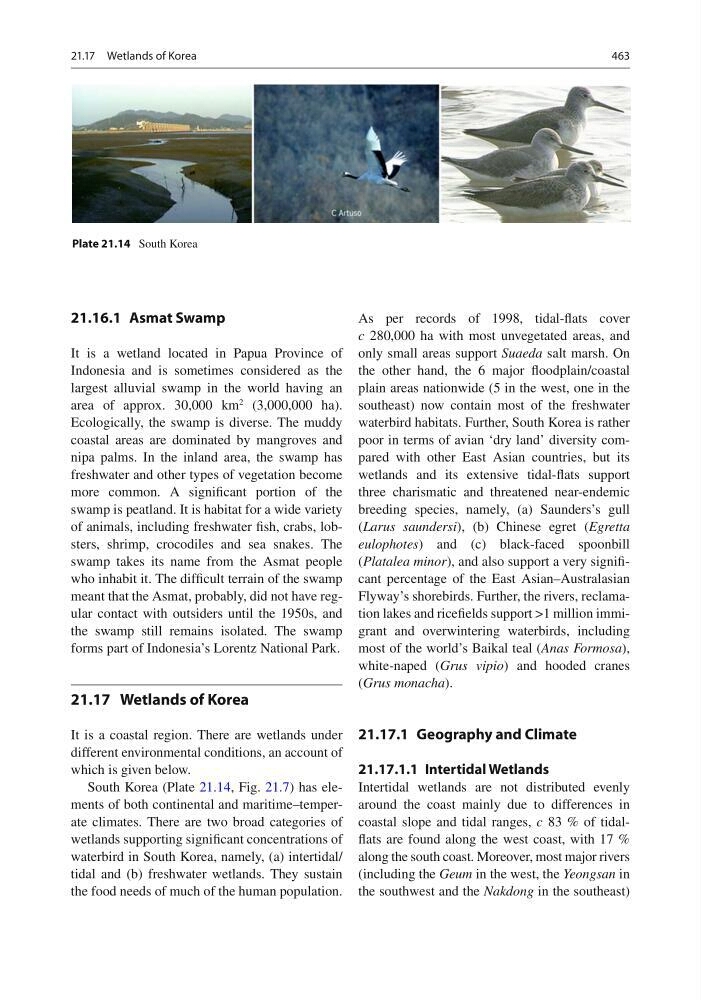
South Korea (Plate 21.14 , Fig. 21.7 ) has elements of both continental and maritime–temperate climates. There are two broad categories of
wetlands supporting signifi cant concentrations of
waterbird in South Korea, namely, (a) intertidal/
tidal and (b) freshwater wetlands. They sustain
the food needs of much of the human population.
As per records of 1998, tidal-fl ats cover
c 280,000 ha with most unvegetated areas, and
only small areas support Suaeda salt marsh. On
the other hand, the 6 major fl oodplain/coastal
plain areas nationwide (5 in the west, one in the
southeast) now contain most of the freshwater
waterbird habitats. Further, South Korea is rather
poor in terms of avian ‘dry land’ diversity compared with other East Asian countries, but its
wetlands and its extensive tidal-fl ats support
three charismatic and threatened near-endemic
breeding species, namely, (a) Saunders’s gull
( Larus saundersi ), (b) Chinese egret ( Egretta
eulophotes ) and (c) black-faced spoonbill
( Platalea minor ), and also support a very signifi -
cant percentage of the East Asian–Australasian
Flyway’s shorebirds. Further, the rivers, reclamation lakes and ricefi elds support >1 million immigrant and overwintering waterbirds, including
most of the world’s Baikal teal ( Anas Formosa ),
white-naped ( Grus vipio ) and hooded cranes
( Grus monacha ).
21.17.1 Geography and Climate
21.17.1.1 Intertidal Wetlands
Intertidal wetlands are not distributed evenly
around the coast mainly due to differences in
coastal slope and tidal ranges, c 83 % of tidalfl ats are found along the west coast, with 17 %
along the south coast. Moreover, most major rivers
(including the Geum in the west, the Yeongsan in
the southwest and the Nakdong in the southeast)
Plate 21.14 South Korea
21.17 Wetlands of Korea
21.16.1 Asmat Swamp
It is a wetland located in Papua Province of
Indonesia and is sometimes considered as the
largest alluvial swamp in the world having an
area of approx. 30,000 km
2 (3,000,000 ha).
Ecologically, the swamp is diverse. The muddy
coastal areas are dominated by mangroves and
nipa palms. In the inland area, the swamp has
freshwater and other types of vegetation become
more common. A signifi cant portion of the
swamp is peatland. It is habitat for a wide variety
of animals, including freshwater fi sh, crabs, lobsters, shrimp, crocodiles and sea snakes. The
swamp takes its name from the Asmat people
who inhabit it. The diffi cult terrain of the swamp
meant that the Asmat, probably, did not have regular contact with outsiders until the 1950s, and
the swamp still remains isolated. The swamp
forms part of Indonesia’s Lorentz National Park.
21.17 Wetlands of Korea
It is a coastal region. There are wetlands under
different environmental conditions, an account of
which is given below.
South Korea (Plate 21.14 , Fig. 21.7 ) has elements of both continental and maritime–temperate climates. There are two broad categories of
wetlands supporting signifi cant concentrations of
waterbird in South Korea, namely, (a) intertidal/
tidal and (b) freshwater wetlands. They sustain
the food needs of much of the human population.
As per records of 1998, tidal-fl ats cover
c 280,000 ha with most unvegetated areas, and
only small areas support Suaeda salt marsh. On
the other hand, the 6 major fl oodplain/coastal
plain areas nationwide (5 in the west, one in the
southeast) now contain most of the freshwater
waterbird habitats. Further, South Korea is rather
poor in terms of avian ‘dry land’ diversity compared with other East Asian countries, but its
wetlands and its extensive tidal-fl ats support
three charismatic and threatened near-endemic
breeding species, namely, (a) Saunders’s gull
( Larus saundersi ), (b) Chinese egret ( Egretta
eulophotes ) and (c) black-faced spoonbill
( Platalea minor ), and also support a very signifi -
cant percentage of the East Asian–Australasian
Flyway’s shorebirds. Further, the rivers, reclamation lakes and ricefi elds support >1 million immigrant and overwintering waterbirds, including
most of the world’s Baikal teal ( Anas Formosa ),
white-naped ( Grus vipio ) and hooded cranes
( Grus monacha ).
21.17.1 Geography and Climate
21.17.1.1 Intertidal Wetlands
Intertidal wetlands are not distributed evenly
around the coast mainly due to differences in
coastal slope and tidal ranges, c 83 % of tidalfl ats are found along the west coast, with 17 %
along the south coast. Moreover, most major rivers
(including the Geum in the west, the Yeongsan in
the southwest and the Nakdong in the southeast)
Plate 21.14 South Korea
21.17 Wetlands of Korea