

446
over 20 % of the population almost entirely
depended on desalinated water.
21.5.4 Fresh and Brackish
Water Ponds
Surface freshwater is generally lacking throughout the archipelago with the exception of a few
swampy areas, shallow freshwater lagoons and
some fresh or brackish water ponds in some of
the islands in the northern and southern atolls. In
heavily populated islands such as Thinadhoo and
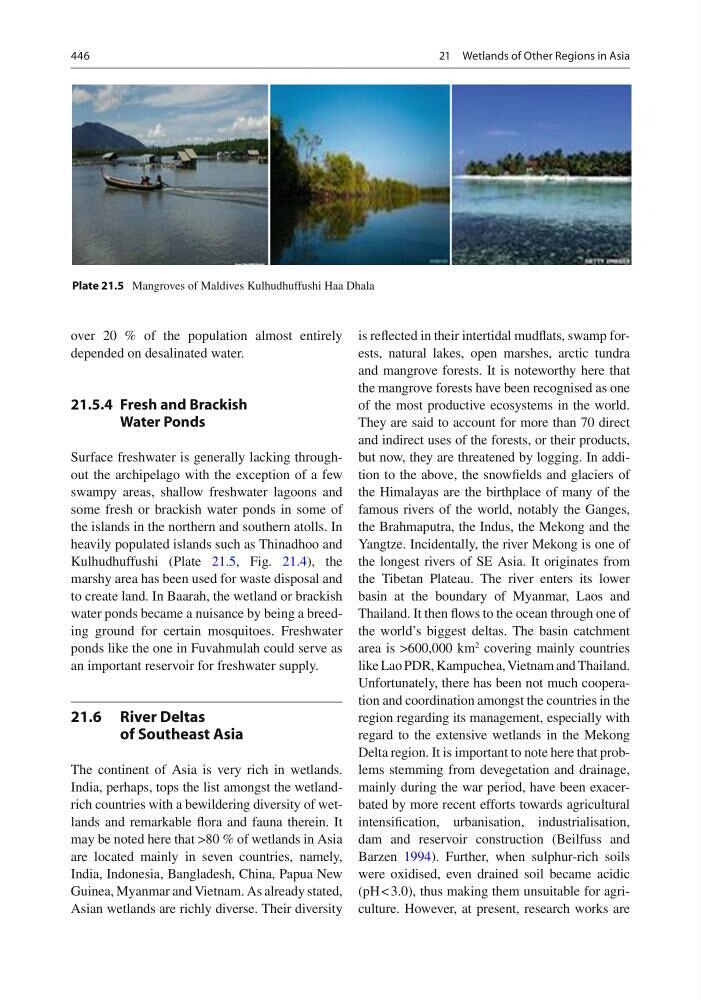
Kulhudhuffushi (Plate 21.5 , Fig. 21.4 ), the
marshy area has been used for waste disposal and
to create land. In Baarah, the wetland or brackish
water ponds became a nuisance by being a breeding ground for certain mosquitoes. Freshwater
ponds like the one in Fuvahmulah could serve as
an important reservoir for freshwater supply.
21.6 River Deltas
of Southeast Asia
The continent of Asia is very rich in wetlands.
India, perhaps, tops the list amongst the wetlandrich countries with a bewildering diversity of wetlands and remarkable fl ora and fauna therein. It
may be noted here that >80 % of wetlands in Asia
are located mainly in seven countries, namely,
India, Indonesia, Bangladesh, China, Papua New
Guinea, Myanmar and Vietnam. As already stated,
Asian wetlands are richly diverse. Their diversity
is refl ected in their intertidal mudfl ats, swamp forests, natural lakes, open marshes, arctic tundra
and mangrove forests. It is noteworthy here that
the mangrove forests have been recognised as one
of the most productive ecosystems in the world.
They are said to account for more than 70 direct
and indirect uses of the forests, or their products,
but now, they are threatened by logging. In addition to the above, the snowfi elds and glaciers of
the Himalayas are the birthplace of many of the
famous rivers of the world, notably the Ganges,
the Brahmaputra, the Indus, the Mekong and the
Yangtze. Incidentally, the river Mekong is one of
the longest rivers of SE Asia. It originates from
the Tibetan Plateau. The river enters its lower
basin at the boundary of Myanmar, Laos and
Thailand. It then fl ows to the ocean through one of
the world’s biggest deltas. The basin catchment
area is >600,000 km
2 covering mainly countries
like Lao PDR, Kampuchea, Vietnam and Thailand.
Unfortunately, there has been not much cooperation and coordination amongst the countries in the
region regarding its management, especially with
regard to the extensive wetlands in the Mekong
Delta region. It is important to note here that problems stemming from devegetation and drainage,
mainly during the war period, have been exacerbated by more recent efforts towards agricultural
intensifi cation, urbanisation, industrialisation,
dam and reservoir construction (Beilfuss and
Barzen 1994 ). Further, when sulphur-rich soils
were oxidised, even drained soil became acidic
(pH < 3.0), thus making them unsuitable for agriculture. However, at present, research works are
Plate 21.5 Mangroves of Maldives Kulhudhuffushi Haa Dhala
21 Wetlands of Other Regions in Asia
over 20 % of the population almost entirely
depended on desalinated water.
21.5.4 Fresh and Brackish
Water Ponds
Surface freshwater is generally lacking throughout the archipelago with the exception of a few
swampy areas, shallow freshwater lagoons and
some fresh or brackish water ponds in some of
the islands in the northern and southern atolls. In
heavily populated islands such as Thinadhoo and
Kulhudhuffushi (Plate 21.5 , Fig. 21.4 ), the
marshy area has been used for waste disposal and
to create land. In Baarah, the wetland or brackish
water ponds became a nuisance by being a breeding ground for certain mosquitoes. Freshwater
ponds like the one in Fuvahmulah could serve as
an important reservoir for freshwater supply.
21.6 River Deltas
of Southeast Asia
The continent of Asia is very rich in wetlands.
India, perhaps, tops the list amongst the wetlandrich countries with a bewildering diversity of wetlands and remarkable fl ora and fauna therein. It
may be noted here that >80 % of wetlands in Asia
are located mainly in seven countries, namely,
India, Indonesia, Bangladesh, China, Papua New
Guinea, Myanmar and Vietnam. As already stated,
Asian wetlands are richly diverse. Their diversity
is refl ected in their intertidal mudfl ats, swamp forests, natural lakes, open marshes, arctic tundra
and mangrove forests. It is noteworthy here that
the mangrove forests have been recognised as one
of the most productive ecosystems in the world.
They are said to account for more than 70 direct
and indirect uses of the forests, or their products,
but now, they are threatened by logging. In addition to the above, the snowfi elds and glaciers of
the Himalayas are the birthplace of many of the
famous rivers of the world, notably the Ganges,
the Brahmaputra, the Indus, the Mekong and the
Yangtze. Incidentally, the river Mekong is one of
the longest rivers of SE Asia. It originates from
the Tibetan Plateau. The river enters its lower
basin at the boundary of Myanmar, Laos and
Thailand. It then fl ows to the ocean through one of
the world’s biggest deltas. The basin catchment
area is >600,000 km
2 covering mainly countries
like Lao PDR, Kampuchea, Vietnam and Thailand.
Unfortunately, there has been not much cooperation and coordination amongst the countries in the
region regarding its management, especially with
regard to the extensive wetlands in the Mekong
Delta region. It is important to note here that problems stemming from devegetation and drainage,
mainly during the war period, have been exacerbated by more recent efforts towards agricultural
intensifi cation, urbanisation, industrialisation,
dam and reservoir construction (Beilfuss and
Barzen 1994 ). Further, when sulphur-rich soils
were oxidised, even drained soil became acidic
(pH < 3.0), thus making them unsuitable for agriculture. However, at present, research works are
Plate 21.5 Mangroves of Maldives Kulhudhuffushi Haa Dhala
21 Wetlands of Other Regions in Asia