

445
post- tsunami response. It focuses on the countries
worst affected by the tsunami, namely, India,
Indonesia, Maldives, Seychelles, Sri Lanka and
Thailand. However, MFF will also include other
countries of the region which face similar issues,
with an overall aim to promote an integrated
ocean-wide approach to coastal zone management, with particular emphasis on mangrove
(wetland) system.
21.5.2 Long-Term Sustainable
Coastal Ecosystem
Management
Notwithstanding the above, the initiative uses
‘mangroves’ as a fl agship ecosystem in recognition of the destruction caused to mangroves by
the tsunami. But MFF is inclusive of all coastal
ecosystems, including coral reefs, estuaries,
lagoons, sandy beaches, sea grasses and wetlands.
In this regard, it may be mentioned that its longterm management strategy is based on identifi ed
needs and priorities for long-term sustainable
coastal ecosystem management. However, these
priorities emerged from extensive consultations
with >200 individuals and 160 institutions involved
in coastal management in the Indian Ocean
Region. Further, MFF seeks to achieve demonstrable results in infl uencing regional cooperation, national programme support, private sector
engagement and community action. As such,
attempts have been directed to achieve this objective using a strategy of generating knowledge and
empowering institutions and individuals to promote good governance in coastal ecosystem
management.
21.5.3 Kedhikolhudhoo Noon
Kedhikolhudhoo (Plate 21.5 ) is, perhaps, the
only inhabited island which is served with desalinated water. The need for desalination arose
during the dry season of 1998 when the inhabitants of Kedhikolhudhoo had to fetch water from
nearby islands. Kedhikolhudhoo, the most densely
populated island in the Maldives, is served by a
reverse osmosis desalination plant with a capacity
of 50 m
3 . The island community operates and
maintains the plant. When the population of
Kedhikolhudhoo was served by desalinated water
in May 1999, about 28 % of the population of the
Maldives had access to desalinated water and
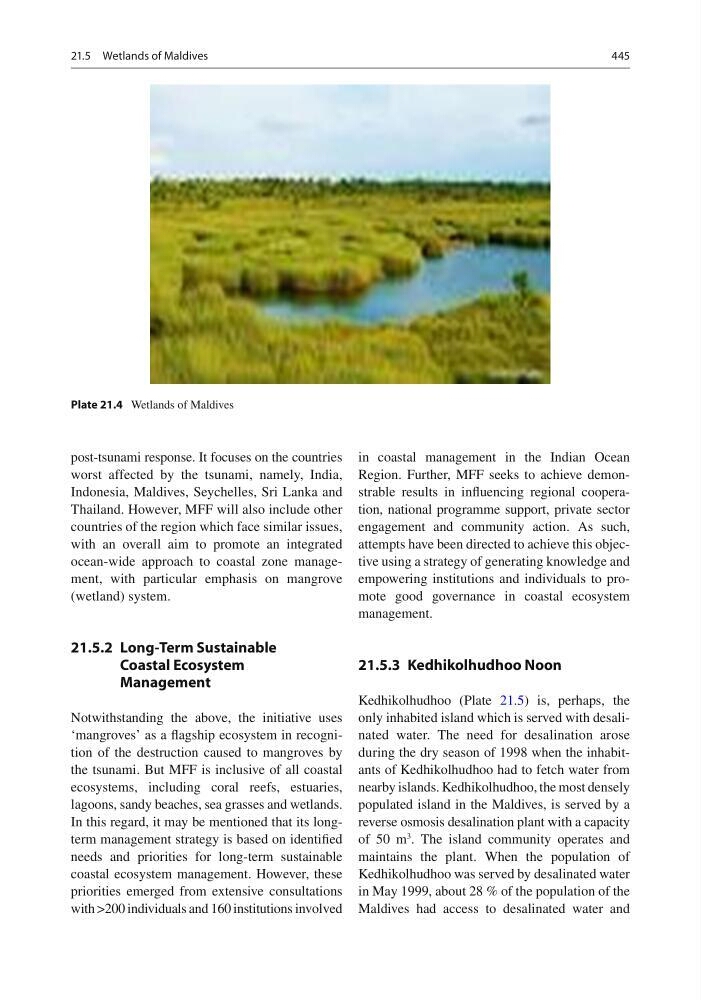
Plate 21.4 Wetlands of Maldives
21.5 Wetlands of Maldives
post- tsunami response. It focuses on the countries
worst affected by the tsunami, namely, India,
Indonesia, Maldives, Seychelles, Sri Lanka and
Thailand. However, MFF will also include other
countries of the region which face similar issues,
with an overall aim to promote an integrated
ocean-wide approach to coastal zone management, with particular emphasis on mangrove
(wetland) system.
21.5.2 Long-Term Sustainable
Coastal Ecosystem
Management
Notwithstanding the above, the initiative uses
‘mangroves’ as a fl agship ecosystem in recognition of the destruction caused to mangroves by
the tsunami. But MFF is inclusive of all coastal
ecosystems, including coral reefs, estuaries,
lagoons, sandy beaches, sea grasses and wetlands.
In this regard, it may be mentioned that its longterm management strategy is based on identifi ed
needs and priorities for long-term sustainable
coastal ecosystem management. However, these
priorities emerged from extensive consultations
with >200 individuals and 160 institutions involved
in coastal management in the Indian Ocean
Region. Further, MFF seeks to achieve demonstrable results in infl uencing regional cooperation, national programme support, private sector
engagement and community action. As such,
attempts have been directed to achieve this objective using a strategy of generating knowledge and
empowering institutions and individuals to promote good governance in coastal ecosystem
management.
21.5.3 Kedhikolhudhoo Noon
Kedhikolhudhoo (Plate 21.5 ) is, perhaps, the
only inhabited island which is served with desalinated water. The need for desalination arose
during the dry season of 1998 when the inhabitants of Kedhikolhudhoo had to fetch water from
nearby islands. Kedhikolhudhoo, the most densely
populated island in the Maldives, is served by a
reverse osmosis desalination plant with a capacity
of 50 m
3 . The island community operates and
maintains the plant. When the population of
Kedhikolhudhoo was served by desalinated water
in May 1999, about 28 % of the population of the
Maldives had access to desalinated water and
Plate 21.4 Wetlands of Maldives
21.5 Wetlands of Maldives