

443
protects wildlife, a big portion of the river Sapta
Koshi (a tributary of the Ganges) and fl oodplain.
In 1987, it was declared as a Ramsar site.
21.4 Wetlands of Sri Lanka
This island nation has a number of wetlands of
different kinds. A brief account of given below.
21.4.1 Bundala National Park
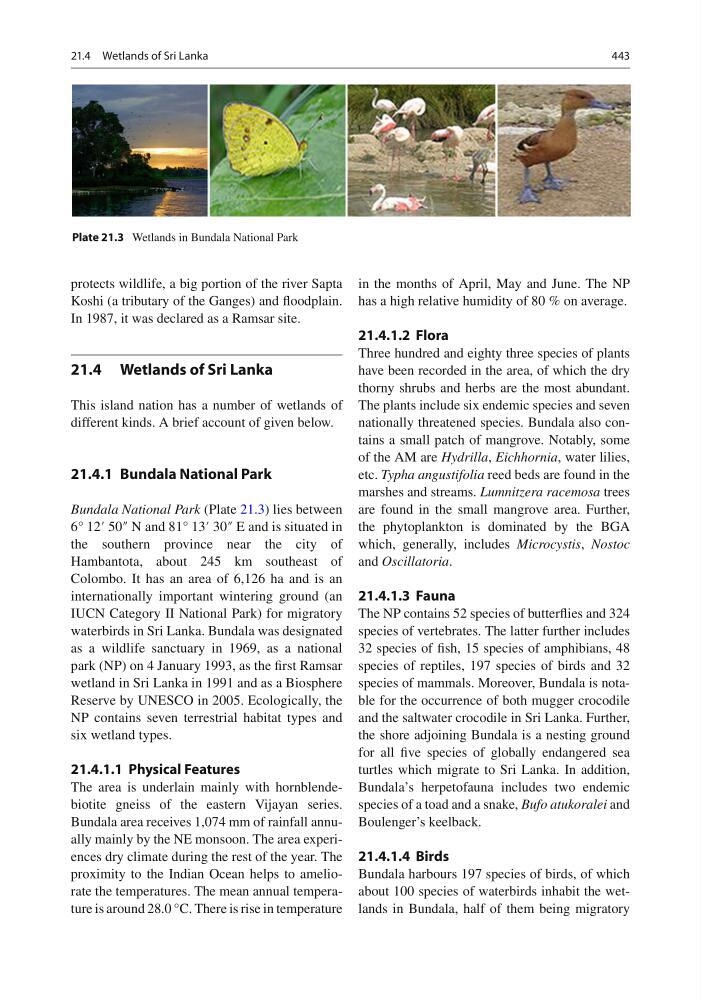
Bundala National Park (Plate 21.3 ) lies between
6° 12′ 50″ N and 81° 13′ 30″ E and is situated in
the southern province near the city of
Hambantota, about 245 km southeast of
Colombo. It has an area of 6,126 ha and is an
internationally important wintering ground (an
IUCN Category II National Park) for migratory
waterbirds in Sri Lanka. Bundala was designated
as a wildlife sanctuary in 1969, as a national
park (NP) on 4 January 1993, as the fi rst Ramsar
wetland in Sri Lanka in 1991 and as a Biosphere
Reserve by UNESCO in 2005. Ecologically, the
NP contains seven terrestrial habitat types and
six wetland types.
21.4.1.1 Physical Features
The area is underlain mainly with hornblendebiotite gneiss of the eastern Vijayan series.
Bundala area receives 1,074 mm of rainfall annually mainly by the NE monsoon. The area experiences dry climate during the rest of the year. The
proximity to the Indian Ocean helps to ameliorate the temperatures. The mean annual temperature is around 28.0 °C. There is rise in temperature
in the months of April, May and June. The NP
has a high relative humidity of 80 % on average.
21.4.1.2 Flora
Three hundred and eighty three species of plants
have been recorded in the area, of which the dry
thorny shrubs and herbs are the most abundant.
The plants include six endemic species and seven
nationally threatened species. Bundala also contains a small patch of mangrove. Notably, some
of the AM are Hydrilla , Eichhornia , water lilies,
etc. Typha angustifolia reed beds are found in the
marshes and streams. Lumnitzera racemosa trees
are found in the small mangrove area. Further,
the phytoplankton is dominated by the BGA
which, generally, includes Microcystis , Nostoc
and Oscillatoria .
21.4.1.3 Fauna
The NP contains 52 species of butterfl ies and 324
species of vertebrates. The latter further includes
32 species of fi sh, 15 species of amphibians, 48
species of reptiles, 197 species of birds and 32
species of mammals. Moreover, Bundala is notable for the occurrence of both mugger crocodile
and the saltwater crocodile in Sri Lanka. Further,
the shore adjoining Bundala is a nesting ground
for all fi ve species of globally endangered sea
turtles which migrate to Sri Lanka. In addition,
Bundala’s herpetofauna includes two endemic
species of a toad and a snake, Bufo atukoralei and
Boulenger’s keelback.
21.4.1.4 Birds
Bundala harbours 197 species of birds, of which
about 100 species of waterbirds inhabit the wetlands in Bundala, half of them being migratory
Plate 21.3 Wetlands in Bundala National Park
21.4 Wetlands of Sri Lanka
protects wildlife, a big portion of the river Sapta
Koshi (a tributary of the Ganges) and fl oodplain.
In 1987, it was declared as a Ramsar site.
21.4 Wetlands of Sri Lanka
This island nation has a number of wetlands of
different kinds. A brief account of given below.
21.4.1 Bundala National Park
Bundala National Park (Plate 21.3 ) lies between
6° 12′ 50″ N and 81° 13′ 30″ E and is situated in
the southern province near the city of
Hambantota, about 245 km southeast of
Colombo. It has an area of 6,126 ha and is an
internationally important wintering ground (an
IUCN Category II National Park) for migratory
waterbirds in Sri Lanka. Bundala was designated
as a wildlife sanctuary in 1969, as a national
park (NP) on 4 January 1993, as the fi rst Ramsar
wetland in Sri Lanka in 1991 and as a Biosphere
Reserve by UNESCO in 2005. Ecologically, the
NP contains seven terrestrial habitat types and
six wetland types.
21.4.1.1 Physical Features
The area is underlain mainly with hornblendebiotite gneiss of the eastern Vijayan series.
Bundala area receives 1,074 mm of rainfall annually mainly by the NE monsoon. The area experiences dry climate during the rest of the year. The
proximity to the Indian Ocean helps to ameliorate the temperatures. The mean annual temperature is around 28.0 °C. There is rise in temperature
in the months of April, May and June. The NP
has a high relative humidity of 80 % on average.
21.4.1.2 Flora
Three hundred and eighty three species of plants
have been recorded in the area, of which the dry
thorny shrubs and herbs are the most abundant.
The plants include six endemic species and seven
nationally threatened species. Bundala also contains a small patch of mangrove. Notably, some
of the AM are Hydrilla , Eichhornia , water lilies,
etc. Typha angustifolia reed beds are found in the
marshes and streams. Lumnitzera racemosa trees
are found in the small mangrove area. Further,
the phytoplankton is dominated by the BGA
which, generally, includes Microcystis , Nostoc
and Oscillatoria .
21.4.1.3 Fauna
The NP contains 52 species of butterfl ies and 324
species of vertebrates. The latter further includes
32 species of fi sh, 15 species of amphibians, 48
species of reptiles, 197 species of birds and 32
species of mammals. Moreover, Bundala is notable for the occurrence of both mugger crocodile
and the saltwater crocodile in Sri Lanka. Further,
the shore adjoining Bundala is a nesting ground
for all fi ve species of globally endangered sea
turtles which migrate to Sri Lanka. In addition,
Bundala’s herpetofauna includes two endemic
species of a toad and a snake, Bufo atukoralei and
Boulenger’s keelback.
21.4.1.4 Birds
Bundala harbours 197 species of birds, of which
about 100 species of waterbirds inhabit the wetlands in Bundala, half of them being migratory
Plate 21.3 Wetlands in Bundala National Park
21.4 Wetlands of Sri Lanka